

Drug Dissolution Rate Analysis: Why It Drives Oral Product Success
2026-01-23


Drug Dissolution Rate Analysis sits at the center of oral drug development because it connects what you make in the lab to what patients experience in the clinic. When an API meets gastrointestinal fluids, its rate of dissolution establishes the concentration available for absorption, and that rate often dictates performance for poorly soluble molecules. Used well, dissolution becomes a decision tool: it guides salt and polymorph selection, informs particle engineering, narrows excipient choices, and ultimately de-risks scale-up and bioequivalence. The goal is not just a pretty curve on paper - it is a biopredictive signal that translates formulation attributes into exposure and, eventually, therapeutic effect.
Kinetic Foundations and the Role of Hydrodynamics
Dissolution is, at its core, a diffusion problem. As a solid surface releases molecules into the surrounding fluid, a thin boundary layer forms where concentration gradients drive mass transfer. The classic perspective (often attributed to Noyes-Whitney and its extensions) tells us three practical truths:
• More accessible surface area accelerates dissolution.
• A stronger concentration driving force (interface solubility minus bulk concentration) increases the rate.
• A thicker boundary layer slows everything down.
Hydrodynamics control that boundary layer. Paddle speed, basket design, flow regime, and vessel geometry shape shear stress and mixing. Meanwhile, the material sets the ceiling: solubility, diffusion coefficient, solid-state form (polymorph versus amorphous), particle morphology, and wettability define the achievable rate. To isolate material behavior from formulation complexity, practitioners use the intrinsic dissolution rate (IDR): a compressed API disk rotates under sink conditions so the resulting constant becomes a material fingerprint for comparing salts, co-crystals, and particle-processing options.
Practical Methods and Media that Tell the Truth
Standardized apparatus create reproducible hydrodynamic environments. USP Apparatus 1 (basket) and 2 (paddle) are workhorses for immediate-release tablets and capsules. Apparatus 3 (reciprocating cylinder) introduces controlled agitation that mimics transit, and Apparatus 4 (flow-through cell) maintains a constant gradient - ideal for low-solubility drugs, low-dose products, and modified-release systems. Whatever you choose, three method levers dominate:
• Medium composition and volume: buffers, pH, surfactant levels, bile components.
• Agitation and temperature control: commonly 37 ± 0.5 °C with well-verified rotational speeds.
• Sampling and quantitation: filtration that avoids sorption or precipitation, UV-Vis for simple analytes, HPLC/LC-MS when specificity or metabolites complicate interpretation.
Sink conditions matter. If the medium cannot comfortably dissolve the dose (typically at least three times the amount required), the boundary layer compresses, the driving force collapses, and you may falsely diagnose a “slow” formulation. Equally critical is deaeration - entrained air alters hydrodynamics and can add noise that masks real differences.
- Choosing Biorelevant Media Without Losing Control
Physiologically relevant media add realism. Fasted and fed state simulated intestinal fluids introduce bile salts and phospholipids that enhance wetting and micellar solubilization. pH-shift experiments mirror the gastric-to-intestinal passage to highlight precipitation risks. Biphasic arrangements incorporate an organic overlay that functions as an absorption sink for lipophilic APIs. The objective is to balance physiological truth with method control: apply the minimum surfactant consistent with GI conditions without suppressing discrimination, assess buffer capacity against expected API loading, and record how food-state transitions alter both the rate and the overall extent of dissolution.
Formulation Levers That Move the Dissolution Needle
Several knobs alter the dissolution profile, and small shifts can have outsized effects:
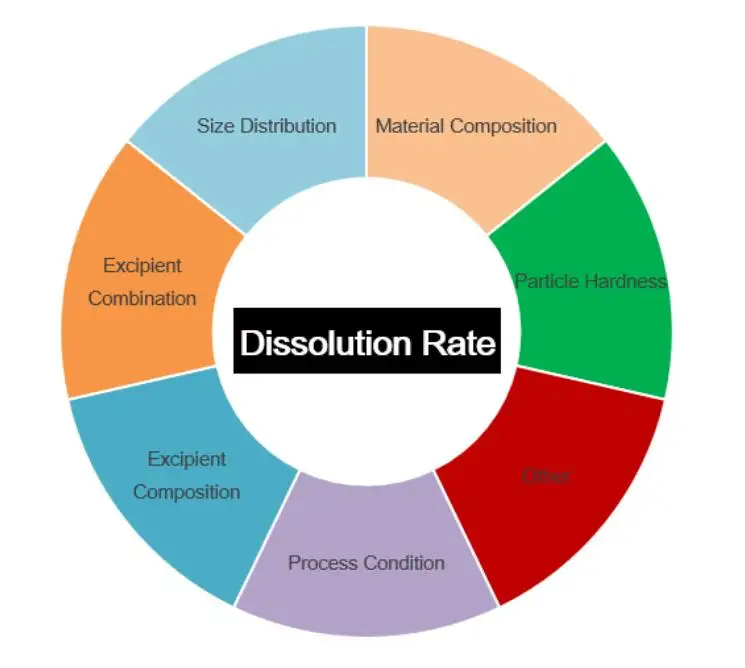
• Particle Size And Surface Engineering: Decreasing particle size raises exposed surface area yet can lead to agglomeration unless surfactants and wetting aids are adjusted. Surface porosity or roughness enhances contact at the interface and alleviates boundary-layer constraints.
• Solid-State Form And Stability: Polymorph choice controls lattice energy and the material's intrinsic solubility. Amorphous and co-amorphous options provide higher apparent solubility and can achieve supersaturation, but they require stabilization (e.g., polymer selection, anti-nucleation measures) to avert recrystallization in storage and during dosing.
• Excipients And Process Dynamics: Disintegrants, wicking components, and surfactants speed wetting and disintegration; overuse of hydrophobic lubricants (such as magnesium stearate) may coat particles and hinder wetting. Compression level, porosity, and tablet hardness shape disintegration kinetics and exposure of new surfaces.
• Modified-Release Architecture: Matrix polymers, crosslink density, osmotic drivers, and coating integrity determine erosion, diffusion pathways, and control over release. Dissolution is then a composite of polymer hydration, swelling, and drug transport - not merely particle shrinking.
From Profiles to Decisions: Models, Metrics, and Equivalence
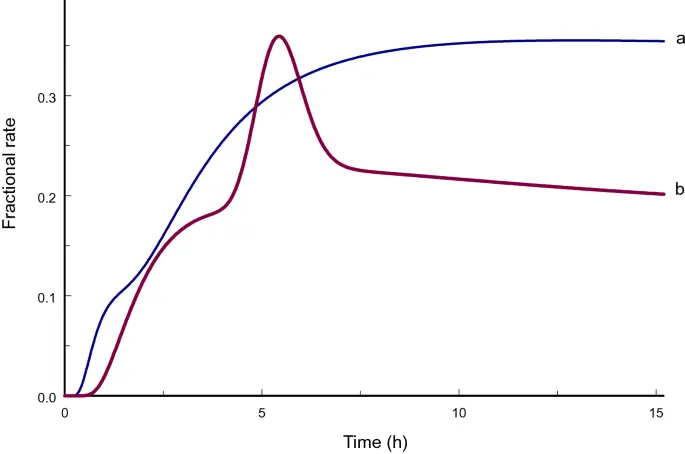
Turning a curve into an actionable decision requires both model-independent and model-based thinking. Time-point metrics such as t50% and t90%, mean dissolution time, and dissolution efficiency are quick to compute and easy to compare. For similarity assessments (e.g., generic versus reference), the f2 metric is widely accepted; values between 50 and 100 suggest comparable profiles when sampling density and variability meet guidance.
Model-based fitting helps uncover mechanisms. Zero-order and first-order capture constant-rate and concentration-driven behavior. The Hixson-Crowell cube-root approach accounts for changing surface area, Higuchi's square-root model speaks to diffusion from porous matrices, the Korsmeyer-Peppas power law decodes polymeric release via the exponent, and Weibull offers flexible empirical fits. Choose the simplest model that is physically plausible, estimate parameters with appropriate error structures, and, when replicate data exist, consider nonlinear mixed-effects to separate within- and between-batch variability.
- Comparative Metrics and Statistics You Can Trust
Single-number answers rarely tell the whole story. Bootstrapped f2 improves confidence in equivalence under realistic variability. Confidence bands around entire profiles reveal divergence that a single time point can miss. ANOVA on model parameters highlights whether release mechanisms are actually the same. Most importantly, method discrimination must be proven: deliberate changes to critical material attributes and process settings should produce detectable shifts. A quality-by-design lens defines critical method parameters (paddle speed, medium pH, surfactant content, deaeration) and establishes proven acceptable ranges, so your test is both robust and sensitive.
Biopredictive Integration and Advanced Tools for the Real World
Drug Dissolution Rate Analysis gains value when it speaks the language of the body. The Biopharmaceutics Classification System (BCS) frames risk: dissolution tends to limit absorption for Class II (low solubility, high permeability) and Class IV (low solubility, low permeability) drugs. For Class I and many Class III immediate-release products, rapid, complete dissolution in multiple media can support biowaivers when criteria are met. Level A IVIVC - linking in vitro release to in vivo input point-to-point - enables biopredictive control and virtual bioequivalence. When a full IVIVC is impractical, physiologically based pharmacokinetic (PBPK) models integrate dissolution profiles with transit times, regional pH, supersaturation and precipitation kinetics, and permeability to forecast exposure under fasted and fed states.
Advanced instrumentation expands the toolkit. Apparatus 4 provides flow-through testing without surfactant artifacts for low-solubility APIs. Real-time fiber-optic UV probes capture dense kinetics without manual sampling; in situ ATR-FTIR and Raman reveal solid-state changes and hydration. Microfluidic systems explore hydrodynamic effects at high throughput. Imaging and tomography visualize swelling, erosion, and pore evolution in controlled-release designs. pH-shift and biphasic setups add realism by emulating physiological transitions and absorption sinks.
- Quality Assurance and Method Robustness
Reliability starts with the hardware. Routine mechanical checks - shaft alignment, vessel centering, wobble, speed accuracy, and bath temperature uniformity - prevent hidden hydrodynamic drift. Medium preparation must honor buffer capacity and surfactant micelle behavior; deaeration reduces bubble-induced variability. Validate filtration to avoid analyte loss or post-sampling precipitation, and verify drug stability and light sensitivity in the chosen medium. Method transfer should compare hardware and procedures point-by-point, with cross-site validation where feasible. Ongoing control charts and proficiency testing catch slow creep before it becomes an audit finding.
In Practice: Make Dissolution Your Competitive Advantage
Drug Dissolution Rate Analysis is more than a compliance checkbox. When you align discriminating methods, biorelevant media, and mechanistic modeling, dissolution becomes a high-signal assay that informs pivotal choices - salt versus amorphous, particle size targets, surfactant levels, and coating strategies. Pair those insights with IVIVC or PBPK, and you can predict food effects, set clinically relevant specifications, and design virtual bioequivalence studies that save time and cost. As pipelines lean toward poorly soluble and complex molecules, teams that master biopredictive dissolution under realistic hydrodynamics will move faster, with fewer surprises, and deliver products that meet both regulatory expectations and patient needs.