




How Dissolution Testers for Pharma Ensure Accurate Drug Quality?
2025-12-23


Before a tablet reaches a patient, it must prove it can dissolve in the right way, at the right time. Dissolution Testers For Pharma are the quiet machines that check this. They place tablets, capsules, or patches into a controlled liquid and track how fast the drug is released. The data looks simple. Behind it are strict standards, hidden risks, and decisions that can affect every batch you make. So how exactly do these testers protect drug quality - and what happens if they fail?

Why Dissolution Testing Sits at the Heart of Drug Quality
For many development teams, dissolution testing is where theory meets reality. Formulators can design the perfect release profile on paper, but only a robust dissolution test will show if the formulation actually behaves as expected in a biorelevant medium.
A well-designed dissolution test:
•mimics critical aspects of the in-vivo environment
•gives a time - concentration profile that can be trended over batches
•supports decisions on formulation changes and scale-up
From a regulatory standpoint, this is non-negotiable. Dissolution Testers for Pharma must be able to run methods described in the main pharmacopoeias: ChP (0931), USP (711/724), and EP (2.9.3/4). If an instrument cannot reliably support these methods, every downstream dossier, audit, and registration becomes harder.
On the shop-floor level, QC managers face recurring pain points:
•constant pressure to prove compliance across multiple markets
•batch failures caused by small drifts in speed, temperature, or dosing time
•manual interventions that introduce inconsistency and eat into analysts' time
This is why more laboratories are re-evaluating their dissolution setups and pushing for platforms that combine compliance, automation, and ease of use in a single system.
What Dissolution Testers for Pharma Actually Do in the Lab
Strip away the stainless steel and software, and the principle of dissolution testing is simple: put a dosage form in a controlled medium and see how fast the active dissolves. In practice, doing this with the precision regulators expect is anything but simple.
A typical system places tablets, capsules, patches, semi-solid products, or even injections into vessels filled with dissolution medium. That medium is stirred, heated, and sampled over time while the concentration of the active ingredient is measured. For Dissolution Testers for Pharma to be genuinely useful, they need to control at least four things very tightly:
•Temperature - usually 37°C, with minimal deviation across all positions
•Agitation speed - stable rotational speeds for paddles or baskets
•Dosing time - synchronized start of dissolution across all vessels
•Sampling - repeatable sample depth and timing, without disturbing the fluid
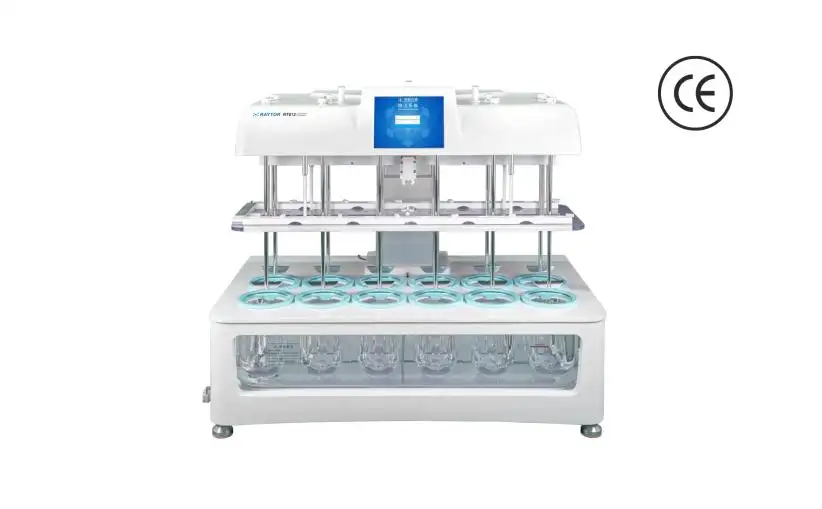
The RT612 Dissolution Apparatus is a good example of how these demands are being handled in modern instruments. It offers 12-position dissolution testing with either single or dual control, so labs can run multiple products or conditions at once without losing control over test parameters. Real-time speed and temperature monitoring keep each vessel within limits, and large storage capacity allows methods and results to be archived without building manual spreadsheets on the side.
What sets instruments like the RT612 apart for many users is how they address day-to-day lab frustrations rather than just ticking specification boxes. Automatic preheating brings the medium to the correct temperature before the run starts. Sampling needles can be positioned according to the set solvent volume and are not left resident in the vessel, helping to reduce turbulence. Covered dissolving cups are automatically centered, so analysts do not waste time wrestling with alignment.
The mechanical design also deserves attention. A rounded-corner water bath reduces dead zones in water circulation, improving both heating uniformity and cleaning. An advanced structure inside the bath and around the vessels is designed to minimize unnecessary fluid turbulence, which supports better repeatability from run to run.
On top of that, the RT612 offers an optional dual-speed mode. The six shafts on one side can run at one speed while the six on the other side run at another. For methods that compare conditions or support method development, this flexibility can dramatically increase throughput without requiring more floor space.
Choosing Future-Ready Dissolution Testers for Pharma
The product mix in many companies has changed. Few portfolios now consist only of simple immediate-release tablets. Labs routinely test:
•solid oral forms such as tablets and capsules
•transdermal patches
•semi-solid preparations
•parenteral dosage forms and intrinsic dissolution of APIs
Dissolution Testers for Pharma must therefore handle basket and paddle methods defined in pharmacopoeias and still leave room for method adaptation. A platform like the RT612, which can support this variety on a single instrument, helps standardize training, reduce maintenance complexity, and simplify validation.
When evaluating a new tester, it is helpful to look beyond the headline "12 positions" or "USP compliant" and ask a few practical questions:
❓Does the system clearly demonstrate compliance with ChP, USP, and EP methods relevant to your markets?
❓Is automated, synchronous dosing available to remove timing differences between vessels?
❓Are speed and temperature visible in real time, and are deviations captured for audit trails?
❓Does the design of vessels, sampling needles, and cups help to reduce turbulence rather than add to it?
❓Can the instrument support all key dosage forms your pipeline relies on?
❓Is data storage integrated in a way that supports audits and long-term traceability without manual workarounds?
If a solution like the RT612 satisfies these points, it can move a lab from minimal regulatory compliance to a more confident, data-driven approach to quality control.
Finally, there is the human element. Even the most advanced Dissolution Testers for Pharma are operated by people under time pressure. Intuitive interfaces, smart automation, and a reduction in repeated manual adjustments all help keep training times short and error rates low. When analysts feel that an instrument works with them rather than against them, they are more likely to follow procedures consistently and make full use of the system's capabilities.
Thinking about upgrading your dissolution setup?
If your team is spending too much time troubleshooting temperature drifts, adjusting heights after every method change, or reconciling scattered result files, it may be time to reassess your current system. Exploring instruments like the RT612 Dissolution Apparatus can be a practical step toward more reliable data, smoother inspections, and a dissolution platform that supports - not slows down - your product pipeline.