





Automated Drug Dissolution Testing System: Precision, Speed, And Full Traceability
2026-04-14


Automated Drug Dissolution Testing System solves pharma QC's biggest headache: human inconsistency. Manual dosing, scribbled time stamps, and rushed filtration worked ten years ago—but not in 2026. Regulators demand end-to-end data integrity, batch windows are shrinking, and OOS rates still hover 5–10% in manual labs.
Raytor's fully automated system changes that. It handles everything from preheating to final sample collection—no semi-automated compromises. Your team focuses on analysis, not pipetting.
Manual Dissolution Is a Regulatory Risk in 2026
Regulatory expectations have accelerated. The FDA's data integrity guidance now treats every manual entry as a potential vulnerability. Meanwhile, the upcoming harmonized revision of USP Chapter <701> (official October 2026) tightens acceptance criteria for mechanical calibration. In this environment, manual dissolution workflows create three unacceptable risks:
• Time-point variability: When an analyst manually samples eight vessels, the difference between first and last pull can exceed two minutes—enough to miss a critical point in a rapidly dissolving formulation
• Filtration inconsistency: Hand-syringe filters introduce variable backpressure, leading to under- or over-filtration that directly affects UV/HPLC results
• Documentation gaps: Paper logs and disconnected Excel files do not satisfy 21 CFR Part 11 audit trail requirements
A true automated drug dissolution testing system closes every one of those gaps. And that is exactly what the RT600-ST delivers.
What "Automated" Really Means?
Automation is not a single feature. It is a complete re-engineering of the dissolution workflow. Raytor has built the RT600-ST to perform every critical step without operator intervention—from the moment you set the method to the moment you collect your final sample vial.
- Automatic synchronous dosing:
• All eight vessels receive media and drug product simultaneously, eliminating the dosing time difference that plagues manual operations
• The exact dosing time is automatically tracked and recorded, creating a tamper-evident audit trail
- Automatic vessel positioning and centering:
• Dissolving cups self-center when installed, reducing setup error to near zero
• No manual alignment checks required before each run
- Automatic sampling at programmable intervals:
• First sample possible at 3 minutes, routine points every 5 minutes thereafter
• Sampling precision ≤±1% across 1–20 mL volumes, outperforming even experienced technicians
- Automatic online filtration:
• Dual online filters continuously remove particulates without clogging
• The instrument auto-performs filter washing and saturation, eliminating a major source of carryover
- Automatic preheating:
• Program the water bath to reach target temperature at a specific time—your medium is ready before you arrive
• Temperature accuracy ≤±0.2°C with 0.01°C resolution, fully compliant with USP <711>
All of this happens while the system displays real-time speed and temperature, with every parameter logged for full traceability. That is the difference between a dissolution tester and a true automated drug dissolution testing system.
Designed for 2026 Buying Trends: Integration, Not Islands
Procurement teams in 2026 are not buying standalone instruments. They are buying integrated solutions. According to recent market analysis, 60–70% of pharmaceutical and biotech labs now operate connected platforms that combine LIMS, robotics, and cloud analytics. A dissolution system that cannot talk to your other equipment is a liability.
Raytor anticipated this. The RT600-ST is built for connectivity:
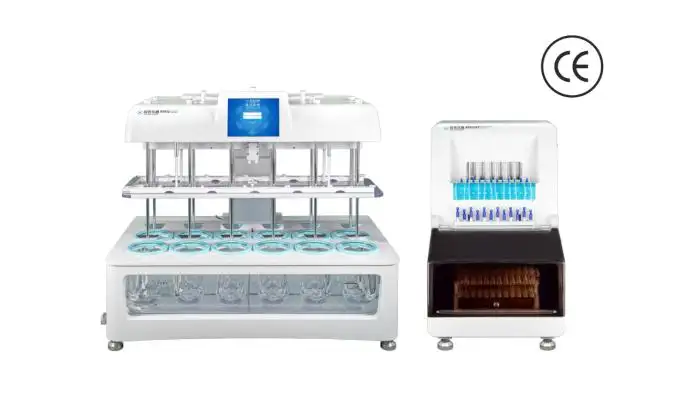
• Raytor cloud system: Connects at least 250 different types of instruments simultaneously—dissolution testers, HPLC systems, balances, and more
• Centralized data management: All dissolution runs, calibration records, and audit trails live in one secure location
• 21 CFR Part 11 readiness: User management, electronic signatures, and timestamped audit trails come standard, not as expensive add-ons
For laboratories scaling from two to twenty dissolution systems, this architecture means you never outgrow your platform. That is exactly what 2026 buyers demand: future-proof design that protects capital investment.
Beyond Oral Tablets: USP <1724> for Semisolids and Patches
Many automated dissolution systems stop at tablets and capsules. The RT600-ST goes further. It follows USP <1724> specifications to perform in vitro release tests and permeation studies for creams, gels, and transdermal patches. Key design elements make this possible:
• Bubble-preventing filling point: Eliminates air pockets that distort release profiles in semisolid testing
• Covered dissolving cups: Minimize evaporation during extended patch studies that can run 24 hours or more
• Paddle-basket co-axial design: Switch between USP Apparatus 1 and 2 without recalibration or height adjustment—essential when moving between tablets and patches
This versatility means one automated drug dissolution testing system serves both your oral solid dose QC and your topical product development teams. Fewer instruments, less training, lower total cost of ownership.
Built To Last: Mechanical Specs Beyond Pharmacopoeias
Automation is only valuable if the underlying mechanics are rock-solid. The RT600-ST's mechanical tolerances are not just compliant—they exceed USP, EP, and ChP requirements by a comfortable margin:
• Speed stability: ≤±0.3 rpm steady-state error across 0–300 rpm range (USP allows ±1 rpm)
• Temperature precision: ≤±0.2°C with 0.01°C display resolution
• Shaft wobble: < ±1.0 mm, well within pharmacopoeial limits
• Vessel verticality: 90°±0.5°, ensuring uniform hydrodynamics across all eight positions
Why does this matter for automation? Because automated sampling cannot compensate for a poorly aligned shaft. The RT600-ST's mechanical excellence means your automated results are accurate results—not just convenient ones.
Real-World Impact: Fewer OOS Events, Faster Release
The business case for automation is straightforward. Laboratories that transition from manual to fully automated dissolution testing typically report:
• 40–50% reduction in OOS events related to sampling variability
• 60% less analyst time spent on dissolution testing, reallocated to higher-value work
• Payback period under 18 months for labs running more than 50 dissolution tests per week
The RT600-ST achieves these outcomes because it automates everything that can be automated—dosing, positioning, sampling, filtering, and data recording. Your analysts are not replaced. They are elevated.
Raytor: A Manufacturer That Understands 2026 Laboratories
Raytor has been designing dissolution equipment since 2015, earning ISO 9001 certification and recognition as a national high-tech enterprise. Unlike brands that treat automation as a premium upgrade, Raytor builds it as the standard. The RT600-ST ships with all automation features active—no hidden licenses, no per-module fees.
Chinese dissolution equipment now holds over 40% of the global QC instrument market, driven by quality that meets pharmacopoeias at a price that respects lab budgets. Raytor exemplifies this shift, investing continuously in R&D to keep pace with USP revisions and FDA guidance.
Ready To Automate Your Dissolution Workflow?
If your lab still relies on manual sampling, paper logs, and disconnected instruments, you are carrying risk that no longer makes business sense. The RT600-ST automated drug dissolution testing system removes that risk—vessel by vessel, sample by sample.
Contact Raytor for a workflow assessment. Or download the product brochure to review full specifications, including the 120-vial sample tray and optional online dilution module.
FAQ
Q: Does an automated system really reduce OOS rates?
A: Yes. Labs using fully automated dissolution typically see 40–50% fewer OOS events linked to sampling and timing errors.
Q: Is the system compliant with USP, EP, and ChP?
A: Absolutely. The RT600-ST meets USP <711>/<724>, EP 2.9.3/4, and ChP 0931 requirements.
Q: Can it handle semi-solid formulations like creams and patches?
A: Yes. It meets the above standard for in vitro release testing and permeation studies.
Q: Overall, do you see a major cost for automation in relation to how it integrates with your existing LIMS?
A: Not at all. The integration with Raytor cloud is fully seamless and has 21 CFR part 11 compliance out of the box.
Q: What is the average return on investment time frame?
A: Due to the increased throughput and the elimination of redundant testing, the majority of labs are able to recover their initial investment in less than 18 months.