







How a Reciprocating Cylinder Dissolution System Delivers True IVIVC
2026-04-16


In pharmaceutical development, the gap between lab results and real-world performance remains one of the most costly hurdles. You develop a formulation, the dissolution test looks perfect, and then human clinical data tells a completely different story. This disconnect forces rework, delays submissions, and drains budgets. The answer lies in establishing a robust IVIVC (in vitro-in vivo correlation)—and that requires the right dissolution methodology. A Reciprocating Cylinder Dissolution System is purpose-engineered to close that gap.
Limitations with Traditional Dissolution Methods
Standard methods applied in the industry like the USP Apparatus 1 and 2 remain useful, but do present challenges with the parameters that can negatively influence the dissolution and absorption IVIVC:
•pH-conditional media simulation: The most prevalent API dissolution systems rely on neutral or acidic—0.1 N HCl or buffer—pH media. The GI tract, however, constantly changes from the stomach to the intestines.
•Constant agitation, but with no pressure: The basket and paddle designs do not allow for the application of hydrodynamic or controlled pressure. As such, they do not reflect the mechanical forces with GI motility or chewing of the tablets.
•Other systems can't emulate multiple phases: For modified-release and enteric-coated systems, temporally gated pH exposure is required to be multiple. Traditional systems with a single vessel do not allow for this.
This results in an absence of comprehensively IVIVC, meaning surprises during later phases of human pharmacokinetic testing and more regulatory delays.
Bridging the Gap with a Reciprocating Cylinder Dissolution System
Dissolution profiles and real time in vivo measurements serve as the foundation of the USP Apparatus 3 (reciprocating cylinder). This provides control and mechanical simplicity to the chemical and mechanistic variables of dissolution.
GI Transit System is Multi-PH Dissolution
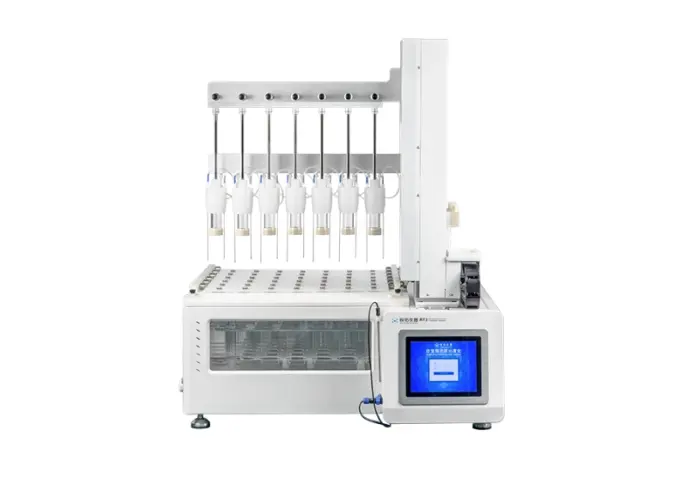
Raytor's RT3 Reciprocating Cylinder Apparatus allows for 7 tubs and 6 rows of dissolution vessels leading to the automated media transition for a wide array of pH values during a single run.
Example run: 2 hours at pH 1.2 in HCl media, followed by 1 hour in buffer of pH 4.5 which is ethyl-acetate, then 1 hour in buffer of pH 5.8 where phosphate is used, and finally 6 hours at pH 6.8 in PBS.
This sequence simulates the gastric to intestinal transition of enteric-coated and extended-release formulations.
Customizable Mechanical Stress Simulation for Real Life Scenarios
RT3 provides control of these two critical mechanical parameters:
•Reciprocating rate: 4 to 60 DPM (dips per minute) with ± 5 % accuracy
•Reciprocating stroke: 2 to 10 cm with ≤ ± 0.1 cm accuracy
The ability to fine-tune these parameters allows for simulating the small intestine's gentle mixing, the vigorous stirring motions of the stomach, and even the mechanical forces associated with chewing. This is particularly important for evaluating the performance of chewable tablets and gummy formulations.
Biorelevant Media and Additives
The design of the Reciprocating Cylinder Dissolution System complements the use of surface-active agents and food particle simulating inert beads and permits testing in both fasted and fed states which increases the clinical relevance of the data compared to other techniques.
Proof of Concept for Reciprocating Cylinder Dissolution Testing
The approach has been validated in published literature. One of the studies developed a USP Apparatus 3 dissolution methodology for metformin extended-release tablets leading to Level A IVIVC with R2 > 0.98, which is a high ex post predictive power, point-to-point correlation.
In another study, it was shown that USP Apparatus 3 can differentiate dissolution behavior of various formulations and eliminate the cone formation phenomenon that is frequently observed with Apparatus 2. More recently, the predictive dissolution modeling over different USP apparatuses confirmed that Apparatus 3 provides the highest levels of agitation and multivessel capabilities, which are not present in Apparatus 1 or 2.
The Raytor RT3: Built for Regulatory Success
To achieve IVIVC, your dissolution system must support data integrity as well. Raytor RT3 Reciprocating Cylinder Apparatus meets this challenge:
•FDA 21 CFR Part 11 compliance: Preinstalled Raytor dissolution operating system on an 8.4” touchscreen with complete audit trails, user access control (up to 100 users with 3 permission levels), and electronic signatures
•Full pharmacopeia compliance: Validated against USP, EP, and ChP standards for Apparatus 3 and Apparatus 7 configurations
•Temperature precision: ≤ ±0.2 °C accuracy with inter-vessel uniformity of ≤ ±0.5 °C for all 7×6 vessel positions to ensure reproducible conditions
•Anti-evaporation automatic vessel cover: Preserves data integrity for extended-release profiles during long testing periods by reducing medium loss
•One-piece water bath with rounded corners: Uniform heating, no dead spots, complete drainage for easy cleaning between runs
Putting IVIVC Into Practice
With the RT3 Reciprocating Cylinder Dissolution System, you get capabilities that enhance your development processes:
•Formulation screening: Find the optimal release profiles by testing a range of pH levels and agitation rates, all in a single run.
•Quality control for complex dosage forms: Validate using biorelevant methods extended-release tablets, enteric-coated products, soft capsules, and orally disintegrating tablets.
•Regulatory submission support: Provide dissolution data with meaningful IVIVC to minimize (or obviate) further human bioequivalence study needs.
•Post-approval change management: Defend with validated IVIVC models manufacturing changes without the need to repeat clinical trials.
The 2026 Advantage
Unlike bio relevant testing and data integrity, the regulatory criteria for testing and data integrity will become rigid. This will require laboratories to have new equipment that combines precision with compliance.
The Raytor RT3 Reciprocating Cylinder Dissolution System is designed with USP Apparatus 3 methodology, with an automation-ready design, multi-batch capability, and full audit trail.
Judging for procurement teams and QC managers looking for new dissolution systems this year, the choice is simple; purchase a system that incorporates IVIVC with every test. For technical specs, validation paperwork, or to see the RT3 Reciprocating Cylinder Dissolution System, reach out to Raytor.
Frequently Asked Questions (FAQ)
Q: What is the difference between USP Apparatus 3 and USP Apparatus 2 for IVIVC studies?
A: USP Apparatus 2 (paddle) offers a single pH medium with ring agitation as a poor simulation of GI conditions. USP Apparatus 3 (reciprocating cylinder) allows for multi-pH levels and adjustable mechanical stimulation, which substantially improves the in vitro-in vivo correlation.
Q: Can the Raytor RT3 manage both immediate-release and modified-release formulations?
A: Yes. The RT3 features adjustable reciprocating rates (4–60 DPM) and stroke lengths (2–10 cm) along with a 7×6 multi-row vessel configuration. Thus, it is appropriate for immediate-release tablets, enteric-coated formulations, extended-release beads, and intricate dosage forms, including soft capsules or gummies.
Q: Is the RT3 compliant with FDA 21 CFR Part 11?
A: Yes. The RT3 is equipped with Raytor's dissolution operating system on an 8.4-inch touchscreen and meets all Part 11 requirements, including audit trails, electronic signatures, user access restrictions, and data integrity protections.
Q: What validation documentation does Raytor provide for regulatory submissions?
A: Raytor provides mechanical PQ (performance qualification) protocols, temperature mapping, stroke accuracy certificates, and compliance statements to support USP, EP, and ChP pharmacopeia — all of which support your NDA, ANDA, or inspection package.