







Automated Sampling, Filtering & Media Change: How The USP 7 Tester Slashes OOS Rates
2026-04-15


The USP 7 Reciprocating Holder Dissolution Tester is now the first line of action to protect from OOS occurrences. Manual sampling and other older systems will not be acceptable by 2026.
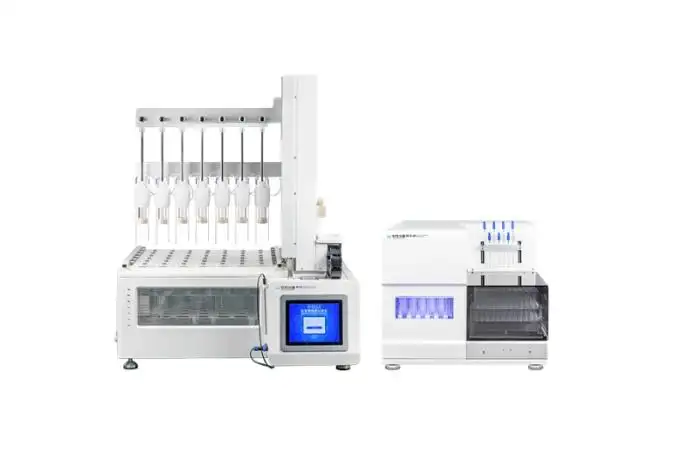
Raytor's RT3-AT system, designed for both automated sampling and automated filtration, systematically tackles the OOS root causes of human error, sample adsorption, media evaporation, and inconsistent filtration. The following explains why we believe the automation of sampling, filtration, and media change will dramatically increase the OOS rate while also meeting 2026 buyer requirements for compliance, throughput, and biorelevant testing.
Why Traditional Dissolution Workflows Generate OOS Events
The majority of OOS investigations are rooted from an operator-related step. The margin of error is greatly expanded when laboratories are using the USP 7 Dissolution Reciprocating Holder Testing Method. The most referenced pain points are:
•Manual sample withdrawal position ranged from 0.25'' to 0.50'' causing a variable error of up to 5-8% in sample withdrawal volume.
•Uncontrolled evaporation of the vessel where the sample is located, ultimately concentrating the API, and generating false positive results of the dissolution.
•Infiltration that either is not adequate or consists of the used filtration device introducing unknown dissolution particles, causing the sample to be underestimated for the amount of dissolved drug.
•Sample adsorption to the tubing or the syringe used for analysis resulting in an out of specification value.
•Media change error due to human being included in the step causing premature invalidation of the extended release and delay release of the tested procedure.
Each of these occurrences are variables that remain and can be eliminated with an automated USP 7 Reciprocating Holder Dissolution Tester.
Hands-Free Withdrawal With Automated Sampling
The RT3-AT combines a precision sampling pump and a sophisticated Teflon pipelining system that transforms dissolution testing from a manual skill to a reproducible and auditable process.
•The precision sampling pump ensures a sampling accuracy of ±1%: the volume withdrawn is exactly what is programmed, completely eliminating the volumetric errors associated with manual pipetting.
•The Teflon pipelining system eliminates sample loss due to adsorption: Teflon has the best chemical resistance and anti-adsorption characteristics which preserves the integrity of samples, especially for low dose and sticky compounds, which is a primary cause of OOS in dissolution testing.
•Up to 30 programmable sampling events per run: the automatic sampling workstation can be programmed for 30 time points to capture the early, peak, and late dissolution stages and can run unattended overnight.
•The sample collector is compatible with 10mL test tubes and HPLC vials: direct transfer to analytical vials minimizes transfer steps and reduces the risk of manipulation errors.
For QC managers, this translates to fewer OOS investigations due to “sampling technique variation.” One industry report cited is machine-induced sampling variation and subsequent dissolution related OOS investigations to be between 40–60%.
Online Filtration for Closed-Loop Particle Control
Filtration is often the most underestimated source of dissolution failure. Too little filtration leaves particulates; too aggressive filtration may remove API. The RT3-AT's complete filtration program solves this with two integrated options.
•Cylindrical filter elements in a pre-pump filtration device: Located prior to the sampling pump, this device captures particles at the point of withdrawal to prevent line obstruction and ensure samples are representative.
•Insert-shaped filter at the injection needle: For laboratories needing in-line filtration at the point of analysis, this solution omits an additional offline filtration step, saving time and minimizing contamination risk.
•Filters available in various sizes: Laboratories can choose the preferred pore size for each formulation, be it coarse for rapid release gummies or fine for slow release pellets.
•Filter integrity check alerts: The system flags any pressure anomalies that could indicate filter blockage or bypass, allowing operators to address issues before they produce invalid data.
By automating filtration, the USP 7 Reciprocating Holder Dissolution Tester removes the variability introduced by different technicians using different filter brands, pressures, or techniques.
Automated Media Change for Biorelevant Sequences
Extended-release, enteric-coated, and delayed-release formulations require sequential exposure to gastric fluid (pH 1.2), intestinal fluid (pH 6.8), and sometimes colonic conditions (pH 7.4). The chances of making mistakes each time changes are made, and making changes is a cumbersome, such processes might be frustrating, and are largely unfeasible for constant adjustment.
•For programmable media changes spanning up to 6 rows and 7 tubes: Complex media-changing protocols are easily set up and executed without any manual changes.
•Commandable and automated vessel covers: These covers effectively reduce evaporation loss of the dissolution medium, maintaining consistent media volume and concentration across 6-hour or even 600-hour unattended runs.
•Following the USP guidelines to the letter, the system executes each step as the user dictates time.
•Compatible with 300mL standard or 1000mL optional vessels: This flexibility allows laboratories to run both small-volume biorelevant tests and larger-volume method transfer studies on the same instrument.
•Automated media change not only slashes OOS rates but also enables laboratories to run overnight and weekend sequences—increasing throughput by 200–300% compared to manual operation.
The Raytor Difference: Designed for 2026's Data Integrity and Throughput Demands
Buyers in 2026 are no longer asking “Does it automate?”—they are asking “How does it protect data integrity and integrate with my existing QC workflow?” The RT3-AT answers both questions.
•8.4-inch touchscreen with Raytor dissolution operating system: Meets FDA 21 CFR Part 11 requirements with full audit trails, user authentication, and electronic signatures.
•One-piece rounded-corner water bath: Provides uniform heating and full drainage—no dead spots that could harbor contaminants or cause temperature gradients.
•Coaxial mounting bracket for rapid holder changeovers: Switch in less than a minute between a reciprocating cylinder, reciprocating holder, and other USP 3/7 attachments to maximize the versatility of the instrument.
•Raytor offers direct manufacturer support: Parts, application training, and validation service support are quicker than competitors who are distributor-based.
Conclusion: Decreased OOS Rates Increased QC Confidence
Out of Specification (OOS) events are costly. Each investigation consumes precious technical resources, extends product launch timelines, and adversely affects the global regulatory footprint. The greatest risk mitigation will come from eliminating the people components of the dissolution testing process.
The USP 7 Reciprocating Holder Dissolution Tester —Raytor RT3-AT with automated sampling, inline filtration, and programmable media change— does just that. It takes dissolution testing from a risky manual process to a secure, auditable, and high-throughput process. For QC leaders and buyers looking at their 2026 capex in the automation of testing, this is not just a productivity gain; it is a direct OOS investment.
Ready to see how the RT3-AT can cut your OOS rates? [Contact Raytor] for a technical consultation or on-site demonstration.
Frequently Asked Questions
Q: How does automated sampling directly reduce OOS rates?
A: It eliminates operator variability in withdrawal timing, depth, and volume—three leading causes of dissolution OOS events. The RT3-AT's precision pump ensures ±1% sampling accuracy.
Q: Can the RT3-AT handle both USP 3 and USP 7 methods?
A: Yes. The coaxial mounting bracket allows quick change between reciprocating cylinder (USP 3) and reciprocating holder (USP 7) configurations on the same instrument.
Q: What filtration options are included to prevent particle interference?
A: A pre-pump cylindrical filter device plus an optional disk-shaped filter head at the injection needle—both enabling online filtration without offline handling.
Q: Does the system comply with FDA 21 CFR Part 11?
A: Yes. The 8.4-inch touchscreen runs Raytor's dissolution OS with full audit trails, user authentication, and electronic signatures.
Q: What vessel sizes are available?
A: Standard 300mL biorelevant vessels, with optional 1000mL vessels for traditional or high-volume testing.