

Dermal Drug Delivery Systems: Emerging Technologies and Testing Challenges
2026-09-23


Dermal Drug Delivery Systems must deliver drug to the intended skin compartment at an appropriate rate and dose. A faster release curve or higher permeation result is useful only when it supports that objective.
At Raytor, our perspective as a testing-equipment manufacturer is practical: evaluating Dermal Drug Delivery Systems requires separating formulation performance from variability introduced by skin, apparatus, and sampling.
Define the Target Before Selecting the Technology
Dermal delivery targets skin tissue; transdermal delivery targets systemic circulation. Microneedles and patches may serve different objectives depending on their design.
For locally acting Dermal Drug Delivery Systems, the drug dispersed in the epidermis or dermis may be more important than the drug reaching the receptor fluid. Therefore, when developing such systems, the following must be determined:
•Target compartment: Skin surface, epidermis, dermis, or systemic circulation.
•Dose and duration: Dose per unit area, exposure time, and interval between dosing.
•Drug: Solubility, ionization, molecular size, and the partitioning of the vehicle-to-skin.
•Formulation: Viscosity, crystallization, evaporation, and physical stability.
The stratum corneum restricts passive transport. Increasing solubility in the vehicle does not necessarily increase delivery: strong vehicle affinity can limit drug partitioning into skin.
Emerging Technologies in Dermal Drug Delivery Systems
| Technology | Mechanism and suitable objective | Critical trade-off | Required evidence |
| Dissolving microneedles | Place payload beyond the outer barrier | Insertion strength versus loading and dissolution | Insertion depth, delivered dose, dissolution, release |
| Lipid/polymeric nanocarriers | Modify drug availability and skin distribution | Encapsulation stability versus release of available drug | Size distribution, free-drug fraction, release, tissue retention |
| Responsive hydrogels | Control diffusion through swelling or environmental response | Trigger sensitivity versus structural stability | Rheology, swelling, release under relevant conditions |
| Iontophoresis-assisted systems | Use electrical current to assist transport | Transport enhancement versus skin tolerance | Current density, permeation profile, barrier integrity |
Microneedle disappearance does not establish complete dose delivery. Detecting a carrier-associated signal in skin does not prove intact nanoparticles crossed the barrier. Hydrogel performance must be tested under realistic trigger conditions.
For Dermal Drug Delivery Systems, these distinctions prevent promising mechanisms from being mistaken for demonstrated performance.
Match the Test to the Decision
| Test | Decision supported | Main output | Limitation |
| IVRT: in vitro release testing | Compare formulation release | Cumulative release per area; release-rate slope | Synthetic membranes do not reproduce skin permeability |
| IVPT: in vitro permeation testing | Compare transport across skin | Cumulative permeation; interval flux | Does not independently establish clinical efficacy |
| Skin retention analysis | Assess local drug distribution | Drug recovered from defined skin layers | Requires validated washing, separation, extraction |
| Microneedle mechanical testing | Confirm reliable administration | Strength, insertion, delivered fraction | Cannot replace release or permeation studies |
For IVRT, a square-root-time model is appropriate only over a justified interval. For IVPT, interval flux is:
J = ΔQ / (A × Δt)
Here, Q is cumulative permeated mass corrected for sampling, A is exposed area, and t is time. Typical units are µg/cm²/h. Finite-dose profiles can rise and decline as the donor depletes; a steady-state slope should not be forced onto them.
Control the Variables That Distort Results
Skin and Dose Conditions
Record donor source, thickness, storage, and preparation. Use a qualified integrity test, such as electrical resistance or transepidermal water loss, with method-specific acceptance criteria.
Distribute formulations across donors where feasible. Replicate cells from one donor do not capture between-donor variability.
Control of mass per area, spreading, exposure duration, and occlusion. In finite-dose experiments, evaporation can change formulation.
Medium, Temperature, and Cell Assembly
For Dermal Drug Delivery Systems, the selection of the medium and the receptor depends on solubility, stability, and compatibility with the barrier. Verify sink conditions; too much solubilizer may change the barrier being studied.
Verify membrane-surface temperature during normal operation. Check seals, exposed area, stirring, and bubbles underneath the membrane.
Recovery and Mass Balance
Quantify the drug in the receptor fluid, skin, surface washings, and the apparatus, if applicable, rinsings.
Recovery (%) = total drug recovered / applied drug × 100
Justify extraction recovery, adsorption, sample stability, and the limits of quantitation of the analytical method. Investigate losses that are not accounted for before assuming that formulation is the cause of the differences observed.
Demonstrate Discrimination, Not Just Repeatability
A precise method may still miss meaningful formulation changes. Challenge it with justified variations in composition or processing, and assess robustness to small operating changes.
FDA's topical IVPT draft guidance addresses qualification, donor variability, discrimination, and robustness within its stated scope. It excludes transdermal and topical delivery systems such as patches; it is not a universal protocol for Dermal Drug Delivery Systems.
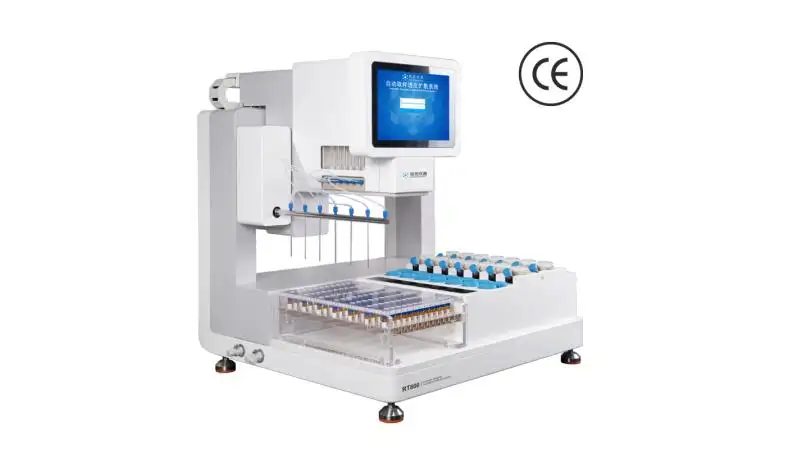
Raytor Designs That Support Method Control
Our RT800 System automates sampling and refilling of Franz cells. It reduces variability through the following features:
•Synchronized sampling: Limits differences to less than 10 ms.
•Shrunken pipelines: Reduce the risk of residue; recovery is still to be validated for each compound.
•Easily removable cells: Allow manual bubble removal and are designed for quality control checks.
Traceability is ensured through audit trails and a database.
The RT800 can sample volumes of 0.2-1.5 mL and can have cell volumes of 10-40 mL. Choose these values based on the desired sensitivity and the sink condition of the sample being taken.
The RT600 provides suitable patch-release methods with USP Apparatus 5/6 configurations. This setup measures the release ofa sample, as opposed to skin permeation. Our dissolution accessories and customization services provide a basis for sample mounting and method discussion.
Plan Testing Around the Delivery Objective
Reliable Dermal Drug Delivery Systems development connects target tissue, technology, complementary endpoints, and validated operating conditions.
Explore Raytor's drug release and dissolution testing solutions to discuss your formulation, diffusion-cell requirements, and sampling strategy with our team.
FAQs
Q1. Which Raytor instrument is suitable for testing Dermal Drug Delivery Systems?
The Raytor RT800 Automated Transdermal Diffusion System combines Franz diffusion cells with automated sampling and refilling. It supports IVRT and IVPT workflows, with method suitability depending on the formulation, membrane or skin model, and study objective.
Q2. Can the Raytor RT800 support both IVRT and IVPT?
Yes. For IVRT, an appropriately qualified membrane supports evaluation of drug release from the formulation. For IVPT, a suitable skin model enables permeation measurements. Each application requires its own method development and validation.
Q3. Which formulations can laboratories evaluate with the Raytor RT800?
Raytor lists creams, ointments, gels, and patches among RT800 applications. Laboratories should confirm sample mounting, exposed area, receptor medium, and dosing conditions for each formulation rather than transferring one method across all dosage forms.
Q4. How does Raytor RT800 synchronized sampling improve testing?
The RT800 provides seven-channel synchronized sampling within a group, helping reduce timing differences between diffusion cells. This supports comparisons at defined sampling points, particularly when concentrations change rapidly. Sampling accuracy and recovery still require qualification.
Q5. What sampling volumes and diffusion-cell volumes does the RT800 offer?
The RT800 lists sampling volumes of 0.2–1.5 mL and diffusion-cell volumes of 10, 15, 20, 25, 30, and 40 mL. Selection should account for analytical sensitivity, receptor-medium solubility, and the proportion of fluid removed during sampling.