

IVRT System for Topical Drug Products – Simply Explained
2026-05-27


IVRT System for Topical Drug Products plays a central role in modern pharmaceutical development. Whether you are formulating a new cream, ointment, gel, or patch, understanding how the active ingredient releases from the semi-solid matrix is essential for both quality control and regulatory approval.
But what makes an IVRT system truly effective in 2026? And how can laboratories—especially those new to transdermal testing—choose equipment that aligns with current design trends and purchasing priorities? This article walks you through the science, the practical challenges, and a solution that brings everything together: the RAYTOR RT806 Vertical Franz Diffusion Cell Tester.
What Is an IVRT System and Why Does It Matter?
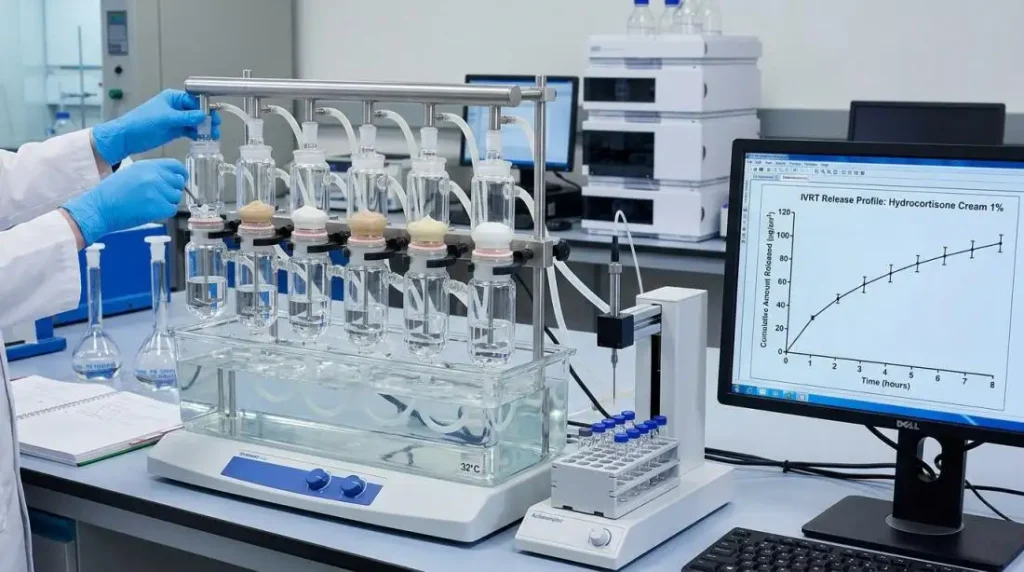
An IVRT System for Topical Drug Products measures the rate at which a drug molecule leaves its carrier (cream, gel, etc.) and diffuses across a synthetic membrane into a receptor fluid. This in vitro release test (IVRT) is distinct from permeation studies (IVPT), but both rely on the same core tool—the Franz diffusion cell. The principle is straightforward:
• The donor compartment holds the topical product.
• A synthetic membrane (or sometimes skin) separates it from the receptor compartment.
• The receptor fluid is stirred and kept at body temperature (32°C for skin, 37°C for other tissues).
• Samples are taken over time to quantify drug release.
Regulatory bodies including the FDA and USP have standardized these procedures, most notably under USP<1724> for semi-solid preparations. Therefore, choosing a compliant IVRT system is not just a technical decision—it is a strategic one.
Three Core Demands of Today's Topical Drug Testing
Modern labs face three interconnected expectations: reproducibility, simplicity, and flexibility. An ideal IVRT System for Topical Drug Products must address all three without compromise.
• To ensure reproducibility, temperature should be controlled to ± 0.5°C with stirring held constant within the range of 200 - 900 RPM.
• Simplicity means minimal bubble entrapment, easy setup, and clear operation.
• Flexibility allows the same system to test creams, ointments, patches, and gels.
The RAYTOR RT806 was engineered precisely around these demands.
Introducing the RAYTOR RT806: Compact, Compliant, and Clever
The RT806 Vertical Franz Diffusion Cell Tester is a small-sized, portable system that integrates heating and a built-in stirrer module. Its layout allows placement anywhere—from a busy QC bench to a dedicated R&D hood. But beyond portability, three design choices set it apart.
1) Bubble-Free Filling For Dependable Results
One of the most overlooked sources of variability is air bubbles trapped under the membrane. The RT806 solves this with a dedicated filling point design that actively prevents bubbles. The outcome is straightforward: fewer rejected runs and higher confidence in every release profile.
2) Full Compliance With USP<1724>
Compliance is not an afterthought. The RT806 meets every performance requirement outlined in USP<1724> for in vitro release and permeation procedures. This includes:
• Temperature error ≤ ±0.5°C (range: room temperature to 55°C)
• Speed error ≤ ±10% (range: 200–900 rpm)
• Diffusion cell geometry that matches the USP description
• Six cells per group, expandable with one or more systems running independently
3) Manual Operation With Smart Oversight
While fully automated systems exist, many laboratories prefer the control and affordability of manual sampling. The RT806 keeps things simple: a touch-screen interface for setting temperature and speed, plus a handheld thermometer that displays real-time cell temperature. This hybrid approach gives you automation where it matters (environmental control) and flexibility where you need it (sampling timing).
Why 2026 Buying Trends Favor the RT806
Purchasing decisions in pharmaceutical labs have shifted. Now, buyers look at total cost of ownership, data integrity readiness, and multi-product versatility. The RT806 aligns perfectly with these trends.
1) Total Cost Of Ownership
Entry-level pricing does not mean cutting corners. The RT806's extremely simple structure reduces maintenance needs. Its portable design means no dedicated benchtop renovation. And because it is built by RAYTOR—a dedicated manufacturer—spare parts and support are readily available.
2) Data Integrity Ready
Although sampling is manual, the system's touch screen stores set parameters and real-time readings. This supports ALCOA+ principles (attributable, legible, contemporaneous, original, accurate) when combined with a basic lab notebook or electronic log. For labs moving toward full digitization, the RT806 integrates without friction.
3) One System, Many Formulations
The RT806 handles all common semi-solid dosage forms:
• Creams (oil-in-water or water-in-oil)
• Ointments (hydrophobic or hydrophilic)
• Patches (matrix or reservoir type)
• Gels (aqueous or alcoholic)
This versatility means a single IVRT System for Topical Drug Products can serve multiple projects, improving equipment utilization.
How The RT806 Simplifies Your IVRT Workflow
Let's walk through a typical day of using the RT806. No jargon, just practical steps.
- Set-up: Place the system on any flat surface. Fill the receptor compartments with degassed buffer. Mount the membrane and donor chamber.
- Control Panel Setting: 32 °C, 600 rpm stirrer speed. Thermal validation of samples will be performed using handheld thermometers.
- Application: There is either cream or gel in donor cells. The design of the filling point avoids trapping of air.
- Sampling: At specified time points, a sample is taken from the filling point and a buffer is put in its place.
- Analysis: For drug quantification, samples will be placed in HPLC or subjected to UV analysis. The release profile tells you everything about formulation performance.
- Throughout the run, the RT806 maintains temperature and stirring within USP<1724> limits. You focus on science, not on babysitting equipment.
Real-World Applications That Benefit
Academic researchers use the RT806 to screen early-stage formulations. Generic drug companies rely on it for IVRT comparisons with reference products. Even cosmetic labs adapt the system for active ingredient release studies. The common denominator is the need for trustworthy, compliance-ready data without a six-figure budget.
Conclusion: A Future-Ready Investment
Choosing an IVRT System for Topical Drug Products no longer means sacrificing convenience for compliance. The RAYTOR RT806 delivers USP<1724>-grade performance, bubble-free operation, and multi-formulation flexibility at an entry-level price. Evolve your lab with equipment designed for tomorrow's formulations.
Frequently Asked Questions
Q: Does the RT806 comply with USP<1724>?
A: The RT806 meets all performance criteria for in vitro release and permeation testing as provided in USP<1724>.
Q: How does the RT806 design remove air bubbles?
A: The RT806 has a filling point design that prevents the formation of air bubbles for reliable and consistent operation.
Q: What formulations can I assess with RT806?
A: RT806 can test all semi-solid dosage forms such as creams, ointments, gels, and patches.
Q: How user-friendly is the RT806?
A: The RT806 is very user-friendly and walk-through manual operations and a touch screen design with a portable setup complement the user-friendly aspect while being compliant.
Q: Are multiple cell groups permissible?A: Yes, one or more diffusion cell systems can operate independently and without any interference and each would house up to six cells per group.