


Franz Diffusion Cell For IVPT Studies: Biopsy to 3D Skin for Precious Human Samples
2026-05-26


IVPT is the gold standard for predicting how topical products cross skin. The workhorse behind most IVPT studies is the Franz Diffusion Cell For IVPT Studies – a simple two-chamber device. But rare human biopsies and costly 3D skin models don't fit standard cells, which require large tissue areas. Enter the micro Franz diffusion cell. This article explores how micro cells – especially the RAYTOR RT806 Vertical Franz Diffusion Cell Tester – transform IVPT using precious human samples and 3D skin models.
Why "Micro" Matters: The Challenge of Scarce Skin Samples
Human skin biopsies (e.g., from plastic surgery or punch biopsies) are limited in size – often only 4–8 mm in diameter. Similarly, commercial 3D skin models (EpiDerm™, LabSkin™, Phenion®) come as small inserts (typical area 0.5–1 cm²). A conventional Franz cell with a 1.8 cm² diffusion area would waste or even fail to accommodate such samples.
Micro Franz diffusion cells reduce the diffusion area to 0.1–0.3 cm² and receptor chamber volumes to as low as 0.5–2 mL. This scaling delivers multiple benefits:
✅ Maximum data from minimal tissue – one biopsy can yield 3–6 replicates.
✅ Lower cost per experiment – less receptor fluid, fewer active pharmaceutical ingredients (APIs).
✅ Faster equilibration – shorter lag time for hydrophobic compounds.
✅ Compatible with standard 96-well plate readers (when using micro-sampling).
Key phrase: A well-designed Franz Diffusion Cell For IVPT Studies must offer scale-down options without compromising USP compliance – exactly what the RAYTOR RT806 system provides.
Application 1: Human Skin Biopsies – Preserving Clinical Relevance
Human ex vivo skin remains the "gold standard" barrier because animal skin (pig, rat, mouse) differs in lipid composition, thickness, and hair follicle density. However, ethical and practical constraints limit access to fresh human tissue. With a micro Franz cell, researchers can:
• Use leftover surgical skin – e.g., from abdominoplasty or breast reduction – and punch multiple 4-mm biopsies.
• Test diseased skin – e.g., from psoriasis or atopic dermatitis patients (extremely rare).
• Perform intra-subject comparisons – treat one biopsy with test formulation, another with control.
Practical tips for biopsy-based IVPT
• Maintain skin integrity by mounting the biopsy without stretching.
• Use a barrier integrity test (transepidermal water loss or tritiated water) before the experiment.
• Because receptor volume is tiny, add a preservative (e.g., 0.01% sodium azide) to avoid microbial growth over 24-hour studies.
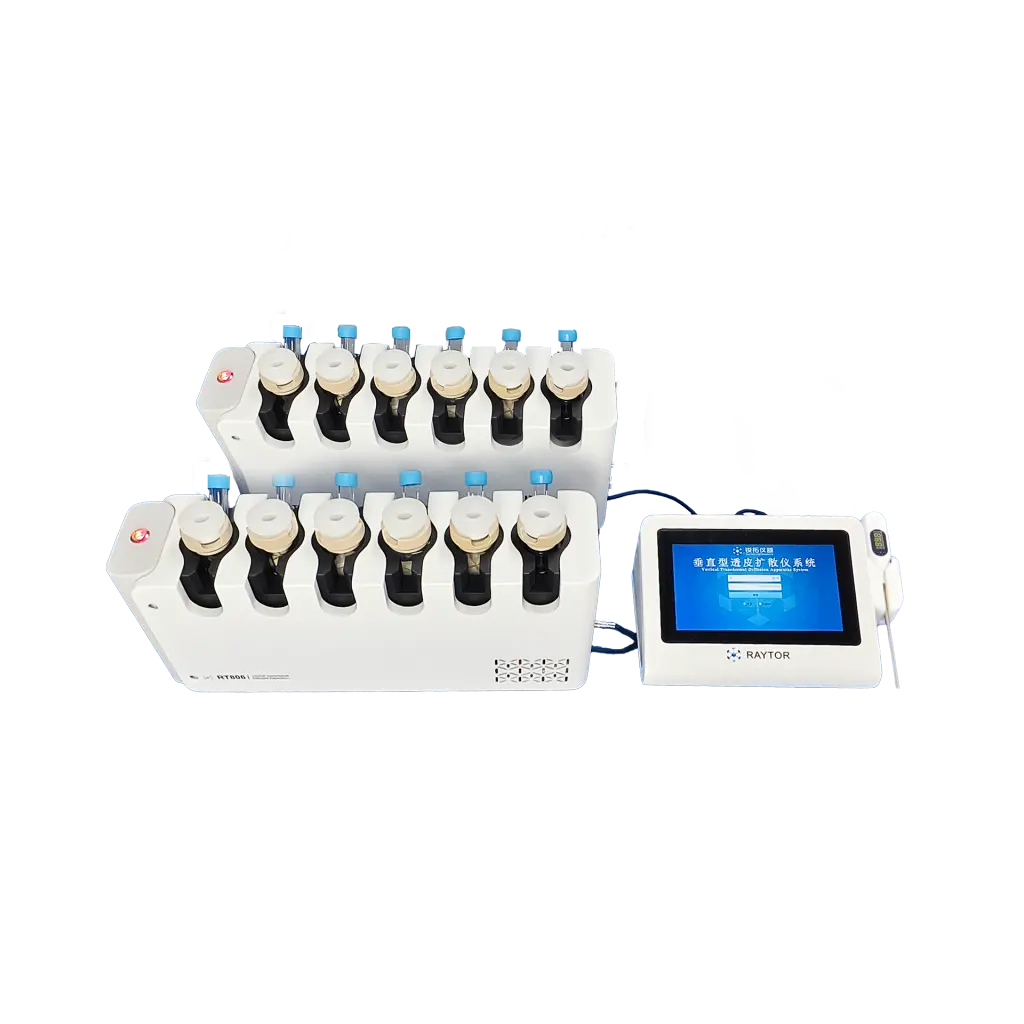
The RAYTOR RT806 is particularly suited for such delicate work. Its vertical design and manual sampling allow gentle handling, while the built-in stirrer and precise temperature control (±0.5°C) ensure that even a 2-mL receptor chamber remains homogeneous.
Application 2: 3D Reconstructed Human Epidermis (RHE) – Standardized & Ethical
3D skin models are bioengineered tissues (e.g., from human keratinocytes grown on a collagen matrix). They are:
• Reproducible – no donor-to-donor variation.
• Ethical – animal-free.
• Available commercially – but expensive (often > $100 per insert).
Micro Franz cells match perfectly with the small surface area of RHE inserts (typically 0.6 cm²). IVPT on RHE is now accepted by regulators (e.g., OECD TG 428 for corrosion testing, and increasingly for sunscreen absorption).
Advantages of combining RHE with a compliant micro system
| Feature | Benefit |
| Small receptor volume | Lower API consumption (ideal for early-stage formulations) |
| Transparent chambers | Visual monitoring of bubbles or formulation spread |
| USP<1724> compliance | Data accepted in ANDA submissions for topical generics |
The RT806 meets all performance requirements of USP<1724> for in vitro release and permeation. Its filling-point design actively prevents bubble formation – a critical factor when working with expensive 3D models where a single bubble can ruin a $500 insert.
Why the RAYTOR RT806 is an Entry-Level Workhorse for Micro Franz Cell IVPT
RAYTOR has designed the RT806 Vertical Franz Diffusion Cell Tester with practicality and compliance in mind. While not exclusively "micro", its flexible configuration allows users to pair it with micro-size donor and receptor chambers. Here's what makes it ideal for scarce-sample studies:
Key specifications (relevant to micro setups)
• Number of diffusion cells – 6 per group (can run multiple groups independently).
• Temperature range – ambient to 55°C, error ≤ ±0.5°C.
• Speed range – 200–900 rpm (magnetic stirrer built-in).
• Sampling – manual (gentle, no cross-contamination).
• Portable layout – fits in a fume hood or on a benchtop.
• Bubble prevention – integrated filling point design.
"Complies with the description of diffusion cell type in USP<1724>" – this phrase guarantees that any IVPT data generated with the RT806 will be accepted by the FDA and EMA for regulatory submissions of creams, ointments, patches, and gels.
RAYTOR's advantages for micro-volume work
• Handheld thermometer – real-time temperature check directly inside the diffusion cell (essential when receptor volume is only 1–2 mL and temperature gradients form easily).
• Extremely simple structure – easy to clean and reassemble, reducing the risk of damaging expensive 3D skin inserts.
• Entry-level price, professional compliance – ideal for academic labs or small CROs starting IVPT on human biopsies.
Step-by-Step: Running an IVPT Study with a Micro Franz Cell (Using RT806 as an Example)
- Skin preparation – Dermatome human skin to 300–400 µm or place a 3D skin insert on the donor compartment.
- Mounting – Carefully clamp the tissue between donor and receptor chambers. The RT806's vertical design helps avoid lateral shearing.
- Receptor medium filling – Degas the buffer (e.g., PBS with 0.1% BSA). Use the filling point to eliminate air bubbles.
- Equilibration – Set temperature to 32±1°C (skin surface temperature). Stir at 400 rpm. Wait 30–60 minutes.
- Application – Apply finite dose (e.g., 5–10 µL/cm² of cream) or infinite dose (300 µL for saturated solution).
- Sampling – At predetermined time points (e.g., 0, 1, 2, 4, 6, 8, 12, 24 h), withdraw 200 µL from the receptor port (manually with a syringe). Replace with fresh buffer.
- Analysis – Quantify API by HPLC-MS/MS. Calculate cumulative permeation, flux, lag time.
Pro tip: For micro chambers, sample volume should not exceed 30% of total receptor volume to maintain sink conditions. The RT806's manual sampling allows precise volume control.
Real-World Impact: What Micro Franz Cell IVPT Has Achieved
• Pediatric drug development – tested morphine permeation through newborn foreskin biopsies (only 5 mm diameter).
• Nanoparticle safety – evaluated zinc oxide penetration through 3D skin models, avoiding ethical concerns of human testing.
• Generic acyclovir cream – used micro Franz cells with 1.5 mL receptor volume to prove bioequivalence, saving months of clinical trials.
All these studies relied on a Franz Diffusion Cell For IVPT Studies that was scaled down but never dumbed down. Compliance with USP<1724> – as offered by RAYTOR RT806 – is non-negotiable for regulatory acceptance.
Conclusion: Small Scale, Big Future
Human skin biopsies and 3D skin models are scarce but invaluable. Micro Franz diffusion cells turn this limitation into an opportunity, generating high-quality IVPT data with minimal tissue. The RAYTOR RT806 Vertical Franz Diffusion Cell Tester offers USP-compliant portability, bubble prevention, and precise temperature control – essential for precious samples. Whether you're testing gels, sunscreens, or generics, a micro Franz cell setup delivers regulatory-ready data from just a single biopsy. Visit RAYTOR's product page for the RT806 – your compliant, tissue-sparing Franz Diffusion Cell For IVPT Studies.
FAQs
1.What is a Franz Diffusion Cell For IVPT Studies?
A two-chamber device that measures how much of a topical drug or cosmetic ingredient permeates through skin or a membrane.
2.Why use a micro Franz cell for human biopsies?
Standard cells need large skin areas. Micro cells work with tiny 4-mm punch biopsies – ideal for rare or costly human samples.
3.Can I use 3D skin models with the RAYTOR RT806?
Yes. The RT806 supports small diffusion areas (e.g., 0.6 cm²) commonly used in reconstructed human epidermis (RHE) models.
4. Are there compliance issues with the RAYTOR RT806?
There are no compliance issues with this system. The RT806 meets/fulfills all the performance criteria outlined in the USP <1724> for In Vitro Release and In Vitro Permeation Testing.
5.How many cells does the RT806 have?
Six cells per group, and you can connect multiple groups – perfect for replicate experiments on precious samples.