






Lifecycle Management for GMP-Compliant Transdermal Diffusion Systems (Method to Production)
2026-06-26


Products in the pharmaceutical and cosmetic industries consisting of semi-solid forms of dispersion such as creams, ointments, gels, and transdermal patches face strict quality control. The GMP Compliant Transdermal Diffusion System aids in compliance and data integrity during the formulation of new topical products or during the scaling-up of the production process. It also ensures that every production lot is uniform.

This article walks you through the entire lifecycle — from early method development to GMP-compliant manufacturing — and highlights how a modern automated system like the RAYTOR RT800 supports each stage.
Why a Lifecycle Approach Matters
A transdermal diffusion system is not just a piece of laboratory equipment. It is a critical analytical tool used for in vitro release testing (IVRT) and in vitro permeation testing (IVPT) as required by USP <1724> and EP 9.0 (2.9.4). The transition from R&D to a GMP environment demands:
• Traceable methods – from proof-of-concept to validated SOPs
• Audit-ready data – every action must be recorded
• Reproducible results – regardless of operator or shift
A GMP Compliant Transdermal Diffusion System must evolve with your product. Below we break down the three key phases.
Phase 1: Method Development – Flexibility and Precision
During early formulation screening, you need a system that allows quick changes in experimental conditions. Typical parameters include:
• Diffusion cell volume (10mL, 15mL, 20mL, 25mL, 30mL, 40mL)
• Sampling intervals (up to 24 time points)
• Temperature range (ambient to 45℃)
• Stirring speed (200–900 rpm)
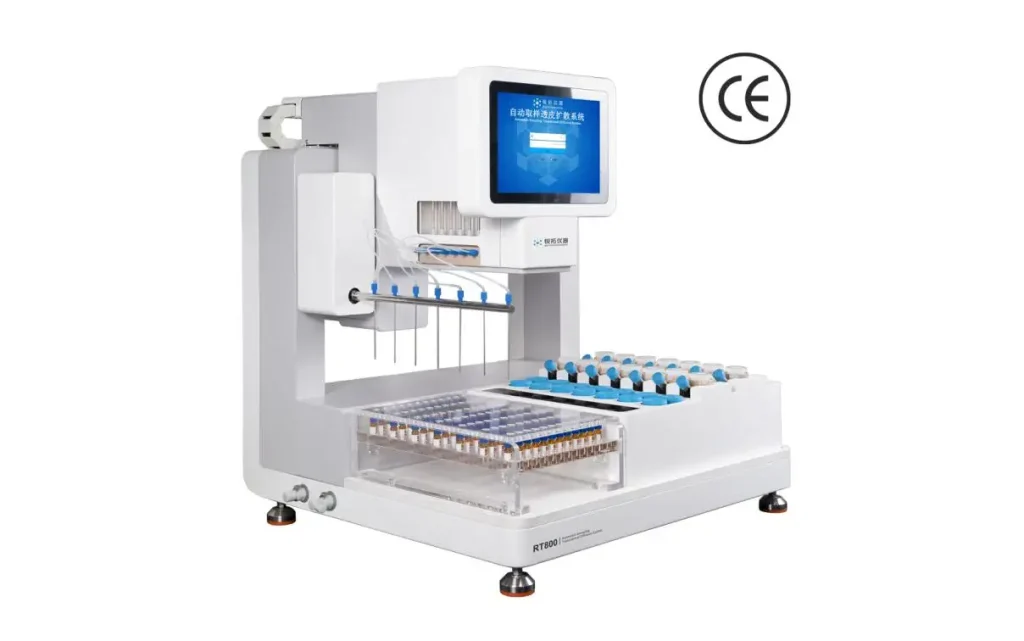
At this stage, the RT800 from RAYTOR offers a 6+1 diffusion cell design – six active cells plus one blank. This layout lets you exclude systematic interference (e.g., from receiver medium or skin artifacts) without sacrificing throughput. The open operating space simplifies cell loading and bubble inspection, while the marked filling point ensures consistent medium volume after manual bubble exhaust.
Key advantage for method development: Short pipelines dramatically reduce sample residue, so even viscous gels and ointments yield accurate concentration profiles.
Phase 2: Method Transfer and Scale-Up – Automation Enters
When moving from a benchtop study to a pre-validation campaign, two challenges arise: sampling time drift and operator variability. Manual sampling of 6–7 Franz cells can take 2–3 minutes – enough to distort early permeation data.
A GMP Compliant Transdermal Diffusion System must automate this process. The RT800 features:
• 7-channel synchronized automatic sampling – all cells in one group are sampled simultaneously, eliminating time-related bias.
• Two independent groups (7×2 configuration) – you can run two different methods or formulations side by side without cross-interference.
• Shorter pipeline design – minimizes dead volume and carryover, a critical factor for IVRT of semi-solids.
In practice, this means you can validate a cream's release rate on Monday while testing a patch's permeation on Wednesday – using the same GMP-qualified platform.
Phase 3: GMP-Compliant Production QC – Data Integrity and Audit Trails
Once your product enters commercial batches, every test becomes a regulatory record. USP <1724> and global GMP guidelines explicitly require:
• Audit trail functionality – who performed which action, when, and why
• User access control – separate roles for operators, method developers, and administrators
• Long-term data storage – unalterable, time-stamped records
The RT800 is built with these requirements in mind:
• Complete audit tracking function with SQL database – no hidden deletion or backdating.
• Operating system stores ≥200 test methods and ≥100 user accounts – suitable for multi-product QC labs.
• Temperature error ≤±0.5℃ and speed error <±10% – ensures run-to-run compliance with pharmacopoeia limits.
Moreover, the dry heating method (vs. water bath) eliminates microbial contamination risks, simplifying cleaning validation – a major headache for GMP inspectors.
Horizontal & Vertical Comparisons: Why RT800 Stands Out
1. Horizontal Comparison (vs. Conventional Automated Systems)
| Feature | Traditional Automated System | RAYTOR RT800 (GMP Compliant) |
| Pipeline length | Long → high residue | Shorter design → minimal residue |
| Sampling synchronization | Sequential per channel | 7-channel simultaneous per group |
| Compliance cells | Fixed style | USP <1724> 5ff-type + quick removal for bubble check |
| Heating | Water bath (biofilm risk) | Dry heating (cleaner validation) |
| Audit trail | Basic or optional | Full SQL database + 100+ accounts |
2. Vertical Comparison (Manual → Semi-Auto → GMP Auto)
• Manual Franz cells – high operator dependence, no audit trail, unsuitable for GMP.
• Semi-automatic samplers – reduced errors but still lack full 21 CFR Part 11 compliance.
• RT800 – true GMP-ready system with synchronized sampling, short pipelines, and exhaustive electronic records.
RAYTOR's Design and Technical Advantages – The RT800 Difference
At the heart of this lifecycle approach is RAYTOR, a manufacturer dedicated to bridging R&D flexibility with GMP discipline. The RT800 Automated Transdermal Diffusion System incorporates:
• Regulatory alignment – complies with EP 9.0 <2.9.4> and USP <1724> (both IVRT and IVPT).
• Operator-centric design – manual bubble exhaust with filling point marks ensures no residual air; easy cell removal for inspection.
• Scalable automation – up to 24 sampling times, sampling volume 0.2–1.5mL, maximum sampling duration 9999 minutes.
• Two independent groups – run 7 cells in group A and 7 in group B simultaneously – ideal for method development vs. QC side-by-side.
• Data integrity by default – meets audit trail requirements for FDA/EU inspections.
Whether you are formulating a new cream, ointment, patch, or gel, the RT800 provides a seamless transition from early discovery to GMP-compliant batch release. By choosing a GMP Compliant Transdermal Diffusion System that grows with your product, you save validation time, reduce regulatory risk, and ensure that every permeation profile tells the truth.
Ready to upgrade your transdermal testing workflow?
Explore the RT800's product brochure and specifications – including the 7×2 diffusion cell positions, dry heating, and SQL audit trail – to see how RAYTOR makes GMP compliance an everyday reality.
FAQs
Q1: What does GMP compliant mean for a transdermal diffusion system?
A: It means the system meets regulatory requirements for data integrity, audit trails, user access control, and validated performance—essential for FDA/EMA inspections.
Q2: To which pharmacopoeias is the RT800 compliant?
A: The RT800 is compliant with both the IVRT and the IVPT sections of the transdermal and semisolids as provided in the USP <1724> and EP 9.0 General Chapter 2.9.4.
Q3: Why is synchronized automatic sampling important?
A: This ensures that there is no time lag in the sampling process and that all the diffusion cells are sampled at the same time which is needed to accurately calculate flux.
Q4: In what other ways does a short pipeline design assist in fulfilling GMP?
A: This design reduces sample carryover and residue leading to easier cleaning validation with no carryover to the subsequent run thus avoiding cross-contamination.
Q5: What is the 6 + 1 diffusion cell arrangement?
A: The arrangement has 6 test cells and 1 blank cell. It meets the requirements of USP <1724> and works to prevent the interference of test media and any cleaning residue.