






Transdermal Drug Delivery Research for Peptides and Large Molecules
2026-10-30


A peptide formulation releases its active ingredient readily through a synthetic membrane, yet almost no intact peptide appears in the receptor solution during skin permeation testing. Is the stratum corneum blocking transport, is the peptide degrading inside the skin, or is the analytical method failing to recover what crossed?

These possibilities cannot be resolved by increasing the dose or extending the sampling period. Each requires a different experiment.
For laboratories conducting Transdermal Drug Delivery Research, the first objective is to distinguish formulation release, skin transport, tissue retention, and molecular degradation before selecting a delivery technology or diffusion-testing system.
Why Molecular Size Alone Does Not Explain Poor Skin Permeation
Peptide permeability depends on more than molecular weight. Hydrophilicity, hydrogen-bonding capacity, ionization, molecular conformation, and susceptibility to proteolysis all influence transport.
The stratum corneum presents a particularly restrictive pathway. Its extracellular lipid layers favor partitioning of certain small molecules, while hydrated, highly polar peptides generally enter these structures poorly.
Increasing peptide lipophilicity through chemical modification may improve skin partitioning, but this creates another potential limitation: the modified molecule may have insufficient aqueous solubility to leave the lipid-rich region.
Consider the following three cases:
• Low membrane partitioning. In this case, the peptide stays mainly in the donor formulation.
• High tissue retention. In this case, the peptide is taken up by the skin but is not retrieved by the receptors.
• Chemical or enzymatic degradation. The peptide may be degraded during transport or during sampling.
Permeation of the peptide through skin may be enzymatically degraded. This means that in the presence of low receptor concentrations, transport may be underestimated by analytical methods that measure the parent compound.
Which Delivery Strategy Is Worth Testing?
Passive diffusion remains useful as a baseline, but many therapeutic peptides require an alternative route across the barrier.
| Delivery approach | Transport mechanism | Critical experimental variable | Main limitation |
| Passive diffusion | Concentration-driven molecular movement | Peptide partitioning and thermodynamic activity | Poor transport of large, polar molecules |
| Chemical enhancers | Temporary modification of barrier properties | Enhancer concentration and skin compatibility | Irritation risk and formulation instability |
| Microneedles | Formation of microscopic transport channels | Insertion depth, force and channel distribution | Inconsistent penetration and channel closure |
| Iontophoresis | Electric-field-driven transport and electroosmosis | Current density, peptide charge and pH | Electrical exposure and variable transport efficiency |
Microneedles can bypass the stratum corneum, but a higher measured flux is not sufficient evidence of a reproducible delivery process.
Needle insertion needs to be described separately. While damage that extends beyond the intended treatment area can result in results that are artificially high, incomplete penetration can decrease transport.
For iontophoresis, receptor sampling alone cannot explain differences between formulations. Electrical conditions, competing ions and peptide charge must also be controlled.
The experimental control must reproduce the enhancement mechanism, not merely the drug concentration.
IVRT and IVPT Answer Different Development Questions
A Franz diffusion cell can support both in vitro release testing (IVRT) and in vitro permeation testing (IVPT), but the membrane and experimental endpoint determine what the results mean.
In IVRT, an appropriately selected synthetic membrane allows researchers to investigate formulation release while minimizing membrane resistance. A poorly selected membrane may instead introduce adsorption or diffusion limitations that obscure formulation differences.
IVPT introduces a biological barrier. Skin source, anatomical location, preparation, thickness and integrity can all influence the measured transport profile.
For peptide formulations, the correct procedure is as follows:
• Determine release from formulation. Estimate the peptide's ability to leave its carrier under controlled receptor conditions.
• Describe the permeation of intact skin. Use validated analytical methods and skin of known integrity to evaluate the basal skin transport.
• Evaluate improved delivery. Conduct a paired test (to control for donor site variations, if possible).
• Assess the retention of tissue. Determine receptor side recovery by skin biopsy.
In particular, skin integrity testing deserves attention in microneedle studies. The criteria for intact skin acceptance cannot be applied post-treatment after intentional microporation. Pretreatment skin integrity and barrier disruption serve different purposes.
Edge leakage around the diffusion-cell seal must also be excluded before interpreting unusually high permeation.
For systemic delivery research, receptor recovery provides an in vitro transport endpoint—not a direct prediction of clinical bioavailability.
Why Receptor Recovery Can Misrepresent Peptide Permeation
A Franz-cell experiment may operate with stable temperature and stirring while producing misleading peptide data.
One frequently overlooked source of error is peptide adsorption to glass, polymeric sampling materials or analytical containers. Another is degradation during prolonged contact with skin enzymes.
Before interpreting the permeation profile, laboratories should verify four conditions.
Receptor Medium and Sink Conditions
The receptor solution must maintain adequate solubility of the intact peptide throughout the experiment.
Although adding solubilizers or adjusting pH can enhance recovery, they can also change the charge, stability, or skin-barrier behaviour of peptides. These effects require independent assessment.
Analytical Stability and Mass Balance
A stability-indicating HPLC or LC-MS/MS method should distinguish intact peptide from relevant degradation products.
Check recovery from the receptor medium, tissue extracts and sample-contact surfaces. Where protease inhibitors are considered, demonstrate that they do not introduce unacceptable changes in the transport experiment.
Sampling and Quantification
For low-permeability peptides, the receptor concentration may approach the assay's lower limit of quantification.
Increasing receptor volume can assist solubility management but also dilute the analyte. Reducing that volume improves concentration sensitivity only if adequate mixing and sink conditions remain achievable.
Flux Calculation
When receptor aliquots are withdrawn and replaced, cumulative permeation calculations must include previously removed analyte.
Flux should be estimated only from a justified linear region of the cumulative permeation curve. An undetectable concentration does not establish zero permeation.
What Should Laboratories Verify Before Purchasing a Franz Cell System?
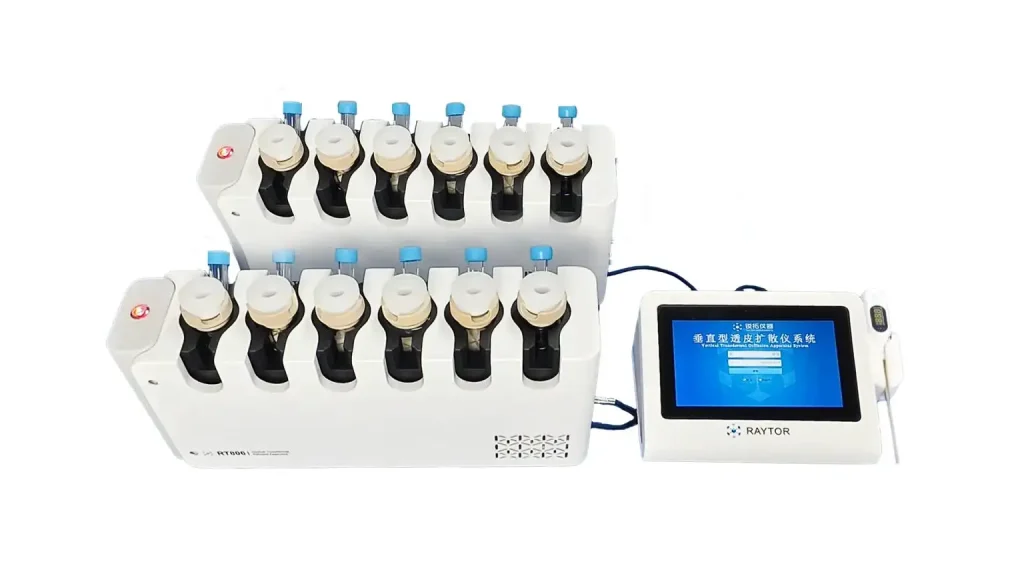
Raytor's RT806 Vertical Franz Diffusion Cell Tester is designed for laboratory IVRT and IVPT applications involving formulations such as creams, gels, ointments and patches.
The Raytor RT806 features six diffusion cells per group and supports manual sampling. According to Raytor's published product specifications, the system offers a temperature range from room temperature to 55°C, a stated temperature deviation of ±0.5°C, and an adjustable stirring speed of 200–900 rpm. Its modular design supports single- or multiple-group configurations, while the filling-point design is intended to help reduce trapped air bubbles during medium filling.
These specifications are just a starting point for peptide experiments. Procurement teams must also verify the following:
• Cell geometry: Compatibility of the skin prep with the diffusion area, receptor volume and seal arrangement.
• Sampling Feasibility: At the proposed sampling interval, is it feasible to remove the aliquot and replace it with a new sample?
• Thermal Verification: What is the actual temperature of the receptor-medium?
• Method qualification: Can the method preserve skin integrity? What is the sensitivity and reproducibility of the method?
For laboratories evaluating peptide formulations, Raytor can provide RT806 product information to support assessment of diffusion-cell configuration, sampling requirements and method compatibility before purchase.
FAQs
Q1. What equipment does Raytor offer for transdermal drug delivery research?
Raytor offers the RT806 Vertical Franz Diffusion Cell Tester for laboratory IVRT and IVPT studies. It supports controlled heating, stirring, and manual receptor sampling.
Q2. Can Raytor RT806 be used for peptide permeation testing?
The RT806 provides a Franz-cell platform for skin permeation studies. Peptide-specific suitability requires verification of membrane compatibility, analytical sensitivity, molecular stability, and recovery.
Q3. Does Raytor RT806 support both IVRT and IVPT?
Yes. The RT806 supports in vitro release and permeation testing. IVRT typically uses a suitable synthetic membrane, while IVPT uses biological skin to evaluate transport.
Q4. How many diffusion cells does the Raytor RT806 support?
The RT806 accommodates six diffusion cells per group. Raytor also offers configurations with one or more diffusion-cell groups.
Q5. What temperature range does the Raytor RT806 provide?
The RT806 operates from room temperature to 55°C, with a specified temperature error of ±0.5°C. Actual receptor-medium temperature should be verified under test conditions.