





Tablet Dissolution Tester USP 1 2: Basket vs. Paddle Methods
2026-10-28


A tablet can produce a smooth dissolution profile in a rotating basket but show delayed or irregular release under a paddle. The difference may have little to do with drug content or compression force. More often, it reflects how the dosage form behaves under two distinct hydrodynamic conditions.
Selecting a Tablet Dissolution Tester USP 1 2 therefore involves more than confirming compliance with USP <711>. Laboratories must determine whether basket containment or paddle-generated circulation provides a reproducible, discriminatory dissolution environment without introducing apparatus-related artifacts.
The authorized method is the most important for established products. The wetting, disintegration, and particle dispersion behavior of the tablet should direct the choice of apparatus during method development.
Basket vs. Paddle: Where Do the Hydrodynamic Differences Matter?
USP Apparatus 1 and 2 share similar vessel and temperature-control arrangements. Their principal difference is how the stirring element moves dissolution medium around the dosage form.
| Technical Factor | USP 1: Basket | USP 2: Paddle |
| Dosage-form position | Confined inside rotating mesh | Generally rests on vessel bottom |
| Typical agitation range | 50–100 rpm | 50–75 rpm for tablets |
| Liquid movement | Exchange through rotating mesh | Circulation generated by paddle |
| Main advantage | Restricts floating and uncontrolled movement | Allows direct exposure and particle dispersion |
| Hydrodynamic limitation | Mesh restricts exchange when obstructed | Low-flow region may form beneath paddle |
| Common interference | Mesh clogging, retained fragments | Coning, floating, uneven particle distribution |
These speeds are commonly recommended operating ranges, not interchangeable method settings. Actual conditions depend on the formulation, applicable monograph, and validated procedure.
USP 1: When Does Basket Containment Become a Limit?
The basket method retains the tablets and/or capsules, and permits free movement of the dissolution medium. Rotating meshes retain larger fragments, and allow medium to be in contact with the tablets.
This method is good for floating tablets or capsules, but the basket method itself poses an additional limitation.
When hydrophilic polymers swell or insoluble excipients accumulate, the material may cover the basket mesh. Liquid medium exchange becomes restricted. This can produce an artificially slow and/or irregular release profile.
Basket-related variability should be investigated by engineers including:
• Mesh: Residues, damaged wires or deformed openings may create obstructions that prevent free exchange of the medium.
• Fragment retention: It may be that the swollen material is retained and does not disperse.
• Basket wobble: Eccentric rotation changes local fluid movements.
• Residue interaction: Formulation residues may interact with the basket mesh and affect subsequent testing.
Standard baskets typically utilize 40-mesh construction. Other configurations may be used with justified methodology.
USP 2: Why Does Coning Distort Tablet Dissolution?
During the paddle method, tablets eventually settle at the bottom of the vessel. Fluid circulation then develops around it as the paddle rotates.
The velocity field is not uniform.
At lower stirring speeds, particles may disintegrate and deposit as a cone-shaped structure directly beneath the paddle. The cone may block or restrict fluid movement of the medium which results in inadequate mixing and contact.
Coning may distort and slow the dissolution of the drug, especially if the drug has low solubility or forms a dense deposited particulate structure.
The cone may be dispersed by increasing the speed of the paddle; however, strong agitation may reduce the method's sensitivity in differentiating formulations.
An improved approach would be to investigate behavior and profiles of the particles at justified speed conditions, rather than selecting the speed that gives the highest release.
Floating presents another problem. A validated sinker may keep the tablet submerged, although sinker geometry can alter local fluid circulation and must be included in method evaluation.
How Should Engineers Select USP 1 or USP 2?
The apparatus should be selected according to observed dosage-form behavior and the intended analytical purpose.
Circumstances warranting investigation for basket testing include:
• Particles of the dosage form exhibit erratic floatation and movement with respect to paddle agitation.
• Improved positional consistency can be attributed to containment.
• Neither swelling nor particle retention limits the exchange of the medium.
• Circumstances warranting investigation for paddle testing include:
• Direct observation is necessary for tablet disintegration and dispersion.
• Behavior of particles with respect to the basket mesh is altered.
The formulation generates a particulate form that is sufficiently dispersed without persistent coning.
Nor is either apparatus more inherently accurate.
For development of formulations, it is imperative to differentiate the two methods. It is important to identify dissolution responses with respect to meaningful variation in formulation and/or process. A method that produces rapid release but fails to differentiate important process differences is unsuitable for routine quality control.
Once a particular basket dissolution test is approved, justification is required to change to a paddle test.
What Must Be Verified Before Comparing Dissolution Results?
A practical verification sequence includes:
• Check mechanical geometry. Verify the centering of shafts, and ensure that there is no wobble or thread misalignment in the bearings and the baskets or paddles are of the correct dimensions. The clearance from the vessel bottom is usually 25 ± 2 mm.
• Measure operating conditions. Verify the rotation speed of the elements and check that the dissolution medium is at the required temperature (usually 37 ± 0.5 °C).
• Inspect the medium. Dissolved gases can produce bubbles on the surfaces of the stirring elements, which can interfere with the wetting of the tablets and the movement of the dissolution medium.
• Control sampling. Verify the sampling position and time, check that the filters are compatible with the dissolution medium and do correct samplinq volume calculations. Permanent sampling elements can cause local fluid flow disruptions.
• Qualify the assembly. Use the laboratory's approved qualification strategy, which includes mechanical calibration and, if applicable, performance verification tests as per the USP.
FDA guidance recognizes mechanical calibration, as an alternative approach to demonstrating apparatus suitability, in certain situations. The qualification method used must consider the sources of variability, for example, vessel dimension, dissolved gases and vibration.
Selection of Raytor Dissolution Equipment for USP 1 and 2
At Raytor, the design of the equipment is tailored to the laboratory's vessel-capacity requirements, method change frequency and sampling pattern.
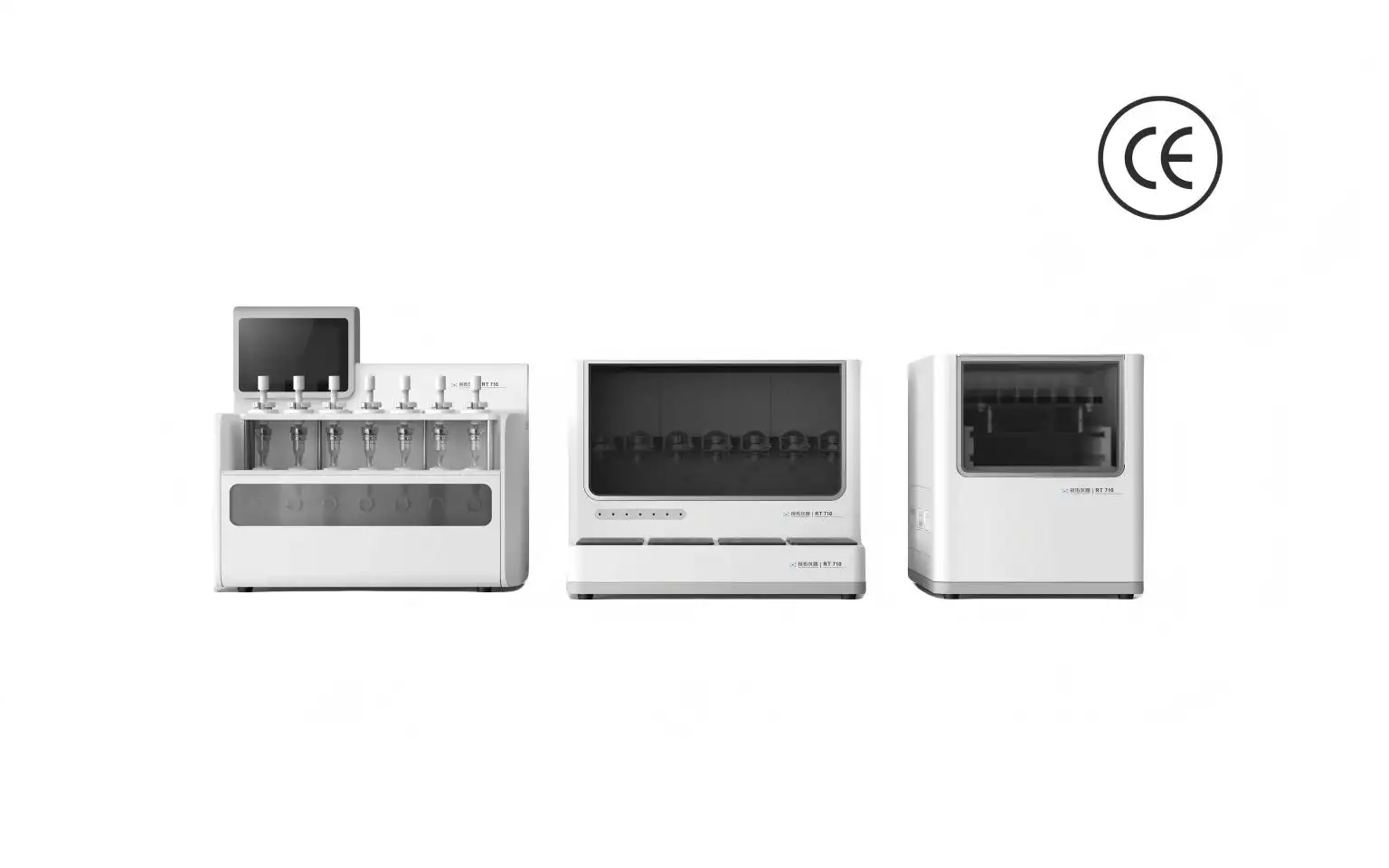
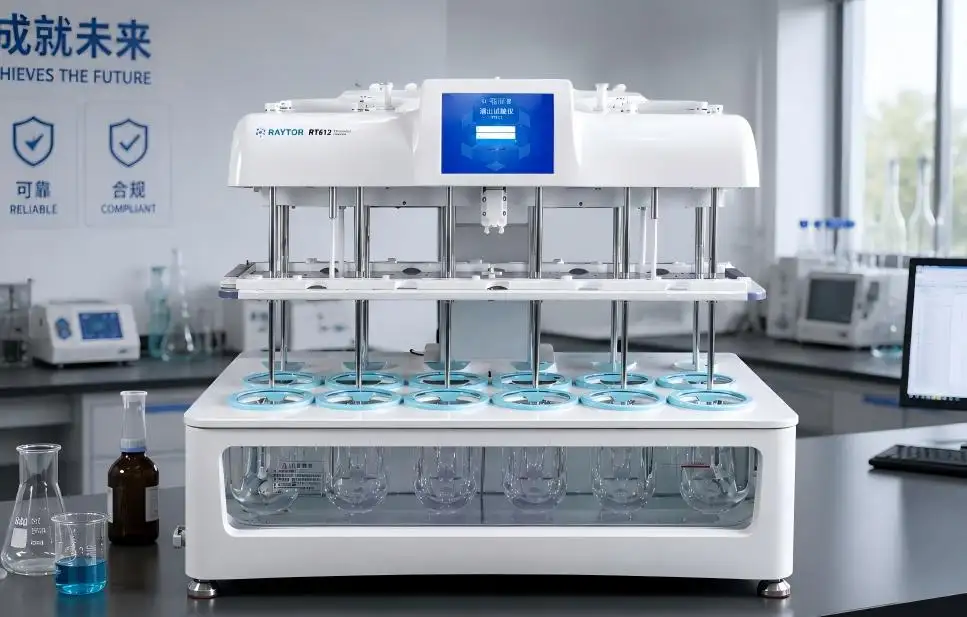
The Raytor dissolution equipment line includes:
• RT600: An eight position, manually sampled dissolution apparatus with automatic and synchronous dosing.
•RT612: A 12-position, interchangeable control, dual-speed systems.
•RT612-ST: An automated sampling and programmable sampling and sample collection with online filtration, dissolution system.
The RT600 and RT612 feature a coaxial paddle–basket design intended to facilitate switching between dissolution methods without manually readjusting the height of the stirring components. Laboratories should verify the applicable mechanical parameters after configuration changes in accordance with their established qualification procedures.
For automated sampling additional qualification should assess filter adsorption, tubing carryover, sampling and withdrawal time, and sample recovery. These should be determined by testing using the drug with the desired formulation and the dissolution medium.
Before purchase, laboratories should request configuration-specific documentation covering apparatus dimensions, mechanical qualification, sampling accessories, software functions, and available IQ/OQ support.
Raytor provides USP 1 and USP 2 dissolution testing equipment for pharmaceutical development and quality-control laboratories. Contact our technical team to compare apparatus configurations against your established dissolution methods and qualification requirements.
FAQs
Q1. What is the difference between USP 1 and USP 2 dissolution methods?
USP 1 uses a rotating basket to contain the dosage form, while USP 2 uses a rotating paddle to circulate dissolution medium. The choice affects hydrodynamics, tablet movement, and drug-release profiles.
Q2. Does Raytor offer dissolution testers for both USP 1 and USP 2?
Yes. Raytor's RT600 and RT612 dissolution systems support basket and paddle configurations for pharmaceutical dissolution testing under applicable USP <711> methods.
Q3. Which Raytor dissolution tester is suitable for routine pharmaceutical QC?
The RT600 provides eight dissolution positions with manual sampling. The RT612 offers twelve positions and optional dual-speed control, making it suitable for laboratories requiring additional testing capacity.
Q4. Can Raytor dissolution testers switch between basket and paddle methods?
Yes. The RT600 and RT612 feature a coaxial paddle-basket design that allows method switching without routine shaft-height readjustment. Mechanical alignment and apparatus dimensions must still be verified.
Q5. Which dissolution method is better for floating tablets?
USP 1 may help contain floating tablets inside the basket. However, basket mesh obstruction must be evaluated. Method selection should follow the applicable monograph or a justified development study.