






What Are the Different Types of USP Dissolution Apparatus?
2026-08-01


There are seven commonly recognized USP dissolution apparatus types: Apparatus 1 (basket), Apparatus 2 (paddle), Apparatus 3 (reciprocating cylinder), Apparatus 4 (flow-through cell), Apparatus 5 (paddle over disk), Apparatus 6 (rotating cylinder), and Apparatus 7 (reciprocating holder). The appropriate apparatus depends on the product monograph, dosage form, release characteristics, and validated test method.
USP General Chapter <711> standardizes four dissolution apparatus: basket, paddle, reciprocating cylinder, and flow-through cell. Drug-release apparatus used for transdermal systems and certain other dosage forms are addressed under USP <724>. The individual monograph and a scientifically justified method should always determine the final apparatus and operating conditions.
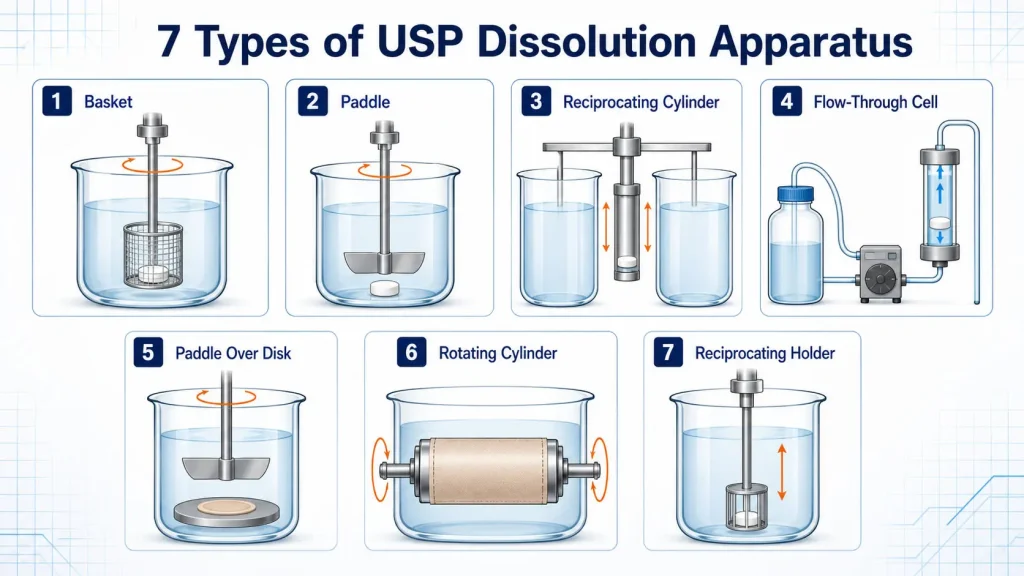
The Seven USP Dissolution Apparatus at a Glance
- USP Apparatus 1 — Basket
- USP Apparatus 2 — Paddle
- USP Apparatus 3 — Reciprocating Cylinder
- USP Apparatus 4 — Flow-Through Cell
- USP Apparatus 5 — Paddle Over Disk
- USP Apparatus 6 — Rotating Cylinder
- USP Apparatus 7 — Reciprocating Holder
| USP apparatus | Common name | Basic motion | Common applications | Related USP chapter |
|---|---|---|---|---|
| 1 | Basket | A dosage form is contained in a rotating wire basket | Tablets, capsules, and dosage forms that tend to float | <711> |
| 2 | Paddle | A rotating paddle agitates the medium above the dosage form | Immediate- and modified-release tablets, capsules, and some suspensions | <711> |
| 3 | Reciprocating cylinder | Cylinders move vertically through one or more media | Extended-release products, beads, pellets, and methods requiring media changes | <711> |
| 4 | Flow-through cell | Medium is pumped through a vertically mounted cell | Poorly soluble drugs, modified-release products, and complex dosage forms | <711> |
| 5 | Paddle over disk | A transdermal system is held beneath a rotating paddle | Transdermal drug-delivery systems | <724> |
| 6 | Rotating cylinder | A transdermal system is attached to a rotating cylinder | Transdermal systems and other specified drug-release tests | <724> |
| 7 | Reciprocating holder | A sample holder moves vertically through the medium | Transdermal and other dosage forms specified by a monograph | <724> |
This table is a general selection aid, not a substitute for an individual USP monograph, regulatory filing, or validated laboratory procedure.
Why Are Different Dissolution Apparatus Needed?
Dissolution and drug-release methods are intended to measure how quickly and to what extent an active substance is released from a finished dosage form under controlled conditions. A single apparatus cannot reproduce suitable hydrodynamics and sample positioning for every tablet, capsule, patch, implant, suspension, or modified-release product.
The apparatus changes how the sample contacts the dissolution medium. It can also affect agitation, flow, media exchange, temperature uniformity, sampling, and the ability to maintain sink conditions. An unsuitable setup may produce excessive variability, poor discrimination between formulations, or results that do not reflect the intended product performance.
Selection should therefore begin with the applicable monograph. If no compendial method is available, the laboratory should evaluate the dosage form, solubility, release mechanism, tendency to float or adhere, required media changes, sampling strategy, and the ability of the method to distinguish meaningful formulation or process differences.
USP Apparatus 1: Basket Method
USP Apparatus 1 uses a cylindrical wire-mesh basket attached to a rotating shaft. The dosage form is placed inside the basket, which is immersed in dissolution medium contained in a vessel. Rotation produces controlled movement of the medium through and around the basket.
Common applications
The basket method is commonly considered for:
- Capsules and tablets
- Dosage forms that tend to float
- Products that require the sample to remain in a defined location
- Methods specifically identified as Apparatus 1 in a monograph
Holding the sample inside the basket can prevent it from floating on the surface or moving unpredictably around the vessel. This can be useful for some capsules and buoyant dosage forms.
Advantages
- Maintains the dosage form in a defined test position
- Widely established in pharmaceutical quality-control laboratories
- Can reduce uncontrolled sample movement
- Supported by well-established mechanical qualification and performance verification practices
Limitations and method considerations
Basket mesh can become blocked by gelatin, excipients, or disintegrated material. Air trapped around the sample or in the mesh can also affect wetting. Basket condition, shaft alignment, wobble, vessel geometry, rotation speed, and temperature should be controlled.
Apparatus 1 should not automatically be selected for every capsule. The product monograph, formulation behavior, and discriminatory capability of the method remain decisive.
USP Apparatus 2: Paddle Method
USP Apparatus 2 uses a paddle attached to a rotating shaft. The dosage form is placed in the vessel beneath the paddle while the paddle provides controlled agitation of the dissolution medium.
The paddle method is one of the most widely used dissolution configurations. FDA resources identify Apparatus 1 and Apparatus 2 as the two apparatus most commonly used for immediate-release solid oral dosage forms.
Common applications
Apparatus 2 is commonly used or evaluated for:
- Immediate-release tablets
- Modified-release tablets
- Capsules
- Some suspensions when specified by the method
- Routine quality-control and formulation-development studies
Advantages
- Simple and widely understood configuration
- Easy visual observation of sample behavior
- Convenient manual or automated sampling
- Compatible with a broad range of oral solid dosage forms
- Available in manual, semiautomated, and fully automated dissolution systems
Limitations and method considerations
Some formulations form a mound of particles directly beneath the paddle, commonly described as coning. Floating capsules may remain at the medium surface unless an appropriate, validated sinker is used. Samples can also adhere to the vessel bottom.
Paddle height, centering, shaft verticality, vessel dimensions, wobble, vibration, deaeration, temperature, and sampling position can influence results. Increasing rotation speed simply to eliminate variability may reduce the method's ability to discriminate between formulations, so agitation conditions require scientific justification.
Laboratories comparing basket and paddle configurations can review Raytor's pharmaceutical dissolution solutions and the RT600 dissolution apparatus.
USP Apparatus 3: Reciprocating Cylinder
USP Apparatus 3 uses inner reciprocating cylinders that move vertically within outer vessels containing dissolution medium. The system can move samples through different vessels, which makes planned media changes possible during a test.
Common applications
The reciprocating cylinder is often evaluated for:
- Extended- and delayed-release dosage forms
- Beads and pellets
- Products that require sequential pH or media changes
- Methods intended to simulate movement through different gastrointestinal environments
- Monographs that specify Apparatus 3
Advantages
- Supports controlled media changes
- Useful for studying release across multiple pH conditions
- Can accommodate bead- and pellet-based formulations
- Provides programmable dipping or reciprocation conditions
Limitations and method considerations
Apparatus 3 introduces more moving parts and method variables than a basic basket or paddle system. Dip rate, stroke, screen mesh, media volume, drainage between vessels, temperature, and the timing of media changes require careful control.
The ability to change media is valuable, but it should reflect a justified method-development objective rather than being used solely to make a difficult formulation release more quickly.
USP Apparatus 4: Flow-Through Cell
USP Apparatus 4 consists of a medium reservoir, a pump, a vertically mounted flow-through cell, and a temperature-control system. The medium is pumped upward through the cell containing the dosage form. The system may operate in an open-loop configuration, where medium passes through the cell once, or a closed-loop configuration, where a defined volume is recirculated.
Common applications
Apparatus 4 is frequently considered for:
- Poorly soluble drug substances and drug products
- Modified- or extended-release formulations
- Products requiring continuous media flow
- Implants, microspheres, liposomes, powders, and other complex dosage forms
- Methods requiring controlled media changes
- In vitro–in vivo correlation and formulation-development studies, when scientifically justified
Open-loop versus closed-loop operation
In an open-loop system, fresh medium flows through the cell and the eluate is collected or directed to an analytical system. This configuration can help maintain sink conditions and can support programmed changes in medium.
In a closed-loop system, the medium is recirculated through the cell and a reservoir. The configuration uses a defined volume and can be appropriate when sample concentration or medium conservation is important.
The choice affects mass balance, sampling, medium volume, concentration calculations, filtration, and analytical integration. It should be defined in the method rather than treated as an interchangeable operating preference.
Advantages
- Provides controlled flow around the dosage form
- Supports open- and closed-loop configurations
- Offers flexibility for difficult or complex dosage forms
- Can facilitate media changes and automated sample collection
- May provide an alternative when conventional vessel hydrodynamics are unsuitable
Limitations and method considerations
Flow rate, pulsation, cell dimensions, filters, glass-bead packing, temperature, tubing, sample position, and pump performance can affect results. Filters may clog, poorly packed cells may introduce variability, and adsorption in tubing or collection pathways should be evaluated.
USP published a dedicated guideline in 2026 describing best practices for mechanical performance qualification of Apparatus 4, including environment, benchtop levelness, assembly, alignment, flow delivery, temperature control, maintenance, and operational checks.
For additional technical information, see Raytor's guide to flow-through cell dissolution systems and the RT710 USP Apparatus 4 system.
USP Apparatus 5: Paddle Over Disk
USP Apparatus 5 is commonly called the paddle-over-disk method. A transdermal system is mounted on a disk assembly at the bottom of a standard dissolution vessel, and a paddle rotates above the exposed surface.
Common applications
- Transdermal drug-delivery systems
- Drug-release testing for patches where specified by the monograph or validated method
- Comparative release testing during product development or quality control
Advantages
- Uses a familiar paddle-and-vessel platform
- Holds the transdermal system in a defined orientation
- Exposes a controlled surface to the dissolution medium
- Can be supported by multipurpose dissolution systems with appropriate accessories
Limitations and method considerations
The patch must be mounted consistently without trapping air or unintentionally changing the exposed area. Adhesive behavior, backing materials, disk dimensions, sample positioning, medium temperature, paddle height, and agitation can influence release.
FDA assessment documents provide examples of approved transdermal products evaluated using USP Apparatus 5, but conditions are product-specific and should not be copied to another formulation without justification.
USP Apparatus 6: Rotating Cylinder
USP Apparatus 6 replaces the basket or paddle with a rotating cylinder. A transdermal system is attached to the outer surface of the cylinder, which rotates in the dissolution medium.
Common applications
- Transdermal patches
- Drug-release testing where a rotating-cylinder method is specified
- Products for which controlled exposure around a cylindrical sample holder is appropriate
Advantages
- Holds the transdermal system in a defined position
- Provides controlled movement of medium across the sample surface
- Avoids a separate disk assembly at the vessel bottom
Limitations and method considerations
Consistent attachment to the cylinder is essential. Wrinkles, bubbles, incomplete adhesion, changes in exposed surface area, or differences in cylinder positioning may alter hydrodynamics and release. The method should define mounting procedures clearly enough for repeatable execution across analysts and laboratories.
USP Apparatus 7: Reciprocating Holder
USP Apparatus 7 uses a sample holder that reciprocates vertically in a vessel containing release medium. Different holder designs may be used for dosage forms specified in an individual monograph or validated method.
Common applications
- Transdermal drug-delivery systems
- Other nontraditional or modified-release dosage forms where specified
- Methods that benefit from reciprocating motion or sequential media exposure
Advantages
- Flexible holder configurations
- Controlled reciprocating motion
- Potential suitability for dosage forms that are difficult to position in basket, paddle, or rotating-cylinder systems
- Can support methods involving multiple vessels or media stages
Limitations and method considerations
Holder design, sample attachment, dip rate, stroke, media volume, drainage, and temperature can affect results. Because configurations may vary, laboratories should provide detailed procedures for sample mounting and holder dimensions and verify transferability between systems.
USP Dissolution Apparatus 1–7 Comparison
| Apparatus | Best-known strength | Main method risk | Typical selection trigger |
|---|---|---|---|
| 1: Basket | Controls floating or mobile samples | Mesh clogging and trapped air | Capsule or tablet requires containment |
| 2: Paddle | Simple, versatile, and widely used | Coning, floating, or bottom adhesion | Common oral solid dosage-form method |
| 3: Reciprocating cylinder | Sequential media changes | Drainage, mesh, stroke, and transfer variability | Modified release across multiple pH conditions |
| 4: Flow-through cell | Controlled flow and flexible media handling | Pump, filter, cell-packing, and tubing effects | Poor solubility or complex dosage form |
| 5: Paddle over disk | Defined patch exposure in a paddle vessel | Air entrapment and disk mounting | Transdermal method specifies paddle over disk |
| 6: Rotating cylinder | Defined cylindrical mounting of a patch | Attachment and exposed-area variability | Transdermal method specifies rotating cylinder |
| 7: Reciprocating holder | Flexible sample holders and reciprocation | Holder-specific method transfer | Monograph specifies a reciprocating holder |
How to Select the Right USP Dissolution Apparatus
1. Start with the individual monograph
If an official monograph specifies an apparatus and test conditions, that method is the primary starting point. A laboratory should not replace it based only on general preference or equipment availability.
2. Identify the dosage form and release mechanism
Immediate-release tablets, floating capsules, multiparticulates, delayed-release products, transdermal patches, implants, and suspensions behave differently. The apparatus must position the sample consistently while producing appropriate contact with the medium.
3. Observe physical behavior during preliminary studies
Determine whether the product floats, sinks, sticks, swells, forms a cone, blocks a mesh or filter, or releases particles that interfere with sampling. These observations often explain why an apparently simple apparatus produces variable results.
4. Evaluate solubility and sink conditions
Poorly soluble products may require different media, surfactants, larger volumes, media replacement, or continuous-flow approaches. Apparatus 4 can be considered when controlled flow or media handling provides a scientifically useful advantage.
5. Determine whether media changes are necessary
Products intended to release across different gastrointestinal environments may require sequential pH stages. Apparatus 3 and some Apparatus 4 configurations can make controlled media changes easier to execute.
6. Define sampling and analytical requirements
Consider sampling volume, replacement medium, filtration, adsorption, automation, collection intervals, UV or HPLC integration, and mass-balance calculations. The sampling pathway is part of the method and must not change the sample unintentionally.
7. Demonstrate discriminatory ability
A useful dissolution method should detect meaningful changes in formulation or manufacturing variables when appropriate. Conditions should not be so aggressive that all formulations produce the same rapid release profile.
8. Qualify the apparatus and validate or verify the method
Confirm mechanical parameters, temperature, motion or flow, sampling accuracy, and data integrity. Validate a newly developed procedure or verify a compendial procedure as required by the laboratory's quality system and applicable regulations.
Apparatus Qualification and Performance Verification
Apparatus selection is only one part of reliable dissolution testing. Laboratories should also control factors such as:
- Vessel dimensions and condition
- Shaft and basket or paddle verticality
- Centering and wobble
- Rotation, dip, or flow rate
- Temperature uniformity
- Vibration and environmental conditions
- Sampling position and timing
- Filter suitability and adsorption
- Software permissions, audit trails, and data retention
USP provides Performance Verification Test resources for Apparatus 1 and 2. Mechanical calibration verifies measurable fixed and operating parameters, while the PVT uses a USP reference standard to provide additional evidence of apparatus suitability. Apparatus 4 has its own mechanical performance qualification considerations, particularly for flow delivery and cell configuration.
Equipment functions may support a laboratory's data-integrity and 21 CFR Part 11 controls, but an instrument should not be described as making the laboratory automatically compliant. Compliance also depends on validated procedures, access control, training, review, record retention, and the laboratory's quality system.
Frequently Asked Questions
How many types of USP dissolution apparatus are there?
There are seven commonly recognized USP apparatus used for dissolution or drug-release testing: basket, paddle, reciprocating cylinder, flow-through cell, paddle over disk, rotating cylinder, and reciprocating holder. USP <711> standardizes Apparatus 1–4, while USP <724> addresses drug-release testing for transdermal systems and other specified dosage forms.
What is the most commonly used USP dissolution apparatus?
Apparatus 1 and 2 are the most commonly used configurations for immediate-release solid oral dosage forms. Apparatus 2, the paddle method, is especially common, but the correct choice depends on the product monograph and validated procedure.
What is the difference between USP Apparatus 1 and 2?
Apparatus 1 contains the sample inside a rotating wire basket. Apparatus 2 places the sample in the vessel while a paddle rotates above it. The basket can help control floating samples, while the paddle offers a simple and widely used open-vessel configuration.
Which USP apparatus is suitable for poorly soluble drugs?
USP Apparatus 4 is frequently considered for poorly soluble drugs because it provides controlled flow and flexible open- or closed-loop operation. It is not automatically the correct choice for every poorly soluble formulation; the method still requires scientific justification and validation or verification.
Which USP apparatus is used for transdermal patches?
USP Apparatus 5, 6, or 7 may be used for transdermal drug-release testing, depending on the individual monograph and validated method. Apparatus 5 uses a paddle over disk, Apparatus 6 uses a rotating cylinder, and Apparatus 7 uses a reciprocating holder.
What is the difference between open-loop and closed-loop Apparatus 4?
In an open-loop system, fresh medium passes through the flow cell and is collected or sent for analysis. In a closed-loop system, a defined volume of medium recirculates between the cell and reservoir. The configurations require different sampling, mass-balance, and concentration calculations.
Can one dissolution tester support multiple USP apparatus types?
Some modular dissolution systems can support more than one USP configuration by changing shafts, baskets, paddles, cylinders, holders, or accessories. Each installed configuration must still meet the applicable dimensional, mechanical, temperature, and method requirements.
How should a laboratory choose a dissolution tester?
Evaluate the applicable USP methods, dosage forms, position count, automation level, sampling accuracy, data-integrity functions, qualification documentation, service capability, and compatibility with UV or HPLC analysis. Selection should support the laboratory's validated methods rather than forcing methods to fit the available instrument.
Conclusion
The seven USP dissolution apparatus provide different ways to control sample positioning, agitation, flow, and media exposure. Apparatus 1 and 2 are widely used for conventional oral solid dosage forms; Apparatus 3 supports reciprocation and media changes; Apparatus 4 provides controlled flow for difficult or complex products; and Apparatus 5–7 support transdermal and other drug-release methods.
The best apparatus is not simply the newest or most automated option. It is the apparatus specified by the applicable monograph or supported by a justified, discriminatory, and validated method.
If your laboratory is evaluating a new formulation, upgrading an existing dissolution workflow, or comparing automation options, Raytor can review the dosage form, applicable monograph, sampling plan, analytical interface, and data-integrity requirements before recommending a system configuration.