

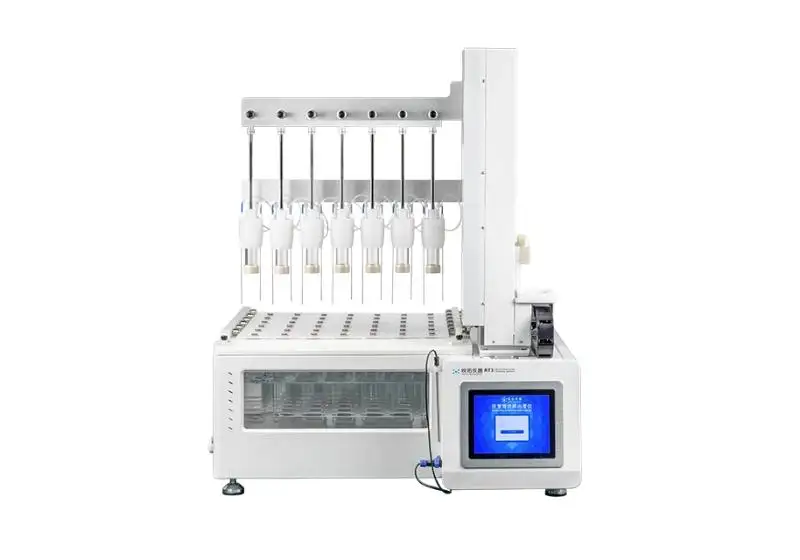
USP Compliant Dissolution Apparatus for Modified-Release Testing
2026-09-23


A USP Compliant Dissolution Apparatus establishes controlled test conditions. Developing a useful modified-release method requires further evidence: the procedure must distinguish relevant formulation changes, withstand normal laboratory variation, and remain reproducible during transfer.
At Raytor, we approach equipment selection through the formulation's release mechanism, medium requirements, and sampling demands. Apparatus suitability and method suitability require separate evaluation.
1. Identify the Release Attributes the Method Must Detect
Modified-release formulations include extended-release and delayed-release products. Their development endpoints differ: extended-release testing characterizes release over time, while delayed-release testing evaluates initial protection and subsequent release.
| Formulation | Critical Variables | Required Method Sensitivity |
| Hydrophilic matrix tablets | Polymer grade, concentration, compression, gel formation | Changes in diffusion and erosion |
| Coated pellets | Coating thickness, permeability, curing | Changes in release rate and coating integrity |
| Enteric-coated products | Coating integrity and dissolution threshold | Premature acid-stage release and delayed buffer-stage release |
| Osmotic systems | Membrane permeability, delivery orifice, medium osmolality | Changes in water uptake and delivery rate |
Define these risks before selecting a USP Compliant Dissolution Apparatus. Development batches with justified variations provide stronger evidence of discrimination than repeated testing of one nominal batch.
2. Compare Apparatus by Release Behavior
Begin with the applicable monograph or established product method. Where development choices remain, compare hydrodynamics, dosage-form behavior, medium handling, and transfer practicality.
| Apparatus | Suitable Development Scenarios | Variables to Control | Potential Artifacts |
| USP 1: Basket | Suitable capsules and multiparticulates | Basket geometry, mesh, rotation | Mesh blockage and particle retention |
| USP 2: Paddle | Suitable matrix tablets and oral solids | Speed, alignment, paddle height, sinker design | Coning, floating, altered erosion |
| USP 3: Reciprocating Cylinder | Sequential medium exposure | Dip rate, screens, transfer timing | Carryover and screen retention |
| USP 4: Flow-Through Cell | Suitable poorly soluble and modified-release products | Flow rate, cell packing, filtration | Channeling, backpressure, incomplete recovery |
The best USP Compliant Dissolution Apparatus configuration preserves sensitivity to product differences without introducing excessive apparatus-related variability. Increasing agitation merely to obtain faster release can weaken that sensitivity.
3. Establish Media and Hydrodynamic Conditions
Solubility, Sink Conditions, and Stability
Measure equilibrium solubility and drug stability in candidate media. A conventional sink-condition assessment is:
Sink ratio = CₛV/M
Cs refers to the saturation solubility of the drug, V is the volume of the medium, and M is the mass of the drug. A sink condition occurs when the ratio Cs/V/M is equal to or greater than 3. This ratio should be recalculated when the pH, surfactant concentration, or volume is changed.
Development should also consider the following:
• Buffer Capacity: Will the formulation be able to change the medium pH?
• Surfactant Concentration: Will an increase in surfactant concentration make a difference in the coating or matrix?
• Drug Stability: Could the drug degrade and give the appearance of a release plateau?
• Deaeration: Are bubbles affecting wettability, floating and flow of the medium?
Medium Transitions and Flow Configuration
Justification for enteric coating should include explanation for the acid and buffer-staged conditions, the duration of acid transfer, residual acid, final pH, and the volume of medium used.
With Apparatus 4, continuous introduction of fresh medium in an open-loop system requires a different consideration from a closed-loop system where the volume is finite and recirculated. Drug accumulation, medium consumption, analyses, and system recovery play a role in the decision.
Temperature and Mechanical Conditions
Long tests require control of actual medium temperature, evaporation, and hydrodynamics. Bath temperature alone does not establish uniform sample conditions. Observe swelling, fragmentation, sedimentation, and changes in dosage-form position.
4. Design Sampling Around the Release Profile
A USP Compliant Dissolution Apparatus should support timepoints that answer specific questions:
• Early: Is there burst release or loss of delayed-release protection?
• Intermediate: Does the method resolve differences in release rate?
• Late: Is release approaching its expected extent?
Sampling calculations must match the configuration. For constant-volume vessel testing with equal-volume replacement:
Mₙ = CₙV + vΣCᵢ
Mₙ is cumulative released mass, Cₙ is current concentration, and the summation covers previous samples of volume v. Different calculations apply without replacement or during open-loop collection.
Validate filter adsorption, discard volume, line recovery, carryover, and sample stability. Automated sampling additionally requires an analysis of transit delay, dead volume, and the timing of actual collection.
5. Separate Qualification, Discrimination, and Validation
| Evidence Package | Purpose | Key Checks |
| Equipment qualification | Establish suitable apparatus operation | Applicable mechanical checks and performance verification |
| Discriminatory studies | Detect meaningful product changes | Polymer, coating, or process variations |
| Method validation | Demonstrate reliable measurement | Specificity, accuracy, precision, range, stability, robustness |
| Method transfer | Reproduce performance at the receiving laboratory | Components, settings, sampling, calculations, analyst procedures |
Robustness means tolerating small procedural variations. Discrimination means detecting relevant product differences.
For profile comparison, assess whether variability and sampling meet the conditions for the selected statistical approach before applying f₂. Similar curves alone do not establish bioequivalence. Predictive IVIVC requires separate development and evaluation under the FDA's extended-release guidance.
6. Raytor Engineering Features for Method Development
Our instruments and sampling designs provide solutions for the needs of the laboratory.
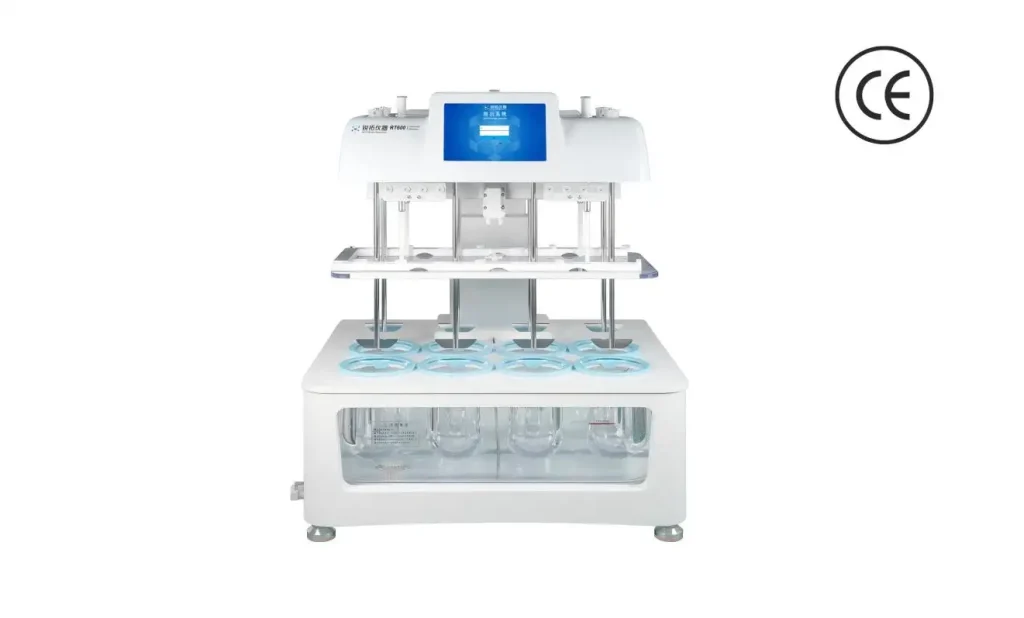
• RT600: Cover vessels to help minimize evaporative losses; provide for synchronous dosing to facilitate reproducible initiations.
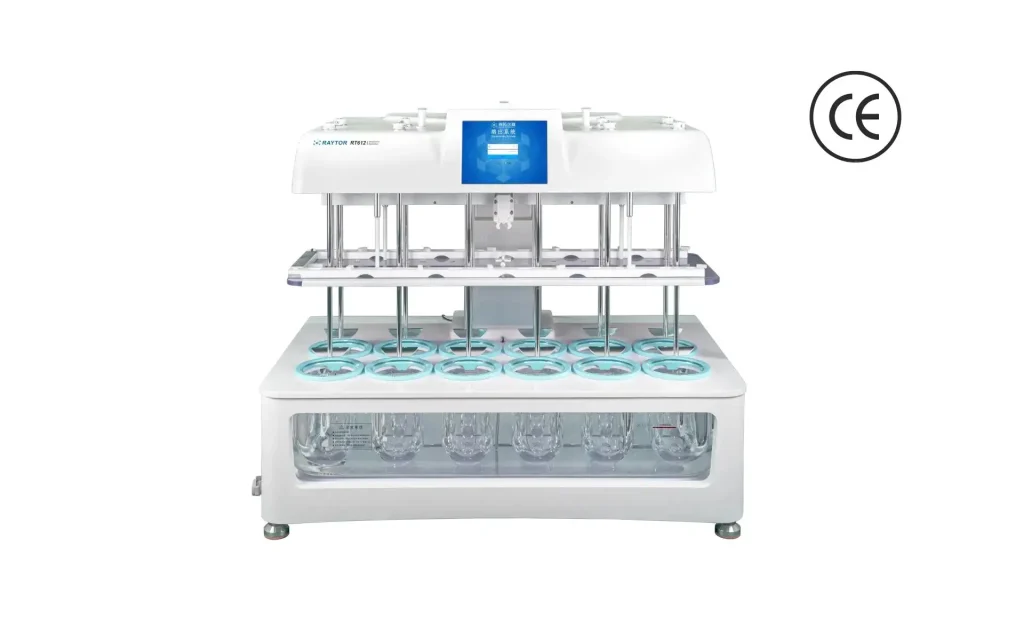
• RT612: Individual temperature monitoring allows for real time assessment of vessel conditions.
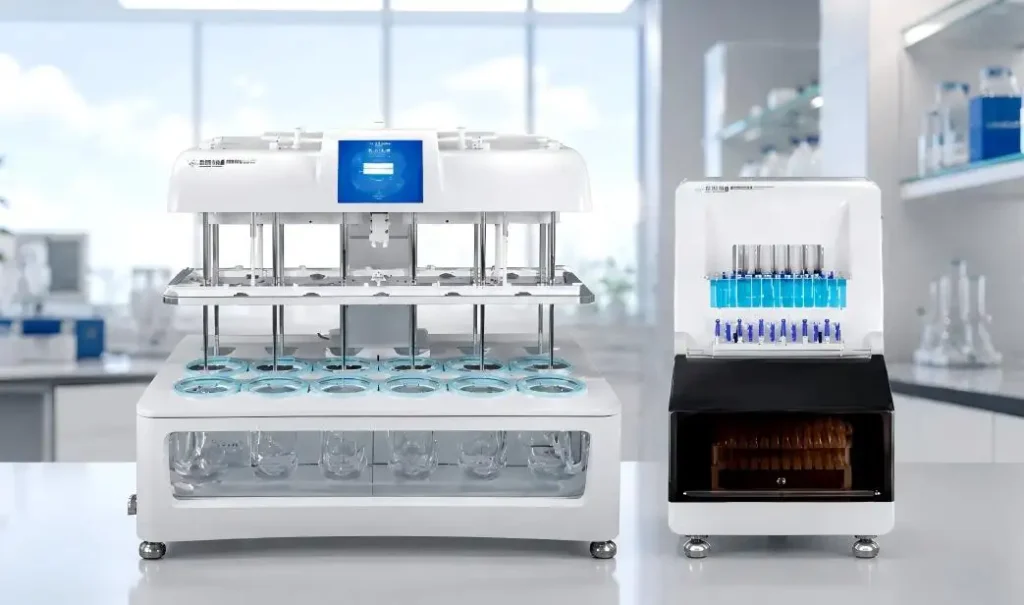
• RT600-ST: Automation of the sampling process, filtration, and the use of adsorption-resistant tubing facilitate standardized collection.
These Raytor configurations still leave the need for product-specific recovery and method validation.
For flow-through development, RT700 provides open- and closed-loop operation, independent channel temperature monitoring, and filtration components designed to reduce backpressure. These features support controlled comparisons of medium renewal and filtration conditions. RT700 product details
From Development to Routine QC
Selecting a USP Compliant Dissolution Apparatus is one part of a defensible method. Routine implementation also needs justified conditions, acceptance criteria, validated calculations, operating procedures, and transfer evidence.
Explore Raytor's dissolution testing systems and share your release mechanism, medium sequence, and sampling requirements with our team. We can help identify an equipment configuration suited to your development and QC work.
FAQs
Q1. Which Raytor dissolution systems can support modified-release method development?
Raytor offers basket and paddle platforms, including RT600 and RT612, alongside the RT300 reciprocating platform and RT700 flow-through cell system. Selection depends on the applicable method, release mechanism, medium sequence, and sampling requirements.
Q2. How should I choose between Raytor RT600 and RT612?
RT600 is an eight-vessel platform featuring covered vessels and synchronous dosing. RT612 offers twelve vessels and individual temperature monitoring. Compare your required test positions, temperature documentation, sample workload, and automation needs before selecting a configuration.
Q3. When should I consider Raytor RT700 for dissolution testing?
Consider RT700 when a flow-through method is appropriate for the formulation, particularly when controlled medium renewal or flow-rate studies are important. Its suitability should be established through recovery, repeatability, and discriminatory studies.
Q4. What is the difference between RT700 open-loop and closed-loop operation?
Open-loop operation supplies fresh medium through the flow cell and collects the effluent. Closed-loop operation recirculates a finite medium volume. Selection affects drug accumulation, sink conditions, medium consumption, analytical sensitivity, and cumulative-release calculations.
Q5. Can Raytor systems support enteric-coated product testing?
Raytor's RT300 reciprocating platform is an option to evaluate for methods requiring sequential medium exposure. The acid stage, buffer stage, transfer procedure, and apparatus configuration must match the applicable product method.