


Pharmaceutical Laboratory Equipment for Modified-Release Dissolution Testing
2026-09-22


Modified-release dissolution testing must characterize how a formulation releases drug over time, including premature release, the intended release phase and incomplete release. A single endpoint cannot describe all three.

At Raytor, we approach Pharmaceutical Laboratory Equipment selection through the analytical method: dosage-form behavior, apparatus suitability, medium conditions, sampling requirements and data review. Automation and instrument capacity become useful when these requirements are defined.
Define the Release Mechanism Before Selecting Equipment
Different experimental designs are required for extended-release and delayed-release products.
• For extended-release products, sampling should be done to capture the early, intermediate and late release. The method should be able to distinguish significant formulation or manufacturing changes.
• For delayed-release products, testing should be done to assess how resistant the product is to the initial stage and to see if the product releases at the prescribed time.
• For both product types, development studies should look at the effect of different solvents, the duration and intensity of agitation, and the formulation.
• For routine Quality Control (QC), methods, sampling schedules and acceptance criteria should be used as directed.
Specific conditions must follow the applicable product method. FDA's SUPAC-MR guidance distinguishes extended-release and delayed-release testing within postapproval-change evaluations; its example conditions should not become universal specifications.
Compare Pharmaceutical Laboratory Equipment by Method Requirements
Apparatus selection changes the hydrodynamic environment. Results from different apparatus types are therefore not automatically interchangeable.
| Apparatus | Method Considerations | Variables Requiring Evaluation | Raytor Platform |
| USP 1: Basket | Suitable where the established method specifies basket containment | Mesh blockage, trapped air, rotation speed and sample distribution | RT600 / RT612 |
| USP 2: Paddle | Common platform for established tablet methods | Coning, floating, vessel geometry and justified sinker use | RT600 / RT612 |
| USP 3: Reciprocating Cylinder | Useful for sequential medium exposure | Screen size, reciprocation, immersion time and residual-liquid transfer | RT300 |
| USP 4: Flow-Through Cell | Supports controlled medium flow through the sample | Cell packing, flow stability, filtration and medium consumption | RT700 |
Our range supports these different apparatus configurations. Selection should remain grounded in the method rather than instrument availability.
For flow-through testing, open-loop operation supplies fresh medium and collects effluent; closed-loop operation recirculates a defined volume. This distinction affects concentration buildup, medium demand and release calculations.
Control the Variables That Distort Long-Duration Profiles
Temperature, Evaporation and Mechanical Conditions
Pharmaceutical Laboratory Equipment must maintain suitable conditions throughout the longest intended run—not simply reach the starting setpoint.
Evaluate:
• Temperature equilibrium across the vessels over time.
• Evaporation in the actual cover and sampling arrangement.
• Shaft alignment and rotation as well as external vibration.
• Temperature disruption after the addition or replacement of the medium.
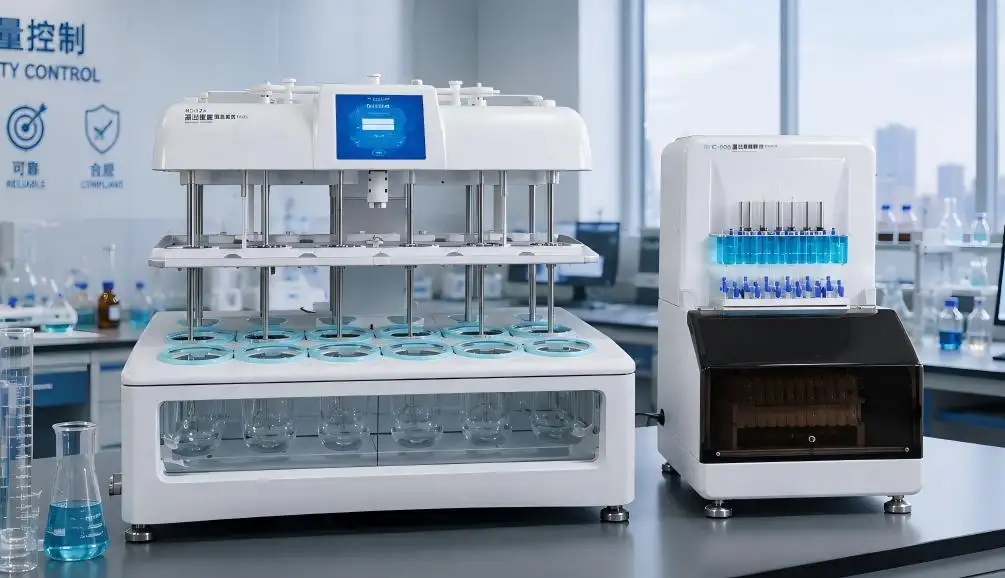
Our RT600 uses vessel covers and synchronous dosing, while the RT612 offers individual temperature monitoring. These designs help with evaporation control, coordinated test initiation, and understanding of the conditions of the vessels.
Medium Composition and Stage Changes
Define pH, buffer capacity, deaeration and drug solubility in each medium. Sink conditions concern the medium's capacity to dissolve the available drug; they should be assessed rather than assumed.
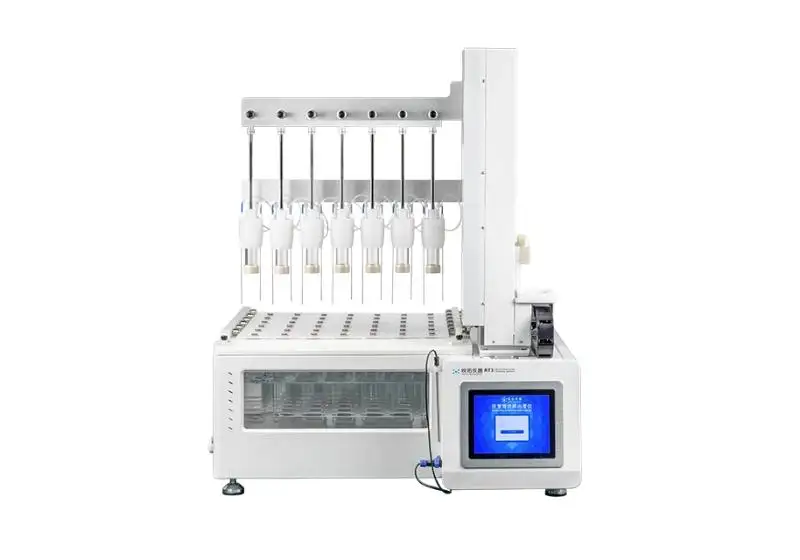
For staged methods, document transition timing, residual acid or buffer, final volume and temperature equilibration. Residual liquid can alter the next stage's pH and composition.
Our RT3 platform includes automatic vessel covers and adjustable reciprocation, immersion and drain times, providing parameters laboratories can evaluate when developing staged methods.
Sampling Recovery and Mass Balance
Even if extractions are carried out at the right time, results can still be biased if the recovery of the analyte changes during filtration or transfer.
Check:
• Adsorption: Analyze the recovery rate at different concentrations for filters and tubes.
• Filtration: Find the particle removal efficiency and the volume of waste produced.
• Timing: Account for the time it takes to pull a sample and the time it takes to transport it.
• Stability: Check if samples can be stored stable during the time it takes to analyze them.
• Volume correction: account for the drug that was removed and the medium that was added, and calculate the cumulative release.
Do not calculate cumulative release solely from the latest concentration when repeated sampling has removed measurable drug.
Manual vs. Automated Pharmaceutical Laboratory Equipment
| Decision Dimension | Manual Sampling | Automated Sampling |
| Development flexibility | Easy observation and intervention | Requires programmable method compatibility |
| Dense sampling schedules | Operator coordination becomes critical | Supports scheduled withdrawals |
| Sample recovery | Usually a shorter transfer pathway | Requires fluid-path recovery studies |
| Overnight operation | Requires staffing | Requires alarms, preservation and interruption procedures |
| Total ownership cost | Lower initial expenditure; recurring labor | Includes qualification, consumables, cleaning and maintenance |
Our RT600-ST offers anti-adsorption pipeline design, filtration options and optional online dilution. Drug-specific recovery and dilution accuracy still require verification.
Detection should also match the sample. Online UV requires adequate specificity and a suitable measurement range. HPLC offers separation when excipients, degradation products or multiple components interfere, but introduces chromatographic cycle time and sample-storage considerations.
Specify Qualification and Data Requirements Before Purchase
A Pharmaceutical Laboratory Equipment specification should cover more than vessel count:
• Maximum test duration, medium stages and sampling capacity.
• IQ/OQ/PQ responsibilities and mechanical-performance checks.
• Comparability between existing and automated sampling procedures.
• Raw-data retention, access controls, audit trails and backup recovery.
• Procedures for missed samples, interrupted runs and deviations.
Equipment qualification establishes fitness for intended use; method validation addresses analytical performance. Software functionality must be assessed within the configured laboratory workflow.
Connect Manufacturing Capabilities to Acceptance Criteria
At Raytor, our published production approach includes quality control from design through final inspection and instrument customization. Translate these capabilities into documented requirements: configuration, inspection evidence, acceptance testing and maintenance access.
Selecting Pharmaceutical Laboratory Equipment becomes more straightforward when release behavior and operating requirements are explicit. Explore Raytor's dissolution testing solutions and share your dosage form, media sequence, test duration and sampling plan so we can help assess an appropriate configuration.
FAQs
Q1. Which Raytor pharmaceutical laboratory equipment should I consider for modified-release dissolution testing?
Raytor offers RT600 and RT612 platforms for basket and paddle methods, the RT300 reciprocating-cylinder platform and the RT700 flow-through cell system. Selection depends on your established method, dosage-form behavior, medium sequence and sampling requirements.
Q2. How do the Raytor RT600 and RT612 differ?
The RT600 is an eight-vessel platform, while the RT612 provides twelve vessels. Raytor also lists individual temperature monitoring for the RT612. Compare usable testing capacity, method requirements and sampling configuration before selecting a model.
Q3. Can Raytor equipment support delayed-release or enteric-coated product testing?
Raytor's RT300 reciprocating-cylinder platform supports staged medium exposure and configurable operating parameters. Suitability depends on the prescribed method, including stage duration, medium composition and control of liquid carried between stages.
Q4. When should a laboratory evaluate the Raytor RT700?
Consider the RT700 when method development calls for a flow-through cell apparatus. Evaluate flow rate, cell configuration, filtration and open- or closed-loop operation against the formulation's release behavior and analytical requirements.
Q5. What features help control evaporation during extended dissolution runs?
Raytor lists vessel covers for the RT600 and automatic vessel covers for the RT3 reciprocating-cylinder platform. These help limit evaporation, but laboratories should assess medium loss over the longest intended test duration under actual operating conditions.