







What USP Dissolution Testing Reveal About Tablet Performance?
2026-02-24


USP Dissolution Testing is one of the clearest windows into how a tablet actually behaves after it leaves the bottle—because it measures drug release under controlled, repeatable conditions that can predict real-world performance risks before patients ever see them.

1) What is USP Dissolution Testing?
USP Dissolution Testing is a consistent lab method for assessing the time course and extent of drug release from dosage forms—typically tablets and capsules—into a liquid medium with controlled test parameters.
In plain terms: it answers, "Does this tablet release the medicine at the right rate, consistently?"
What it’s used for:
• Quality control (QC): confirm batch-to-batch consistency
• Product development: compare formulations, coatings, excipients, and processes
• Stability monitoring: detect performance changes over shelf life
• Regulatory compliance: meet pharmacopeial/compendial requirements
How it works (simple view):
A tablet/capsule is placed in a vessel of dissolution medium (like simulated gastric/intestinal fluid) kept at 37°C. A standardized stirring tool—usually:
• Paddle (Apparatus 2) or
• Basket (Apparatus 1)
spins at a set RPM. Samples are taken at defined time points and analyzed (often by UV or HPLC) to calculate % drug dissolved vs. time.
What you get from the result:
• A single-point pass/fail result (e.g., "Q = X% at 30 minutes"), or
• A full dissolution profile (release curve) that reveals performance differences.
2) Why Tablet Performance Is More Than "It Dissolves"
Many beginners assume dissolution is simply "does the tablet fall apart." In practice, tablet performance is a chain of events: wetting, disintegration, deaggregation, and then drug release into the medium. A tablet can look perfect and still release too slowly, too fast, or too inconsistently between batches.
That is why compendial dissolution exists: USP <711> Dissolution is used to determine compliance with dissolution requirements stated in monographs for tablets/capsules. When you run the method correctly, you are not just collecting numbers—you are testing whether formulation, compression, coating, and processing control are stable enough to deliver reliable release.
From Raytor’s manufacturer perspective, we often describe dissolution data as a "performance fingerprint." If the fingerprint changes, something in the product or process changed—even if basic QC tests still pass.
3) What USP Dissolution Testing Reveals About Tablet Performance
A well-designed dissolution profile can reveal problems that typical appearance or assay checks cannot. For oral tablets, it helps answer:
• Does the tablet release at the intended rate, especially across time points?
• Do batches behave the same under the same method?
• Is the product sensitive to small process shifts (granulation moisture, compression force, coating weight gain)?
Here are the practical "signals" you can learn to read:
✓ Release Speed And Risk: Too fast can increase variability or side effects; too slow can reduce therapeutic effect.
✓ Batch-to-Batch Consistency: When profiles drift, it often points to process instability.
✓ Formulation Robustness: A robust tablet keeps its profile even when raw material variation occurs.
✓ Manufacturing Control: Dissolution trends can expose subtle issues like lubricant over-mixing, binder changes, or coating defects.
Dissolution is also part of a broader family of performance tests. For example, USP <724> Drug Release is used where drug-release requirements apply (often for transdermal systems and other dosage forms). These chapters reinforce a key idea: performance testing is not "extra testing," it is how you prove the dosage form performs as designed.
4) The Variables That Most Affect Dissolution Results
The easiest way to get confused with USP Dissolution Testing is to change several variables at once. A more reliable learning path is to control the basics first, then fine-tune.
Key Variables You Should Control First
Start with the factors that most commonly cause noise or false shifts:
✓ Temperature Stability: Small temperature drift can change viscosity and release rate.
✓ Agitation Accuracy: RPM stability matters as much as the setpoint.
✓ Timing Discipline: Dose timing and sample timing must be consistent.
✓ Sampling Pathway: Adsorption, carryover, and filtration can distort results.
✓ Media Handling: Degassing, preheating, and volume accuracy protect repeatability.
Once those are stable, you can interpret tablet performance with more confidence. When those are unstable, you may end up "optimizing" the formulation to match a measurement problem, not a product problem.
5) How RT600-ST Turns USP Dissolution Testing Into Repeatable Daily Work
In real QC environments, the challenge is not understanding the theory—it is producing consistent, audit-ready results day after day. That is where automation matters.
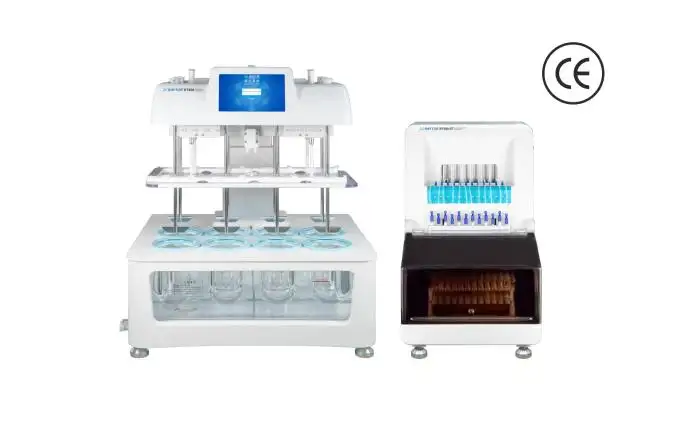
Raytor’s RT600-ST Automated Dissolution System is built as an 8-position, single-drive, autosampling platform designed to meet major compendial requirements, including ChP (0931), USP (711/724), and EP (2.9.3/2.9.4). It supports automatic dosing, automatic positioning, automatic sampling, optional online dilution, and real-time display of speed and temperature—aiming for high precision with higher efficiency.
Here is how specific design advantages translate into practical value for your team:
• Automatic Preheating + Covered Dissolving Cups
You can schedule constant-temperature water bath preheating and maintain uniform conditions. For beginners, this removes a major source of variability: inconsistent media temperature at start.
• Automatic Synchronous Dosing
Dosing time differences can create artificial profile differences. RT600-ST tracks dosing time so multiple vessels begin under the same timing logic.
• High-Precision Sampling Pump + Optional Online Dilution
Accurate sampling improves data trust. Optional online dilution helps labs handle high-concentration or challenging products without manual dilution mistakes.
• Teflon Pipeline With High Chemical Stability And Anti-Adsorption
Sampling lines can silently "eat" analyte through adsorption. A high anti-adsorption pathway helps protect low-dose or sticky APIs so your results reflect the tablet—not the tubing.
• Dual Online Filters + Continuous Filtration
Clogging is a real operational problem. Dual filters help reduce blockages and keep sampling stable, especially with formulations that shed particles.
• Paddle-Basket Co-Axial Design (No Recalibration When Switching Methods)
Switching between basket and paddle methods becomes simpler, reducing downtime and minimizing setup errors that beginners commonly make.
• 120-Vial Automatic Sample Collection
The sample tray capacity (up to 120 vials) supports longer runs, multiple time points, and higher throughput without constant operator interruption.
If your goal is to learn what USP Dissolution Testing reveals about tablet performance, repeatability is everything. An automated, disciplined workflow makes the "reveal" trustworthy.
6) Beyond Tablets: Where USP Dissolution Testing Connects to Other Dosage Forms
Although this article focuses on tablets, modern labs rarely test only one dosage form. RT600-ST is designed for broader application coverage, and the standards help guide that expansion.
For example, USP <1724> Semisolid Drug Products—Performance Tests discusses developing in vitro performance tests to evaluate drug release or skin permeation for topical and transdermal semisolid and liquid-based products (creams, gels, patches, and more). This highlights an important mindset: performance testing is a toolkit, and dissolution/drug-release methods are part of a continuum.
Common application directions include:
•Oral Tablets (QC dissolution profiles)
•Patches (drug release / dissolution approaches depending on monograph)
•Semi-Solid Preparations (in vitro release and related performance concepts)
•Injections (where relevant performance tests apply)
•Intrinsic Dissolution Rate of API (material performance screening)
7) Data Integrity and Scale: From One Test to a Smarter Lab
As throughput grows, the next bottleneck is not the vessel—it is data handling and instrument coordination.
Raytor’s Data Cloud System is designed to connect at least 250 different types of experimental instruments for intelligent management across a lab network. This raises traceability and reduces time for cross-instrument review of dissolution changes and batch signals.
CTA (For QC Teams and New Labs): Start right in 2026—Raytor will help map methods (USP/EP/ChP), select appropriate automation, and configure RT600-ST features—online dilution, filtration strategy, and sample collection—around your products. Reach out to request an application discussion, a configuration recommendation, or a demo plan tailored to your dosage forms.