

What Is A Pharmaceutical Dissolution Apparatus? A Complete Guide To USP Apparatus Types 1–7
2026-04-22


What Is A Pharmaceutical Dissolution Apparatus? This device of precision engineering assesses the rate of dissolution of active pharmaceutical ingredients in a tablet or capsule form. This dissolution method is governed by USP <711>. This ensures each batch produced is in compliance with the requirements of bioavailability and performance.
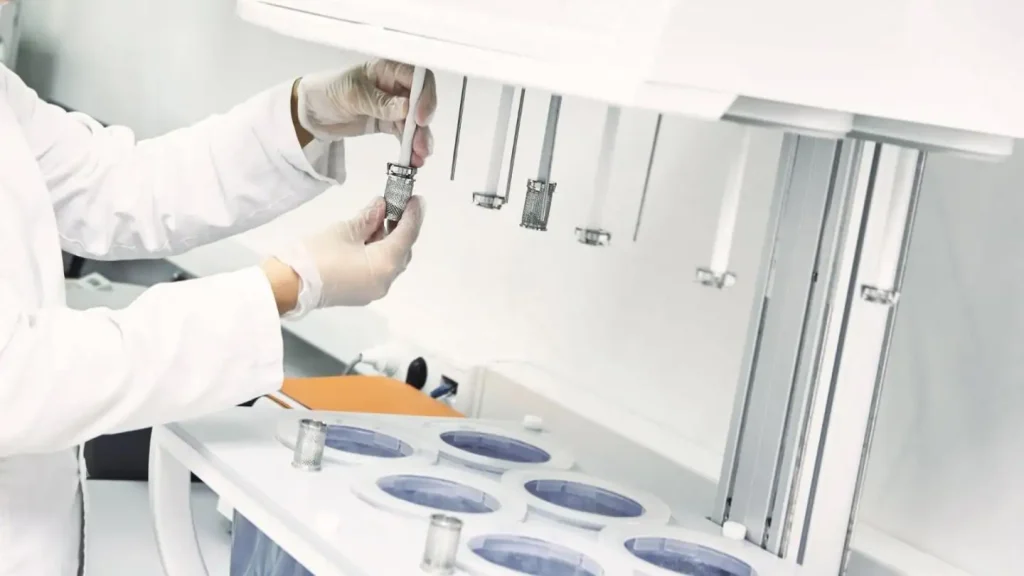
The USP defines seven distinct types of dissolution apparatuses, each designed for specific dosage forms, ranging from immediate-release tablets to transdermal patches and stents. Knowledge of the distinctions among these types is crucial for personnel in quality control when determining apparatus selection for their product line.
What Is a Pharmaceutical Dissolution Apparatus Type 1 (Basket)
The rotating basket is the first of the official dissolution apparatuses, added to the USP in 1970. This apparatus consists of a rotating shaft that holds a cylindrical wire mesh basket that is immersed in 37 ± 0.5 °C dissolution medium in a vessel that typically holds 900 mL or 1000 mL.
Most suitable dosage forms are capsules, floating tablets, suppositories, and delayed-release dosage forms that are likely to float.
Standard operating conditions: the basket is set to rotate at 100 rpm for the majority of the methods with the dosage form contained within the mesh, which is designed to cause immersion of floating dosage forms, thereby ensuring uniform contact at the requisite surface.
The key benefit is that other than the rotating mesh basket, there is no contact with the sample, thereby eliminating the issue of floating or sticking associated with the paddle methods.
What Is a Pharmaceutical Dissolution Apparatus Type 2 (Paddle)
The paddle apparatus is by far the most common dissolution assembly in the pharmaceutical industry. It is especially popular with immediate-release oral solid dosage forms. Within the dissolution vessel, a paddle-shaped stirrer is used to replace the basket.
•Dosage forms: Non-floating tablets, capsules, suspensions, and other oral dosage forms.
•Operating conditions: Paddle speed at 50 rpm for capsules and 25 rpm for suspensions, and the vessel temperature at 37 ± 0.5 °C.
•Advantage: Low turbulance and good reproducibility over a wide range of formulations.
What Is a Pharmaceutical Dissolution Apparatus Type 3 (Reciprocating Cylinder)
The reciprocating cylinder is designed for the development of modified and controlled release dosage forms. Within one procedure, it simulates the gastrointestinal tract by combining contained agitation and different pH conditions.
•Dosage forms: Extended release tablets, enteric coated products, chewable tablets, soft capsules, and bead-filled capsules.
•Operation: The cylinder assemblies ascend and descend through the series of Vessels each containing different fill media (e.g. pH 1.2, 4.5, 6.8), simulating the pH gradient of the gastrointestinal tract.
•Key advantage: Can run unattended for up to six days, storing up to 15 programs with programmable agitation rates, dip times, and media change intervals.

What Is a Pharmaceutical Dissolution Apparatus Type 4 (Flow-Through Cell)
The flow-through cell apparatus, first developed by the FDA in 1957, continuously pumps fresh dissolution medium through a cell containing the dosage form. It can function in either open-loop (single-pass) or closed-loop (recirculating) systems.
•Application areas: Implantable devices, drug-eluting stents, poorly soluble drugs, powders, pellets, microspheres, liposomes, and suppositories.
•Mechanism: The dissolution medium is pumped upwards in the flow-through cell, and filter membranes are used to retain undissolved particles. The system is capable of operating up to eight distinct channels at the same time, each having programmable flow rates.
•Main feature: During the test, the system maintains sink conditions, which is especially important for poorly soluble APIs, and allows for media changes at up to four different pH values throughout a single run.
What Is a Pharmaceutical Dissolution Apparatus Type 5 (Paddle Over Disk)
Apparatus 5 adjusts the paddle assembly for use with transdermal delivery systems. A disk clamps the patch in a while against the paddle shaft to ensure consistent, even, and controlled surface exposure to the medium.
•Application areas: Ideal for transdermal patches and other topical drug delivery system applications that impact surface exposure control.
•Mechanism: The patch is secured to a disk assembly located at the bottom of the vessel, and the paddle is driven to create a consistent flow across the surface of the patch.
•Main feature: The patch will not curl or float, thus yielding reproducible release profiles for semi-solid, as well as for transdermal, formulations.
What Is a Pharmaceutical Dissolution Apparatus Type 6 (Rotating Cylinder)
Apparatus 6 is designed specifically for transdermal patches and some medical devices, and uses a stainless steel cylinder that replaces the conventional basket.
•Application areas: Primarily transdermal patches, adhesive-based delivery systems, and some topical semi-solids.
•How it works: The device rotates a patch on the outer surface of a rotating cylinder at a controlled speed within a dissolution medium.
•Benefits: Uniform shear stress is yielded to a patch surface and is closely aligned to in vivo release conditions of transdermal products.
What Is a Pharmaceutical Dissolution Apparatus Type 7 (Reciprocating Holder)?
Of all the USP dissolution systems, Apparatus 7 is the most flexible as it extends the reciprocating principle of Apparatus 3 to include small-volume and non-standard dosage forms.
•Ideal dosage forms: These include stents, implants, drug-eluting devices, ophthalmic inserts, and combination products that require stronger agitation and smaller volumes of media.
•How it works: Samples are mounted on holders that reciprocate vertically through media-filled vessels. The device can be configured to use baskets (Apparatus 1), paddles (Apparatus 2), paddle-over-disk (Apparatus 5), or rotating cylinders (Apparatus 6).
•Key advantage: It accommodates media changes, decreased volumes (as low as 50-100 mL per vessel), and complex agitation profiles that other simpler apparatuses can’t.
How to Choose The Right Usp Apparatus for Your Product
Choosing a dissolution apparatus is not a matter of random selection; there must be a synergic relationship between dosage form characteristics, mechanism of release, and what the regulation requires.
•Begin with the dosage form: For tablets and capsules, Apparatus 1 or 2 is a good starting point. For floating tablets, it may require Apparatus 1 (basket) to control for buoyancy.
•Take the release profile into account: Immediate-release formulations are best suited with Apparatus 2. For extended-release and enteric-coated products, Apparatus 3 or 4 are the ones to use.
•Align with the regulatory monograph: Most USP monographs specify an apparatus, but in the absence of such guidance, a test should be performed with both Apparatus 1 and Apparatus 2 in order to assess which of the two provides the best discriminative and reproducible results.
Anticipate future needs: Modular systems with multiple apparatus configurations, such as Raytor’s USP 1–7 compatible systems, provide laboratories with the necessary flexibility to accommodate new configurations as their product portfolios grow, thereby minimizing capital costs and simplifying method transfer.
Final Words
A dissolution apparatus can do a lot more than simply provide a positive response to a regulatory check; it can increase the consistency of results from one batch to the next, speed up the time it takes to launch a product in the market, and provide the QC laboratory staff with the assurance they need to have in the products they test.
Regardless of whether you are working on a straightforward immediate-release tablet formulation or a highly complicated drug-eluting stent, an appropriate dissolution apparatus within the ranks of the USP standards is both the backbone and the primary cornerstone of the dissolution data you can be confident is ready for audit.
FAQs
Q: Which USP apparatus is most commonly used for immediate-release tablets?
A: Apparatus 2 (Paddle) is the most widely used for immediate-release oral solid dosage forms.
Q: Does one dissolution system have the ability to accommodate several USP apparatus types?
A: Yes. As an example, Raytor’s systems are modular and permit swapping of Apparatus 1–7 with different accessories.
Q: Will I require a different apparatus for transdermal patches?
A: Yes. For transdermal delivery systems, USP Apparatus 5 (Paddle Over Disk) or 6 (Rotating Cylinder) are more applicable.
Q: Apparatus is what a monograph requires?
A: For your product, look at the particular USP monograph—it will dictate the apparatus and it’s condition.
Q: Does Apparatus 4 apply to only poorly soluble drugs?
A: Primarily, yes. The flow-through cell maintains sink conditions, making it ideal for low-solubility APIs, implants, and powders.