

Dissolution Apparatus for Transdermal Drug Patches: Matrix vs. Reservoir Patch Testing
2026-09-18


Dissolution Apparatus for Transdermal Drug Patches should measure formulation release without changing the structure that controls it. Matrix and reservoir patches can sometimes use the same apparatus, but sample mounting, medium selection, and failure investigation require different considerations.
At Raytor, we connect equipment selection with the analytical method: patch dimensions, exposed area, structural integrity, hydrodynamic conditions, and sampling recovery. These factors determine whether a release profile reflects product performance or experimental interference.
Matrix vs. Reservoir Patches: What the Method Must Detect
Matrix patches contain drug within a polymer or adhesive matrix. Reservoir patches generally incorporate a drug-containing compartment separated from the release surface by a rate-controlling membrane.
| Evaluation Dimension | Matrix Patches | Reservoir Patches |
| Principal release variables | Drug solubility in the matrix, diffusivity, layer thickness, crystallization | Membrane permeability and thickness, reservoir composition, concentration gradient |
| Mounting sensitivity | Stretching, compression, adhesive displacement, edge exposure | Membrane deformation, seal stress, reservoir leakage |
| Specimen preparation | Cutting requires evidence that edge effects and preparation do not alter release | Cutting that breaches the reservoir invalidates the intended structure |
| Development challenges | Changes in coating thickness, polymer composition, or drug state | Changes in membrane properties, formulation, or seal integrity |
| Abnormal profile investigation | Crystallization, matrix aging, inconsistent exposed area | Leakage, membrane damage, or attachment failure |
The EMA transdermal patch guideline emphasizes preserving patch performance during sample preparation. Neither architecture guarantees a particular release curve: reservoir systems are not automatically zero-order, and matrix systems do not universally follow square-root-of-time kinetics.
Selecting Dissolution Apparatus for Transdermal Drug Patches
Start with the applicable product method and study objective. Then assess whether the apparatus accommodates the intact patch and maintains reproducible exposure.
| Apparatus | Testing Arrangement | Critical Suitability Check |
| USP 5: Paddle Over Disk | Patch secured to a disk beneath a paddle | Defined exposure, fixture obstruction, paddle clearance, trapped air |
| USP 6: Rotating Cylinder | Patch attached around a rotating cylinder | Curvature tolerance, attachment consistency, seal stress |
| USP 7: Reciprocating Holder | Mounted specimen moves vertically through medium | Holder geometry, reciprocation conditions, integrity during medium changes |
| Franz Diffusion Cell | Drug passes through a selected membrane or skin | Membrane function, receptor conditions, diffusion area, endpoint |
A standard paddle vessel alone does not establish a USP 5 configuration; the appropriate disk assembly and geometry matter.
Release and permeation are separate endpoints. Release testing measures drug leaving the formulation. Skin permeation testing additionally measures transport through a biological barrier. Franz-cell results therefore require interpretation according to the membrane and protocol used.
Control the Variables That Can Distort Release
Mounting and Exposed Area
The Dissolution Apparatus for Transdermal Drug Patches must be able to maintain the designated release surface throughout the duration of a process.
- Document attachment material, orientation, and exposed area.
- Prevent stretching, overlapping, curling, and unintended edge exposure.
- Be sure to check for bubbles after immersion process is complete.
- Document the state of membrane, seal, and the attachment after testing.
Uneven or abrasive release of reservoir patches or visible leakage indicates that an integrity evaluation is necessary. Exposed cut edges of matrix patches may create additional drug diffusion pathways.
Medium, Sink Conditions, Temperature
Choose a medium which has solubility for the drug, accounts for the stability of the drug in the analytical sense, and is suitable for adhesives and membranes. Consider sink conditions with the amount of drug anticipated to enter the medium in the study.
Excessive surfactant may alter the patch materials and may lower method discrimination. More aggressive extractions are not always the best release method.
Control actual medium temperature across positions. Use the applicable method's temperature and tolerance; assess elevated-temperature exposure through a separately justified protocol.
Method Discrimination and Robustness
Dissolution Apparatus for Transdermal Drug Patches must discern significant changes from insignificant changes in the testing process.
• Matrix patches: Development batches should be assessed based on variations in the thickness of the coating, the type and quantity of adhesive, and the form of the drug.
• Reservoir patches: Variations in membrane thickness and permeability should be justified. Conduct separate tests on samples that leak.
• Method robustness: Evaluations should be conducted on the agitation, sample positioning, and preparation of the solvent/medium to determine the impact of medium/solution preparation on the test results.
We at Raytor advise adoption of challenges prior to final fixture construction. If changes in mounting result in changes in the sampled profile that are significant from relevant changes in formulation, then the methodology must be further refined. This enables the laboratory to determine whether differences in observed results can be attributed to the performance of the test or the quality of the patches used.
Interpret Profiles Before Assigning a Formulation Cause
Report cumulative mass, percentage of a clearly identified drug-content denominator, and—where useful—mass per exposed area. An interval release rate can be expressed as ΔM/(AΔt); this is not automatically skin flux.
Before considering differences in patch architecture:
• Ignoring mounting, temperature, and recovery errors.
• Compare individual profiles to the averages.
• Check for patch integrity and residual drug, as appropriate.
• Demonstrate sensitivity to significant changes in formulation or process.
In case of transfer and validation of the method, the impacts of precision, robustness, sampling recovery and consistency of the fixture should be considered. Like release profiles, equivalent skin permeation cannot be inferred from similar release profiles.
Raytor Design Features Matched to Method Requirements
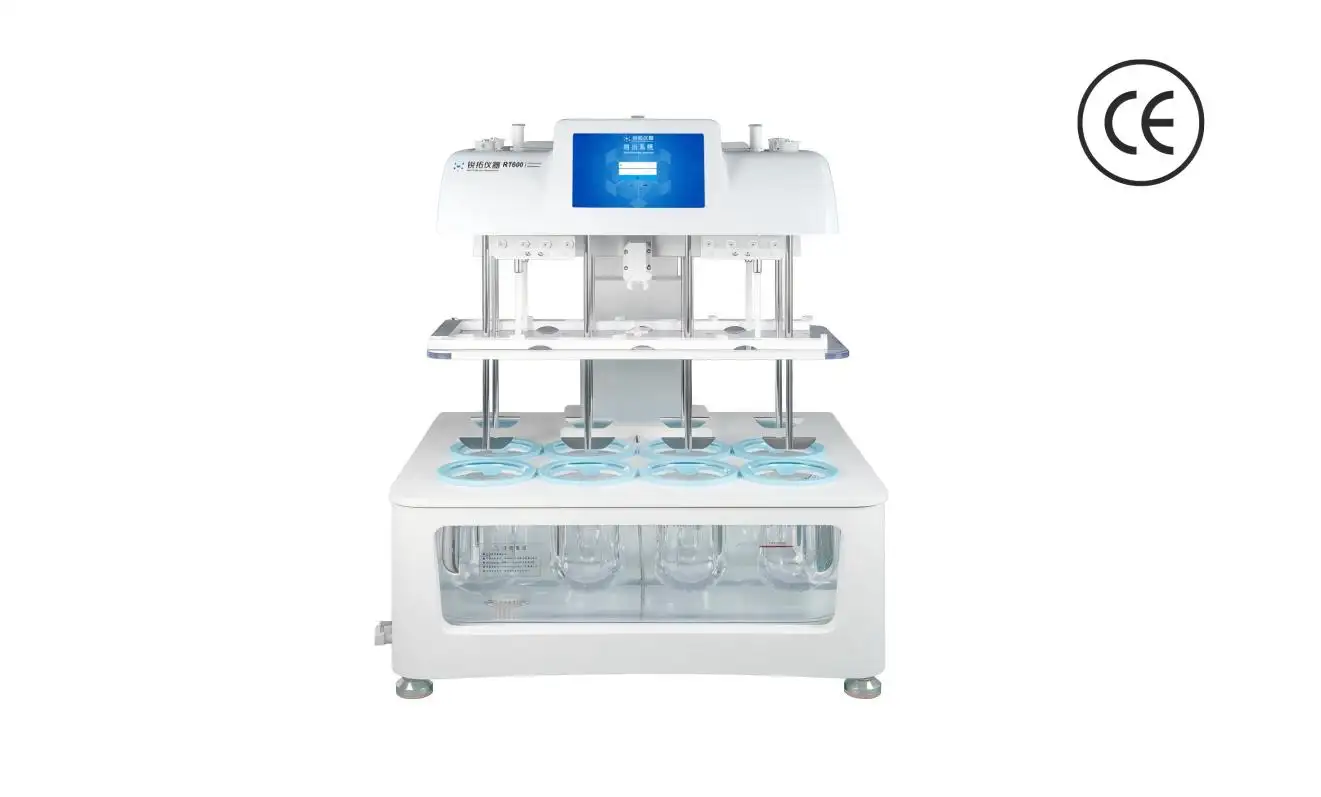
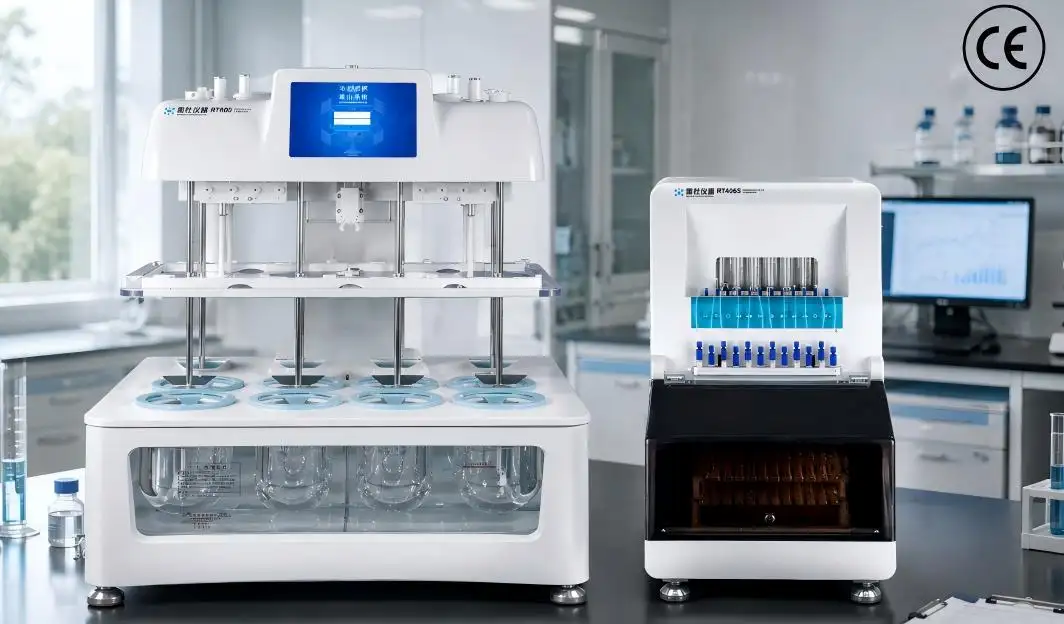
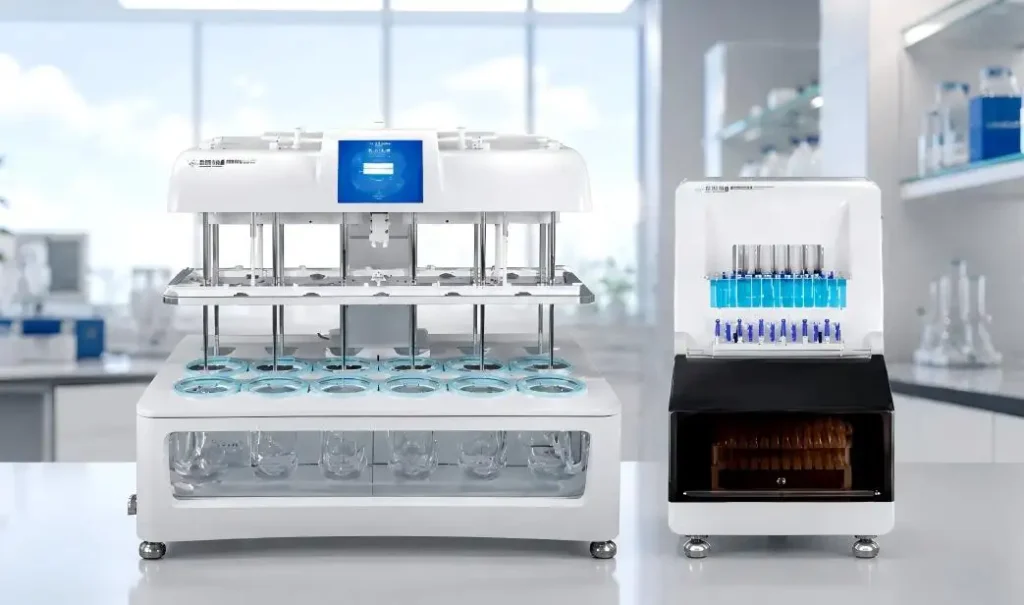
Our approach to Dissolution Apparatus for Transdermal Drug Patches combines apparatus configuration with accessory and sampling suitability.
| Raytor Option | Published Feature | Practical Application |
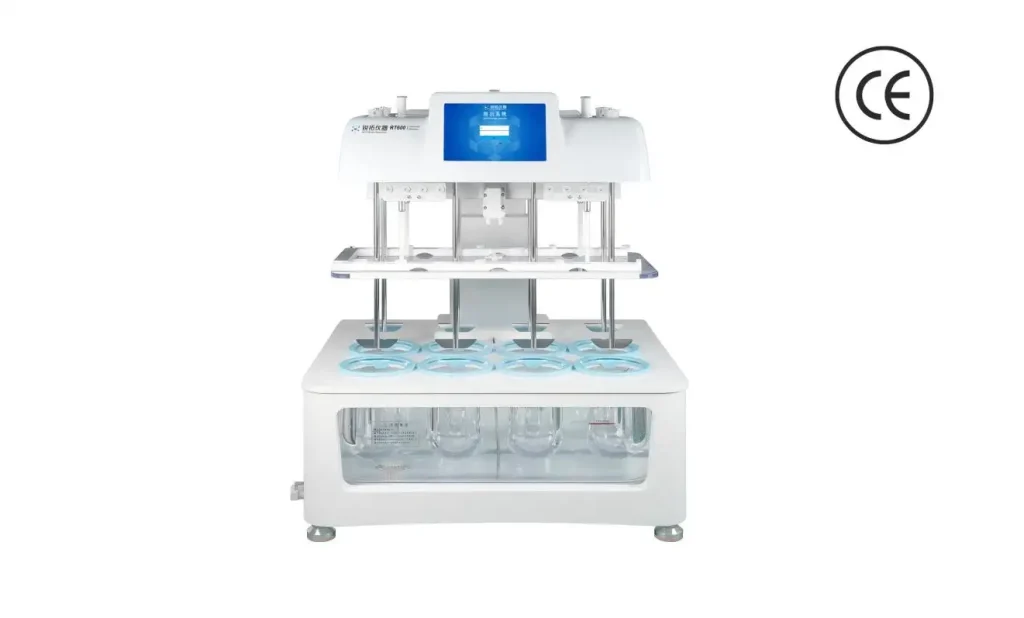
| RT600 | USP 1/2/5/6 configurations | Evaluate USP 5 or 6 methods with confirmed patch accessories |
| RT612 | Individual temperature monitoring | Document positional temperature differences |
| RT600-ST | Automated sampling, filtration options, anti-adsorption pipeline design | Support scheduled collection with formulation-specific recovery verification |
| Accessory customization | Dissolution accessories and customization service | Address patch dimensions, attachment geometry, and exposure requirements |
These capabilities are listed in Raytor's dissolution portfolio. Configuration suitability still depends on the actual patch and validated method.
Select Equipment Around Patch Integrity
Effective Dissolution Apparatus for Transdermal Drug Patches preserves the dosage form, controls experimental variability, and detects relevant product differences. Explore Raytor's dissolution testing solutions to discuss fixtures, apparatus configurations, and sampling workflows suited to your matrix or reservoir patch studies.
FAQs
Q1. Which Raytor models can be evaluated for transdermal patch dissolution testing?
Raytor RT600 and RT612 list USP 5 and USP 6 configurations among their supported apparatus options. Selection requires confirmation of the patch fixtures, sample dimensions, and intended test method.
Q2. Can one Raytor system test both matrix and reservoir patches?
Potentially, yes. The same apparatus platform may accommodate both architectures with suitable accessories. Each method must establish appropriate mounting, exposed area, medium conditions, and sample integrity.
Q3. How should laboratories choose between USP 5 and USP 6 configurations?
Start with the applicable product method. USP 5 holds the patch on a disk, while USP 6 mounts it around a rotating cylinder. For a Raytor configuration, confirm that the selected arrangement avoids deformation, obstruction, or seal stress.
Q4. Does Raytor offer automated sampling for patch release studies?
Raytor RT600-ST provides automated sampling and filtration options. Laboratories should verify the intended sampling schedule, collection capacity, sample stability, and drug recovery for their specific study. RT600-ST product details
Q5. How does Raytor RT612 support temperature monitoring?RT612 includes individual temperature monitoring, helping laboratories document conditions across test positions. The operating temperature and acceptance limits should follow the applicable method.