

Dissolution Media Preparation System for Biorelevant Media: Compatibility and Process Control
2026-09-18


A Dissolution Media Preparation System must contain biorelevant media and maintain properties that affect drug dissolution. When assessing a particular system, one must consider the formulation composition, material compatibility, the history of the processing and cleaning, heating capacity, and the dispersing speed.
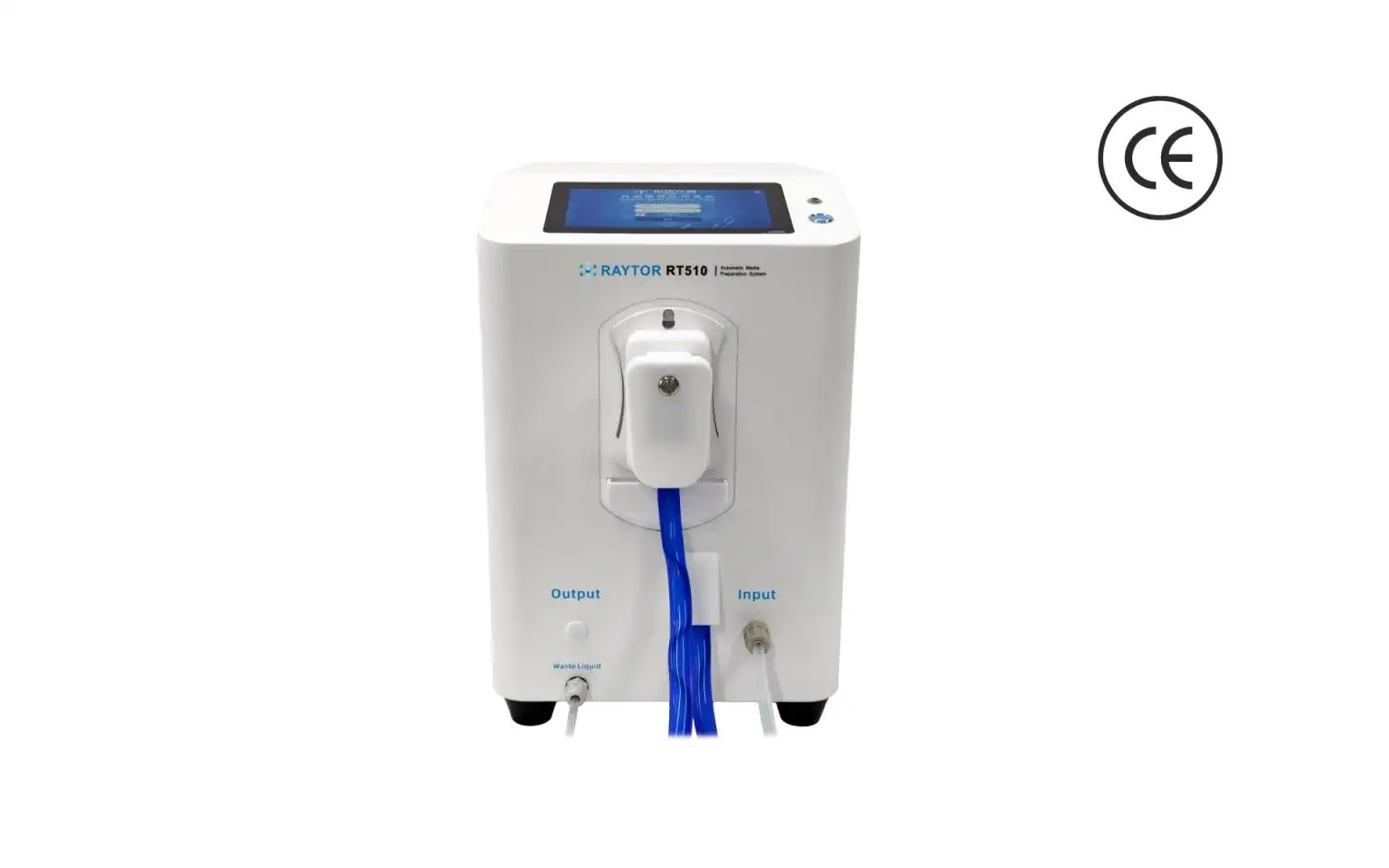
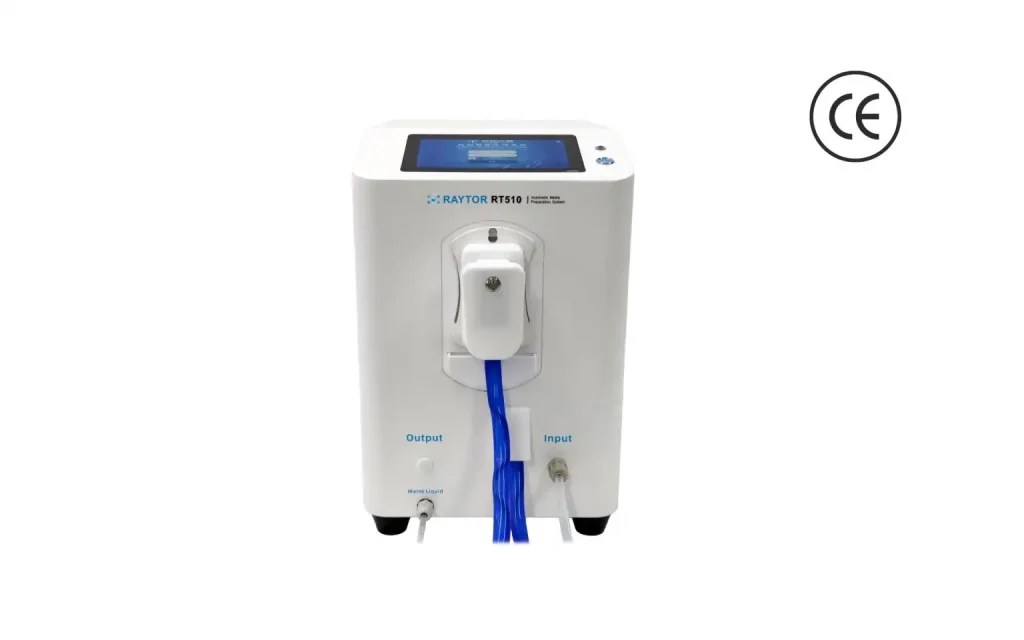
The RT510 from Raytor provides heating, degassing, and dispensing in one unit. For biorelevant applications, these features should be validated against a defined laboratory method with acceptance criteria defined for the actual medium.
Biorelevant Media Go Beyond pH Controlled Buffers
Fasted State Simulated Intestinal Fluid (FaSSIF) and Fed State Simulated Intestinal Fluid (FeSSIF) contain bile salts and phospholipids, for example, which influence drug solubilization. As a result, two media of the same pH can give different results if they are composed or prepared differently, despite appearing identical.
Published studies have shown that solubility and dissolution can be impacted by pH, the composition of biorelevant media, and formulation excipients. Biorelevant testing is used to evolve a formulation, and on its own, does not provide evidence of in vivo performance. Reference research.
| Evaluation Dimension | Conventional Buffer | Biorelevant Medium |
| Composition | Buffer concentration and pH | Also bile salt–phospholipid composition and recipe version |
| Preparation endpoint | Dissolution and final volume | Recipe-specific dispersion and equilibration |
| Handling risks | Temperature drift and delivery error | Additional foam, component retention, and residue concerns |
| Verification | Method-defined chemical and physical checks | Additional evidence that processing preserves medium performance |
Before selecting a Dissolution Media Preparation System, specify the medium version, preparation procedure, batch size, and intended use period.
Assess Compatibility Across the Entire Fluid Path
Wetted Materials and Component Recovery
Review every contact surface: tanks, tubing, seals, connectors, and dispensing outlets. Material resistance alone does not establish suitability. Components retained on surfaces could alter the delivered medium without producing an obvious visual change.
A practical assessment should include:
• A documented wetted-material list.
• Exposure under intended temperature and contact-time conditions.
• Comparison of relevant medium attributes before and after processing.
• Component-recovery measurements where adsorption or retention is a credible risk.
Foam, Transfer, and Cleaning
To properly assess the Performance of the Dissolution Media Preparation System, we must mimick as closely as possible real operating conditions. Therefore, media foams and media that behave differently during water-only pumping tests cannot be used to determine System Performance.
Take into account start-up, consecutive dispensing, and end-of-run conditions. For a volume balance, account for the dispensed volume, the residual liquid, and line priming.
Residual media carryover and cleaning agent residues are both of concern during a cleaning study. Conductivity or total organic carbon may be appropriate screening tests, but their appropriateness and sensitivity must be demonstrated for the residue being controlled.
Control the Variables That Affect Dissolution Results
| Process Variable | Control Strategy | Evidence to Record |
| Formula and raw materials | Fix recipe version, component quantities, and addition order | Material lots, calculations, and preparation record |
| pH and buffer composition | Follow the specified adjustment stage and measurement conditions | Calibrated pH result and measurement temperature |
| Mixing and equilibration | Use recipe-defined conditions and endpoint criteria | Mixing duration, standing time, and observations |
| Thermal exposure | Define permitted temperature and holding duration | Actual medium temperature and exposure time |
| Degassing | Establish necessity and recipe-compatible conditions | Settings and method-suitability results |
| Dispensing | Verify delivered quantity with actual medium | Bias and repeatability across the working range |
| Storage and use | Establish container, conditions, and maximum holding period | Preparation and use timestamps |
Distinguish Temperature Resolution from Accuracy
A display showing 0.1°C increments does not demonstrate temperature accuracy of ±0.1°C. Likewise, the preparation-system setpoint does not establish the temperature inside the dissolution vessel.
Verify actual medium temperature at the point relevant to the method, including after transfer and before dosage introduction.
Verify Volume with Appropriate Density Data
Gravimetric verification can assess dispensing performance using:
Delivered volume = net medium mass ÷ medium density
Use density data appropriate to the formulation and defined reference temperature. Applying water density indiscriminately to biorelevant media can introduce a systematic calculation error.
Degassing Requires Method-Specific Justification
A Dissolution Media Preparation System should provide controlled processing, while the laboratory establishes whether that processing is needed.
Bubble formation because of dissolved gases affects dissolution. This happens more with some methods and dosage forms than others. Other degassing methods should be investigated, and air introduced during subsequent handling may complicate the situation.
For biorelevant workflows:
• Establish whether degassing belongs before or after addition of specific components.
• Evaluate vacuum exposure, heating, foaming, and any filtration step.
• Limit unnecessary transfers and define preparation-to-use time.
• Avoid treating a dissolved-oxygen reading as a universal measure of medium suitability.
Qualify the Equipment and Verify the Method
Qualification demonstrates that the Dissolution Media Preparation System operates as specified. Application verification establishes that the selected process is suitable for the medium.
Compare automated preparation against an established reference procedure. Include representative recipes, volumes, holding times, and challenging changeovers.
Assess relevant physicochemical attributes and dissolution performance using predefined acceptance criteria. Select the curve-comparison approach according to the study design; use the similarity factor only when its applicability requirements are satisfied.
Raytor RT510: Practical Design with Defined Verification Boundaries
Our RT510 Automated Media Preparation System combines handling functions with remote dispensing, previous-program recall, and cart-assisted mobility.
| RT510 Specification | Laboratory Evaluation |
| Dispensing range: 100–1,000 mL | Confirm coverage of required vessel volumes |
| Dispensing error: ≤1% | Verify using each intended medium |
| Temperature range: room temperature–50°C | Check compatibility with preparation conditions |
| Temperature error: ≤±1°C; resolution: 0.1°C | Independently confirm method-required temperature |
| Degassing rate: ≥900 mL/min; oxygen: ≤3 ppm | Establish applicability under actual operating conditions |
These specifications support equipment selection; they do not constitute blanket validation for FaSSIF or FeSSIF. Raytor RT510 specifications
To evaluate a Dissolution Media Preparation System for your laboratory, explore Raytor's dissolution testing solutions and discuss your medium formulations, processing requirements, and verification objectives with our team.
FAQs
Q1. What does the Raytor RT510 Dissolution Media Preparation System do?
The Raytor RT510 combines heating, degassing, and quantitative dispensing in one system. It supports dissolution media handling, with remote dispensing and program recall to simplify repeated preparation tasks.
Q2. Can Raytor RT510 be used with FaSSIF and FeSSIF?
Suitability should be evaluated for the specific formulation and preparation procedure. Before using RT510 with FaSSIF or FeSSIF, confirm wetted-material compatibility, foaming behavior, component recovery, dispensing performance, and cleaning effectiveness.
Q3. What dispensing volumes does Raytor RT510 support?
RT510 has a published dispensing range of 100–1,000 mL, with a stated dispensing error of ≤1%. Laboratories should verify performance using their actual media across the intended working range.
Q4. What is the temperature range of Raytor RT510?
RT510 operates from room temperature to 50°C. Its published temperature error is ≤±1°C, with a display resolution of 0.1°C. Independently verify the medium's temperature inside the dissolution vessel before testing.
Q5. How fast can Raytor RT510 degas dissolution media?
Raytor specifies a degassing rate of ≥900 mL/min and an oxygen level after degassing of ≤3 ppm. These specifications should be evaluated under the laboratory's operating conditions; they do not establish compatibility with every biorelevant formulation