

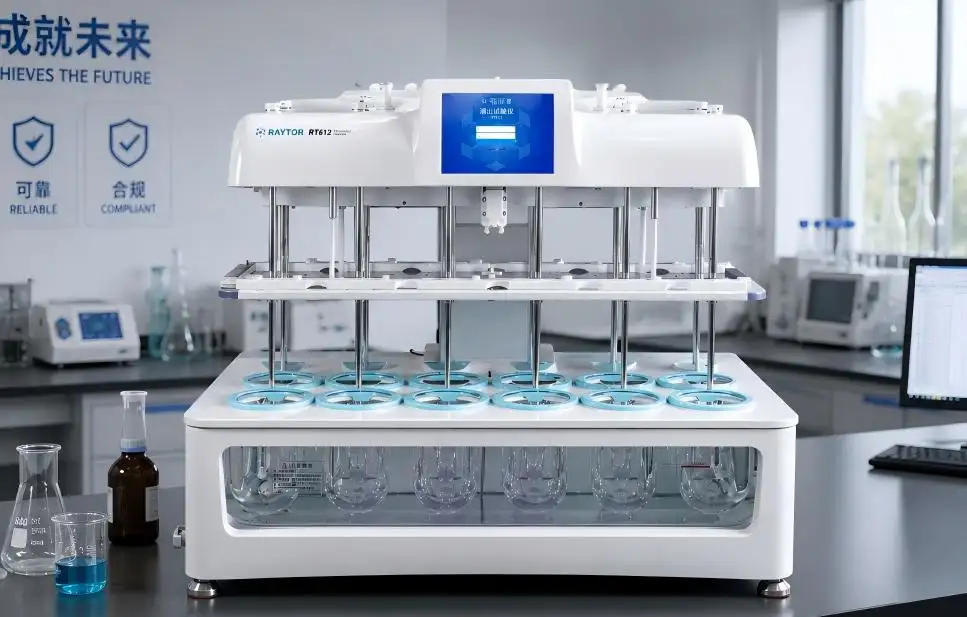
Dissolution Equipment for Pharmaceutical QC Lab: USP, EP, and ChP Compliance Comparison
2026-07-24


Pharmaceutical manufacturers frequently test the same drug product for the United States, European, and Chinese markets. Although USP, the European Pharmacopoeia, and the Chinese Pharmacopoeia share several dissolution principles, laboratories should not assume that their apparatus specifications, operating parameters, acceptance criteria, or documentation practices are fully interchangeable.

Dissolution Testing Apparatuses should have optimized characteristics in temperature control, sampling, speed, stability, geometric precision, and certification in pharmaceutical QC labs. The existing Pharmacopeia must be validated or outlined in product monographs or registered methods in the applicable legal state.
What is the Role of Dissolution Testing Equipment in a QC Lab?
Dissolution testing determines the rate and extent of release of the active pharmaceutical ingredient from the dosage forms, such as tablets and capsules.
A typical workflow is:
Dissolution Medium + Dosage Form + Controlled Agitation + Timed Sampling + Filtration + UV/HPLC + Compliance Decision
Dissolution Apparatus for Pharmaceutical QC Lab may be used for:
• Release testing of finished products;
• Stability testing;
• Development of Analytical methods;
• Method transfers between labs;
• Comparison of formulations;
• Investigations for out-of-specification results or deviations.
Dissolution testing apparatus controls the test environment for the medium and may vary the temperature, rotational speed, the mode of agitation, duration of the test, and the position for sampling. The final results may also be influenced by the medium preparation, deaeration, filtration, and the analytical method used.
What Does USP Require for Dissolution Testing?
USP General Chapter <711> covers commonly used dissolution procedures, including:
• Apparatus 1: Basket apparatus;
• Apparatus 2: Paddle apparatus;
• Other apparatus referenced by specific dosage forms or methods.
The selected apparatus must match the applicable USP monograph or approved product method. Describing a tester as "USP type" only indicates a general equipment design; it does not prove that the installed system, method, and laboratory procedure are compliant.
Mechanical Qualification vs Performance Verification
These activities evaluate different aspects of Dissolution Equipment for Pharmaceutical QC Lab.
| Evaluation | Main Purpose | Typical Checks |
| Mechanical qualification | Confirm physical and operational condition | Speed, temperature, shaft verticality, vessel centering, wobble, levelness |
| Performance Verification Test | Evaluate overall apparatus performance | Testing with specified USP reference standards under prescribed conditions |
Mechanical calibration alone may not replace an applicable Performance Verification Test. Laboratories should determine the required approach according to the current USP text, internal procedures, and registered method.
What Does the European Pharmacopoeia Require?
Ph. Eur. Chapter 2.9.3 addresses dissolution testing for solid dosage forms. Laboratories should confirm:
• Apparatus type and geometry;
• Dissolution-medium composition and volume;
• Temperature and rotational speed;
• Sampling time and sampling position;
• Filtration and analytical procedure;
• Product-specific monograph requirements.
Parts of the USP and Ph. Eur. dissolution texts have undergone pharmacopoeial harmonization. However, harmonization does not mean that all regional notes, product methods, acceptance limits, and documentation expectations are identical.
For European-market testing, Dissolution Equipment for Pharmaceutical QC Lab must be evaluated against both the applicable Ph. Eur. text and the product's registered analytical method.
What Should Laboratories Check for ChP Compliance?
For Chinese-market products, laboratories should refer to the applicable general chapters, dosage-form requirements, individual monographs, and registration standards in the current Chinese Pharmacopoeia.
The 2025 edition of the Chinese Pharmacopoeia became effective on October 1, 2025. Laboratories should therefore avoid relying on requirements that have been replaced or revised.
ChP-oriented laboratory control may include:
• Equipment calibration and qualification records;
• Approved standard operating procedures;
• Operation, cleaning, and maintenance logs;
• Method verification or validation records;
• Deviation and abnormal-result investigations;
• User-access and software-permission controls;
• Data backup and audit-trail review.
These controls may originate from the pharmacopoeia, GMP requirements, registered methods, or the company's internal quality system.
USP vs EP vs ChP: Key Comparison
| Comparison Area | USP | Ph. Eur. | ChP | Laboratory Focus |
| Main reference | <711> and monographs | 2.9.3 and monographs | Current general chapters and monographs | Confirm effective version |
| Common apparatus | Basket, paddle, and method-specific systems | Basket, paddle, and method-specific systems | Defined by applicable text | Match apparatus to method |
| Qualification | Mechanical checks and applicable PVT | Current text and quality-system procedures | Current text and laboratory procedures | Maintain complete records |
| Method parameters | Monograph or approved method | Monograph or registered method | General chapter, monograph, or registration standard | Verify medium, speed, time, and sampling |
| Automated sampling | Suitability must be demonstrated | Suitability must be demonstrated | Method and quality-system evaluation required | Check filtration, replacement volume, and carryover |
Exact dimensions, tolerances, and operating limits should always be taken from the current official pharmacopoeial text.

Which Equipment Features Affect Test Reliability?
When selecting Dissolution Equipment for Pharmaceutical QC Lab, evaluate more than vessel quantity.
Temperature and Speed Control
The system should provide:
• Consistent temperature across all vessels;
• Accurate and stable rotational speed;
• Reliable operation at low and high method speeds;
• Documented calibration of sensors and drive components.
Apparatus Geometry and Vibration
Critical mechanical factors include:
• Shaft verticality;
• Basket or paddle wobble;
• Vessel centering;
• Stirring-element height;
• Equipment levelness;
• External bench vibration.
Small mechanical deviations may become important in sensitive or low-release dissolution methods.
Sampling Configuration
Available configurations include:
• Manual sampling;
• Semi-automated sampling;
• Automated sampling with media replacement;
• Online UV analysis;
• HPLC-connected systems.
Increased throughput and timing consistency due to automation are generally positive in a laboratory setting, but automation must first be evaluated for tubing delay, filter adsorption, media replacement error, sample carryover, and cleaning effectiveness.
Manual vs Automated Dissolution Systems
| System | Suitable Application | Main Evaluation Point |
| Manual | Low-volume QC and method development | Operator consistency |
| Semi-automated | Moderate sample throughput | Sampling timing and replacement volume |
| Automated sampling | Routine release and stability testing | Cleaning, filtration, and carryover |
| Online UV | Rapid dissolution-profile generation | Spectral interference |
| HPLC-connected | Complex formulations or multiple analytes | Sample stability and system delay |
Higher automation does not automatically mean greater compliance. The appropriate configuration should match sample volume, analytical method, cleaning capability, and data-management requirements.
Selecting Equipment for Different QC Scenarios
| QC Scenario | Recommended Direction | Priority |
| Routine tablet release | Six- or eight-position basket/paddle system | Temperature, speed, qualification |
| Multi-market products | Interchangeable apparatus and programmable methods | USP, EP, and ChP compatibility |
| High-volume laboratory | Automated sampling and media replacement | Cleaning and traceability |
| Stability studies | Programmable multi-time-point sampling | Long-duration stability |
| Method development | Flexible parameters and apparatus options | Method adaptability |
| Data-integrity-focused QC | Access control and audit-trail software | User roles, records, and backup |
Final Selection
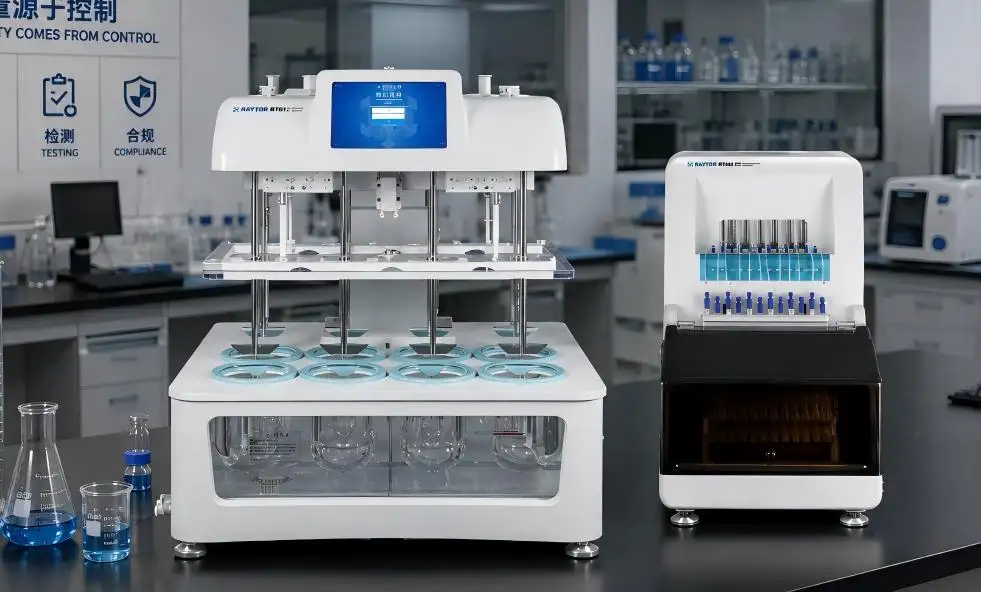
Planning a Dissolution Equipment for Pharmaceutical QC Lab configuration? Raytor provides pharmaceutical dissolution solutions designed to support Chinese, U.S., EU, and other national pharmacopoeial requirements, with 21 CFR Part 11 audit-ready functions.
The portfolio covers USP Apparatus 1–4, mechanical performance test kits, solvent-handling equipment, a configurable operating interface, and a range of accessories with customization support. Please provide us with your dosage form, assay method, provided volume, UV or HPLC method, and what documentation you need to evaluate a compatible configuration. We will conduct final testing according to the pharmacopoeia and the approved methods.
FAQs
Q1. What kinds of dissolution apparatuses does Raytor provide?
Raytor supplies pharmaceutical dissolution systems for USP Apparatuses 1-4. This includes a range of dissolution accessories, sampling systems, solvent-handling systems, and mechanical performance test kits.
Q2. Do Raytor systems cover methods in USP, European, and Chinese Pharmacopoeias?
Raytor systems cover dissolution methods for the USP, European, and Chinese Pharmacopoeias. However, laboratories are required to select the appropriate apparatus, parameters, accessories, and qualification processes for the given monograph or method.
Q3. What are the available types of USP dissolution apparatus?
Raytor's range includes:
• USP 1: Basket apparatus
• USP 2: Paddle apparatus
• USP 3: Reciprocating cylinder
• USP 4: Flow-through cell
Selection of the appropriate apparatus is based on the dosage form and the registered dissolution method.
Q4. Do Raytor systems comply with 21 CFR Part 11?
Some Raytor dissolution systems provide functionality to support a 21 CFR Part 11 compliant system, including secure login, access control, data management, and audit trail. Buyers should confirm the necessary software and the scope of validation for the selected system.
Q5. Does Raytor provide IQ, OQ, and PQ documentation?
Raytor states that IQ and OQ documentation is available for the RT6 series, as is PQ documentation, provided that the laboratory selects either prednisone or salicylic acid for verification.