







USP 4 Flow Through Cell Dissolution System for Poorly Soluble Drug Products
2026-07-22


Dissolution method development faces many difficulties with poorly soluble drug products. Within a fixed-volume vessel, the dissolution medium can reach its saturation concentration before the complete drug dosage is dissolved. The release profile may be further complicated by the combination of aggregation, sedimentation, poor wettability, the particular polymorphic form, and interactions with the excipients.
The USP 4 Flow Through Cell Dissolution System defines a test cell to which medium is continuously delivered. As controlled hydrodynamics and varying medium types are readily accommodated, this system is useful for drug products that are slowly soluble, extended-release products, and evaluation of complex drug products that are difficult to assess using basket or paddle methods.
Why Are Poorly Soluble Drugs Difficult to Test?
Limited Solubility and Medium Saturation
As the drug concentration in the medium approaches the solubility limit, the concentration gradient that drives the dissolution process decreases. The measured dissolution rate may therefore slow, even when the formulation continues releasing the active pharmaceutical ingredient.
Particle Aggregation and Sedimentation
Dissolution behavior may be influenced by:
•API particle size and particle-size distribution;
•Crystal form and surface energy;
•Powder wettability;
•Interactions with hydrophobic excipients;
•Particle agglomeration;
•Sample position within the vessel;
•Accumulation of material at the vessel bottom.
Sensitivity to Hydrodynamics
Paddle speed, basket rotation, medium flow, air bubbles, and sample positioning can alter the diffusion boundary layer around the dosage form. For poorly soluble drugs, small hydrodynamic differences may produce noticeable variation between test runs.
How Does a USP 4 Flow Through Cell Dissolution System Help?
Continuous Medium Renewal
When in open-loop mode, the system allows the inflow of fresh medium into the flow-through cell, while the effluent is collected for analysis. This continuous renewal can reduce medium saturation and support more stable concentration gradients.
Defined Flow Conditions
A USP 4 Flow Through Cell Dissolution System allows laboratories to control several important variables:
•Medium flow rate;
•Flow-through cell diameter;
•Cell geometry;
•Glass-bead arrangement;
•Sample holder design;
•Sample position;
•Filtration configuration.
These parameters can be standardized during method development to improve repeatability.
Reduced Sedimentation Effects
While the static design of the vessel encourages localized sedimentation, the flowing medium designs can reduce sedimentation and may enhance the contact between the sample and the dissolution medium. The actual influence will depend on the selected cell, flow rate, method of loading, and formulation characteristics.
Long-Term Testing and Media Changes
The USP 4 method can be used for a release study that is several hours to several days in length. Additionally, the different dissolution media can be used to simulate the effect of different dissolution media on changing pH. However, to be able to substantiate and validate the method, a sound scientific reason must be provided.
Open-Loop vs Closed-Loop USP 4 Testing
| Evaluation Factor | Open-Loop Mode | Closed-Loop Mode |
| Medium movement | Fresh medium passes through once | Medium recirculates |
| Medium volume | Usually higher | Limited and controlled |
| Saturation risk | Generally lower | Depends on dose and solubility |
| Sample concentration | May be relatively low | Builds up during testing |
| Medium consumption | Higher | Lower |
| Typical application | Very low solubility or long release | Screening or low-dose products |
| Data processing | Fraction-based cumulative release | Recirculating-volume calculation |
For highly insoluble compounds, an open-loop USP 4 Flow Through Cell Dissolution System is often considered because fresh medium continuously enters the cell. Closed-loop operation may be preferable when analytical sensitivity is limited or when laboratories need to reduce medium consumption.
Critical Method Parameters
Dissolution Medium
Medium selection should consider:
•pH and buffer capacity;
•Buffer salt type and concentration;
•ionic strength;
•Surfactant type and concentration;
•Physiological relevance;
•API and formulation stability.
Surfactant concentration should not be increased only to accelerate dissolution. The selected medium should also preserve the method's ability to distinguish meaningful formulation or manufacturing differences.
Flow Rate
Flow rate affects medium renewal, shear force, boundary-layer thickness, cumulative release, and channel-to-channel repeatability. Method developers should evaluate several flow rates instead of selecting a single condition without comparison.
Cell and Sample Configuration
The appropriate setup depends on whether the sample is a tablet, capsule, powder, microsphere, implant, or another dosage form. Cell diameter, tablet holders, powder cells, glass beads, and sample supports can all change the internal flow path.
Filtration, Temperature, and Degassing
Filter selection should be evaluated for:
•Pore size;
•Membrane material;
•Drug adsorption;
•Excipient blockage;
•Particle breakthrough;
•Recovery percentage.
Temperature control, medium degassing, and complete tube priming are also important. Air bubbles may interfere with pump performance, sample wetting, and effective flow rate.
Proposed Framework for Developing Test Methods
- Study solubility at different pHs, temperatures, and with varying surfactants.
- Define the objectives of the tests which may include formulation screening, batch comparisons, quality control (QC), and characterization of the release.
- Select between open-loop and closed-loop systems.
- Select the type of flow-through cell that corresponds with the sample and dosage form.
- Examine different combinations of media and flow rates for reliability and sensitivity.
- Check recovery and compatibility of filtration with tubing and collection containers.
- Test the robustness for small changes in flow and temperature, the loading, and the composition of the medium.
- Establish system suitability criteria for flow accuracy, temperature, recovery, and sampling.
USP 4 vs USP Apparatus 1 and 2
| Feature | USP Apparatus 1 | USP Apparatus 2 | USP Apparatus 4 |
| Test structure | Rotating basket | Paddle and vessel | Pump and flow-through cell |
| Medium format | Fixed volume | Fixed volume | Open or closed loop |
| Medium renewal | Limited | Limited | Continuous in open-loop mode |
| Sedimentation control | Formulation-dependent | Cone formation may occur | Adjustable through flow conditions |
| Method complexity | Lower | Lower | Higher |
| Typical value | Conventional solid dosage forms | Routine tablets and capsules | Poorly soluble and long-release products |
A USP 4 Flow Through Cell Dissolution System is not automatically superior to USP Apparatus 1 or 2. Selection should be based on dosage form, study objective, analytical sensitivity, reproducibility, and method discrimination.
Raytor RT710 Flow-Through Cell Dissolution System
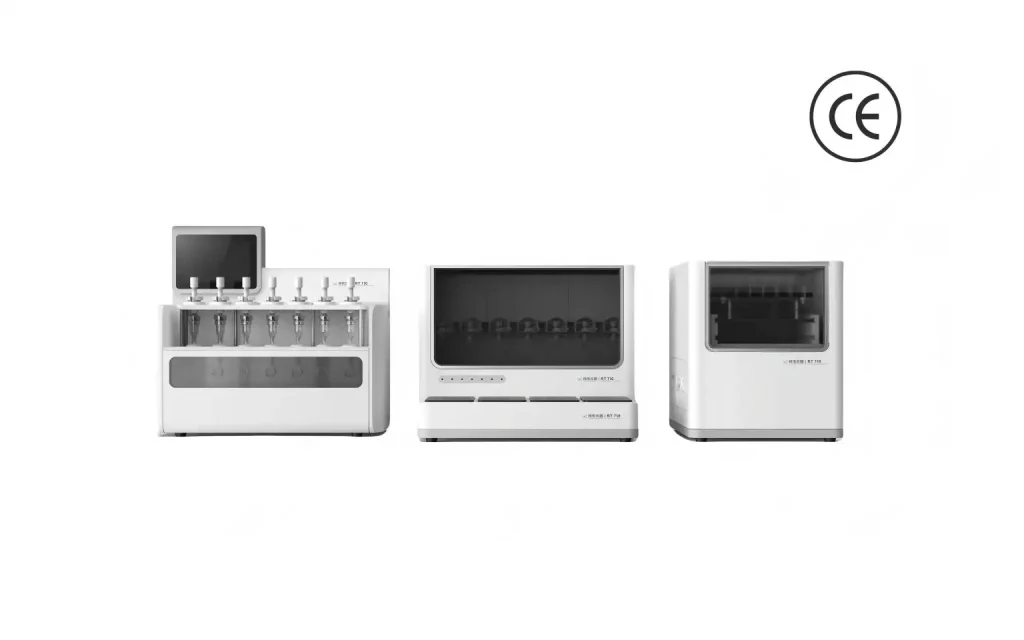
The Raytor RT710 combines a flow-through cell apparatus, medium conveying workstation, solvent heating workstation, and automatic sampling workstation. It is designed for methods based on USP Apparatus 4, European Pharmacopoeia Apparatus 4, and the corresponding Chinese Pharmacopoeia method.
Key system capabilities include:
•Seven independent test channels;
•Adjustable flow from 1 to 40 mL/min;
•Open-loop and closed-loop operation;
•Simultaneous testing with two flow rates;
•High-precision syringe-pump delivery;
•Independent temperature monitoring for each channel;
•Temperature control within ±0.5°C;
•Multiple sampling and filtration configurations;
•Audit trails, user permissions, data backup, and other 21 CFR Part 11-related functions.
The system can be configured for tablets, capsules, powders, ophthalmic preparations, injections, topical products, and other formulations according to the selected flow-through cell.
Final Thoughts
The USP 4 Flow-Through Cell Dissolution System aids laboratories in the management of medium saturation, sedimentation, controlled hydrodynamics and prolonged testing of poorly soluble drug products. Results can be impacted if there is unsubstantiated media, unvalidated flow rates, inappropriate filtration, inconsistent sample loading, and unqualified equipment.
When choosing a system, a laboratory must first determine the solubility profile of the drug, the dosage form of the drug, the duration of the test, the method of analysis, the dissolution medium, the frequency of sampling, and the degree of automation required.
FAQs
Q1. What are the features of Raytor RT710 Flow-Through Cell Dissolution System?
The Raytor RT710 employs the USP 4 design to provide a seven-channel, Flow Through Cell Dissolution System. This system contains all the components needed for pharmaceutical dissolution and release testing: flow through cells; delivery of the dissolution media; heating; temperature and flow rate control; filtration; and automated sample collection.
Q2. Does the Raytor RT710 support both open-loop and closed-loop testing?
The RT710 is designed to perform both open-loop and closed-loop methods within the same automated sampling workstation. This flexibility allows testing and circulation methods to be adapted to the solubility of the drug, the sensitivity of the analytical method, the consumption of the medium, and the time of the test.
Q3. What is the flow-rate range of the Raytor RT710?
The Raytor RT710 is designed with an adjustable flow rate in the range of 1 to 40 mL/min. The flow rate for each test should be selected and validated to the specific requirements of the dosage form, the configuration of the flow through cell, the dissolution media, and the objective of the test.
Q4. How many test channels does the Raytor RT710 provide?
The Raytor RT710 is designed with seven test channels, and is capable of supporting two different flow rates at the same time. This feature allows the comparison of the hydrodynamic conditions of dissolution method testing in the laboratory.
Q5. How does the Raytor RT710 control temperature?
The Raytor RT710 is designed with real time temperature control and monitoring for each test channel. The temperature control within the system is stated to be within ± 0.5 °C. This means that the flow through cells are maintained at an equal temperature, allowing for the creation of different temperature conditions for each of the seven flow through cells.