







Pharmaceutical Dissolution Testing for Eye Drops: Methods, Challenges, and Equipment
2026-07-23


Not every eye drop requires conventional dissolution testing. In a simple ophthalmic solution, the active pharmaceutical ingredient is already dissolved, so testing usually focuses on attributes such as assay, impurities, pH, osmolality, sterility, and delivery performance. Pharmaceutical Dissolution Testing for Eye Drops is more relevant to certain suspensions, emulsions, nanoparticle systems, gels, and ointments when drug-release behavior must be characterized.
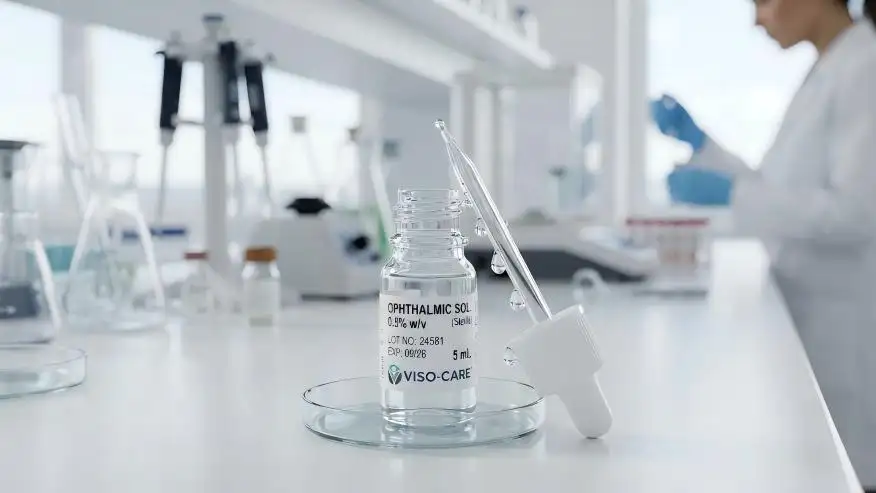
FDA's quality guidance for topical ophthalmic drug products provides draft, non-binding recommendations rather than a universal dissolution requirement for every eye drop. Testing should therefore be applied to certain ophthalmic dosage forms when scientifically justified.
What Is Pharmaceutical Dissolution Testing for Eye Drops?
Pharmaceutical Dissolution Testing for Eye Drops measures the rate and extent at which an API becomes available from an ophthalmic formulation under controlled laboratory conditions. It may support:
•Formulation and process development
•Batch-to-batch comparison
•Stability studies
•Manufacturing-change assessment
•Pharmaceutical quality control
•Generic-drug comparison
Dissolution testing generally emphasizes drug transfer into a selected medium. In vitro release testing, or IVRT, is a broader term often used for complex liquids and semisolid preparations.
The appropriate eye drop dissolution method should therefore reflect the dosage form, release mechanism, analytical objective, and regulatory strategy.
Which Ophthalmic Products May Need Release Testing?
Ophthalmic Solutions
Traditional dissolution testing usually adds limited value because the API is already dissolved. Exceptions may include products containing a controlled-release carrier or another structure that affects drug availability.
Ophthalmic Suspensions
The performance of a drug product and the process of dissolution may be affected by modifications to the drug substance particle characteristics. The influence of particle characteristics on the release profile may be attributed to the fraction of the drug that is soluble, viscosity, settling, redispersibility, and the form of the crystals.
Emulsions and Nanoparticle Systems
Droplets, micelles, liposomes, or solid nanoparticles can make it difficult to distinguish released drug from drug that remains associated with the formulation.
Gels and Ointments
These products may require vertical diffusion cells, specialized sample holders, flow-through cells, or other validated accessories rather than a standard liquid-dose setup.
Main Testing Methods
| Method | Potential Application | Main Advantage | Key Limitation |
| Paddle method | Adapted ophthalmic suspensions | Familiar speed and temperature control | Settling and large medium volume may affect relevance |
| Basket method | Samples placed in validated holders | Stable sample positioning | Usually unsuitable for free liquid drops without adaptation |
| Flow-through cell | Suspensions and semisolids | Continuous medium renewal | Flow rate, filtration, and cell packing need validation |
| Vertical diffusion cell | Gels, ointments, selected suspensions | Suitable for membrane-based release | Membrane resistance may control the result |
| Dialysis method | Emulsions, liposomes, nanoparticles | Separates the formulation from receptor medium | May produce artificially slow release |
| Specialized perfusion | Complex particulate products | Improved separation of drug phases | Requires dedicated equipment and development |
Key Testing Challenges
Small Dose and Rapid Release
Eye drops contain small sample volumes, and early release may occur quickly. Minor differences in dosing or sampling time can therefore distort the release curve.
Representative Sampling
Particles in ophthalmic suspensions can settle. Changes to needle placement, mixing speed, dosing position, or waiting time may affect the concentration of the drug measured.
Released-Drug Separation
Some filtration membranes may adsorb the API in the dissolved state or allow the API in the fine particulate state to pass through. Among various separation techniques, filtration, centrifugation, and dialysis must be evaluated for recovery, selectivity, and retention of particles.
Medium Selection
The dissolution medium must be an optimal compromise between the relevance to in vivo conditions and the performance of the analysis. Key variables include:
•pH and buffer capacity
•Lonic Strength
•Concentration of Surfactants
•Volume of the Medium
•Sink Conditions
•Stability of the API
•Hydrodynamics
Vessel centering, vertical alignment of the shaft, rotation speed, and type of sampling and dosing used all influence the movement of the fluid in the immediate environment.
An effective Pharmaceutical Dissolution Testing for Eye Drops method should identify significant differences in particle size, viscosity, crystal structure, droplet size, excipient proportions, or changes in the manufacturing process; it should not simply yield a smooth release profile.
Stepwise Development of Methods
Identify the kind of dosage form: Is it a solution, suspension, emulsion, gel, ointment, nanoparticle system or solid?
•Identify the objective of the method: Does the method relate to development, quality control (QC), and/or stability testing, or does it relate to changes in process or equivalence testing?
•Select the appropriate apparatus: Consider the paddle, basket, flow-through, diffusion, dialysis, and other specialized perfusion methods.
•Construct the medium: Evaluate the solubility and stability of active pharmaceutical ingredient (API), pH, surfactant concentration, and degree of discrimination.
•Control Dosing: Determine the onset time, mixing, dose and the dosing site.
•Optimize sampling: Consider the following; needle depth, retention and adsorption of the particles, adsorption to the filter and replacement of the medium.
•Validate the method: The method should be evaluated for, specificity, linearity, accuracy, robustness, precision, stability of solutions and the range of measurement.
FDA's product-specific guidance for prednisolone acetate ophthalmic suspension recommends comparative IVRT using at least 12 units from each batch. It also calls for a method capable of identifying formulation differences and capturing the complete release profile. These requirements are product-specific and should not be applied automatically to every eye drop.
Critical Parameters to Control
| Parameter | Control Focus |
| Temperature | Bath uniformity and equilibration |
| Rotation speed | Actual rpm, stability, and method sensitivity |
| Vessel geometry | Centering, shaft verticality, and wobble |
| Dosing | Synchronous addition and traceable start time |
| Sampling | Needle depth, timing, and filter recovery |
| Medium volume | Fill accuracy, evaporation, and replacement |
How Raytor RT612 Supports Controlled Testing
After an appropriate test principle has been established, the instrument must control dosing time, temperature, rotational speed, vessel geometry, and sampling disturbance.
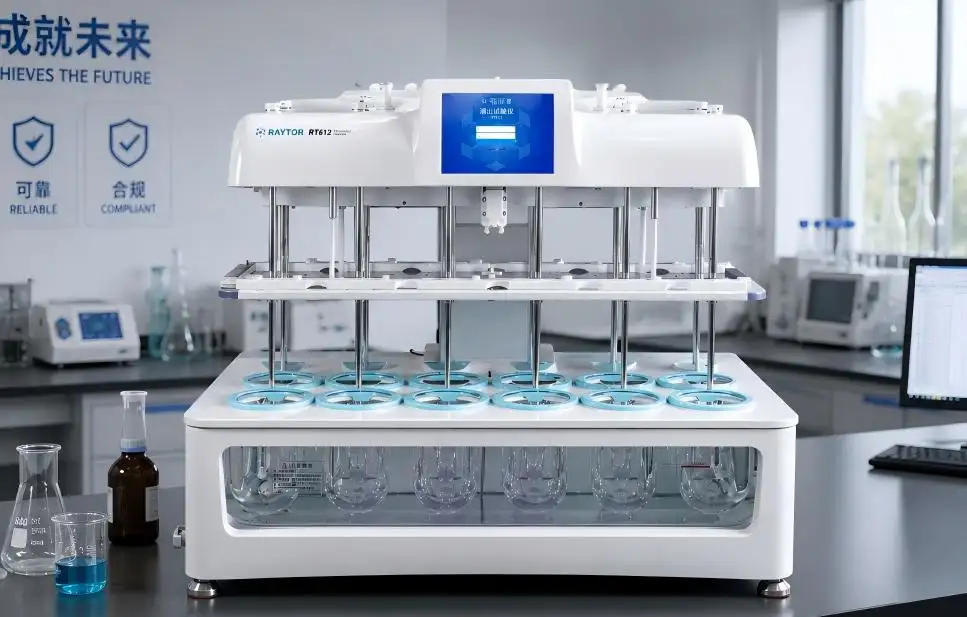
The 12-position Raytor RT612 Dissolution Apparatus provides:
•Automatic synchronous dosing
•Individual temperature monitoring
•Real-time speed and temperature display
•Automatic medium preheating
•Non-resident sampling needles
•Automatic sampling-height positioning
•Automatically centered dissolution vessels
•Coaxial paddle-and-basket design
•Optional dual-drive operation
Raytor specifies a speed range of 0–300 rpm, steady-speed error within ±0.3 rpm, and temperature accuracy within ±0.2°C.
These functions may support validated paddle or basket methods, ophthalmic suspension screening, parallel formulation comparison, and studies requiring reduced sampling disturbance.
However, emulsions, liposomes, nanoparticles, gels, or ointments may still require specialized separation systems, sample cells, membranes, or accessories. Compliance with general pharmacopeial apparatus requirements does not automatically validate a product-specific ophthalmic method.
Conclusion
Pharmaceutical Dissolution Testing for Eye Drops should begin with the dosage form and analytical objective—not with the instrument. The main challenges are separating released drug from unreleased material, controlling rapid sampling, maintaining representative samples, and proving that the method can detect meaningful formulation differences.
For laboratories developing ophthalmic dissolution or IVRT methods, Raytor can review the formulation type, medium volume, sampling plan, and proposed apparatus configuration. Share your testing objectives to evaluate whether the RT612 or another Raytor testing setup better fits the intended method.
FAQs
Q1. What are the benefits of the coaxial paddle-and-basket design?
The coaxial paddle-and-basket design enables laboratories to alternate between paddle and basket methodologies without requiring the readjustment of the dissolution-unit height. Thus, the design accommodates changes of method that require different dissolution shaft heights, while ensuring that the position of the shaft can be repeated.
Q2. How many dissolution positions are available in the RT612?
The Raytor RT612 has twelve dissolution positions. This layout allows parallel formulation screening or comparison, method validation and other tasks that require multiple replicate units or dissolution methods.
Q3. What is the rotational speed range of the RT612?
The RT612 has a rotational speed range of 0-300 rpm with a resolution of 0.01 rpm and a steady state error of ±0.3 rpm. The selected speed of the system should be justified in the framework of method development.
Q4. Why develop synchronous dosing for eye drop dissolution testing?
Within the early sampling window, small variations in the dosing time can lead to a large variance in the results of the testing of sensitive rapid-release ophthalmic formulations. The RT612 system minimizes dosing time differences between vessels and thus supports the same sampling window by logging real time dosing for early sampling.
Q5. How does the RT612 provide temperature control?
The RT612 provides the function of temperature control of the dissolution medium and of the surrounding water with an accuracy of ±0.2 °C. It supports scheduled tests by automatically preheating the water bath and the dissolution medium. Additionally, temperature control of each dissolution position is provided with a configurable real time display of the parameters.