


Dissolution Test System for Pharmaceuticals: Immediate-Release vs. Extended-Release Testing
2026-09-16


Selecting a Dissolution Test System for Pharmaceuticals requires more than matching vessel capacity to laboratory workload. Immediate-release (IR) methods may demand closely spaced early samples, while extended-release (ER) methods require sustained control of temperature, medium volume, and sample stability.

At Raytor, we evaluate these requirements together. Automation is useful when it preserves the validated method's timing, recovery, and discriminatory power.
Immediate-Release vs. Extended-Release: What Changes?
IR formulations release drug without an intentional release-retarding mechanism. ER formulations use matrices, coatings, or other structures to prolong release. Neither category has a universal test duration or acceptance threshold.
| Decision Dimension | Immediate-Release Testing | Extended-Release Testing |
| Analytical objective | Characterize dissolution rate and extent | Characterize release throughout the intended period |
| Sampling strategy | Early profile points during development; potentially one specified QC point | Early, intermediate, and final points |
| Formulation sensitivity | Disintegration, particle size, wetting, and excipients | Polymer properties, coating integrity, diffusion, and erosion |
| Medium selection | Solubility, pH, and method discrimination | These factors plus interaction with the release mechanism |
| Dominant risks | Missed early changes, flotation, coning | Excessive early release, incomplete release, evaporation |
| System requirements | Accurate timing and short sampling cycles | Sustained control, volume accounting, and sample stability |
| Result interpretation | Product-specific acceptance or profile comparison | Stage-specific release limits and individual-unit variability |
Dissolution methods serve development, batch consistency, and manufacturing-change assessment. The required information differs between these applications. FDA IR dissolution guidance
Apparatus and Medium Should Preserve Method Discrimination
Basket vs. Paddle
A Dissolution Test System for Pharmaceuticals needs to generate the correct hydrodynamic conditions. Both the basket and the paddle methods can be used for IR and ER products; however, the choice can be made based on the behavior of the formulation.
• Floating Capsules: Assess if a suitable basket design is provided or if a sinker configuration is provided justifiable.
• Swelling of capsules: May promote coning at the paddle.Note the accumulation of particlesand hydrodynamics before adjusting the paddle speed.
• Swelling Matrices: Deformation and adhesion during the process should be analyzed. Also, analyze position throughout the run.
• Mechanical variation: Analyze shaft alignment, wobble, vessel geometry, and the height of the stirring element.
Increasing agitation can improve apparent dissolution and conceal significant differences in the formulation.
Sink Conditions and pH
Sink conditions refer to the volume of the medium which is at least three times the amount required to make a saturated solution of the dose. Verify your conditions to check if sink conditions are met.
Although improving solubility with surfactants is possible, the method can become less discriminating with higher surfactant concentration. High concentrations may affect both the hydration of the polymers and the permeation of the coatings for ER products.
ER and enteric delayed-release products are distinct. Acid-to-buffer transitions are not automatically required for every ER method.
Sampling Is a Critical Method Parameter
The suitability of a Dissolution Test System for Pharmaceuticals depends on when a sample represents the vessel contents—not simply when the collection vial receives liquid.
Timing and Transport Delay
For rapidly dissolving IR products, closely spaced samples may be necessary to resolve early differences. Validate sampling timing across channels and account for tubing transport and flushing.
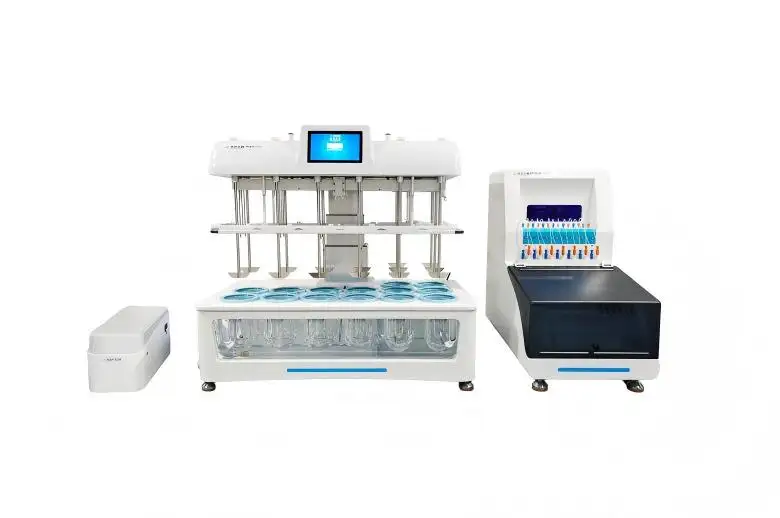
Our RT614-ST Automated Dissolution System specifies a minimum first-sample interval of three minutes and subsequent intervals of five minutes. Methods requiring tighter spacing need a compatibility assessment before transfer. RT614-ST specifications
Volume and Mass Balance
During repeated withdrawals, both the medium and the dissolved drug are removed. With replacements of drug-free medium of equal volume, the cumulative dissolved mass can be calculated as:
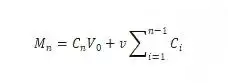
Here, C_n is the concentration of the vessel samples taken at sampling point n, V_0 is the maintained volume of the vessel, and v is the constant volume withdrawn.
This equation is applicable to representative sampling with a constant volume, and withdrawals are not replaced. Appropriate calculations should be done taking withdrawn samples into account.
Rationale Behind Filters and Stability
Total Sample Pathway Validation:
• Filter recovery: Compare with a reference prep and set discard volume.
• Tubing recovery: Assess adsorption and carryover at desired levels.
• Particle removal: Confirm that sample collection does not permit any particles that will cause dissolution.
• Sample stability: Confirm that sample collection does not allow sample to deteriorate between collection and analysis.
• Evaporation: Analyze anticipated volume changes over extended ER testing.
Consider the Curve, Not Just the Endpoint
Final percentages that are the same can have different release patterns. An ER formulation may satisfy the requirement by releasing most of the drug in the initial stages.
Review:
• Early release results in loss of control of release pattern.
• Intermediate release progresses to final release.
• Completion of the final release.
• Individual assessment of units and variability.
For IR products, acceptability testing must be performed separately from comparative profile studies. The similarity factor (f2) must not be used to assess the comparison of IR and ER formulations, which are meant to be different.
In vitro results can not be extrapolated to clinical results. For a relationship to exist between the two, an IVIVC must be developed and validated.
Raytor RT614-ST: Design Linked to Verification
When configuring a Dissolution Test System for Pharmaceuticals, we connect component design with measurable method requirements.
| RT614-ST Feature | Practical Contribution | Required Verification |
| High-precision sampling pump | Consistent withdrawal | Volume accuracy and timing |
| Teflon tubing | Chemically resistant sample pathway | Analyte recovery and carryover |
| Optional dual online filters with primary-filtrate discharge | Standardized filtration | Filter compatibility and discard volume |
| 210-position rack for 1.5 mL vials | Organized collection | Capacity against the sampling schedule |
| Access controls, audit tracking, and backup functions | Traceable records | Configuration and computerized-system validation |
These design features support workflow evaluation; laboratory compliance still depends on validated use and operating procedures.
Select Around the Method
A reliable Dissolution Test System for Pharmaceuticals must preserve sampling resolution, recovery, and release-profile information across both IR and ER studies.
Explore the Raytor RT614-ST Automated Dissolution System and discuss your apparatus, medium, sampling schedule, and analytical workflow with our team to assess an appropriate configuration.
FAQs
Q1. How many samples can the Raytor RT614-ST collect?
The RT614-ST has a 210-position rack for 1.5 mL vials. Laboratories should calculate capacity from the number of active sampling channels and collection points; rack capacity is separate from the number of programmable sampling events.
Q2. What should laboratories check before selecting the Raytor RT614-ST?
Confirm your dosage form, apparatus, medium volume, temperature, rotation speed, sampling times, and analytical workflow. Compare these requirements with the system's operating specifications, particularly for rapidly dissolving IR products.
Q3. What sampling intervals does the Raytor RT614-ST support?
Raytor specifies a minimum interval of three minutes for the first sample and five minutes for subsequent samples. Methods requiring more frequent early sampling need a compatibility review before implementation.
Q4. How does the Raytor RT614-ST automate sample filtration?
The system can accommodate dual online filters and automatically discard primary filtrate to condition the filter. Laboratories should validate filter material, drug recovery, and discard volume for each method.
Q5. Why does Raytor use Teflon sampling tubing?
Teflon provides chemical resistance and helps reduce adsorption risk along the sample pathway. Drug-specific recovery and carryover testing remain necessary, especially at low analyte concentrations.