





How Corrosion-Resistant Components Improve Durable Dissolution Equipment
2026-10-27


A dissolution tester can deliver the correct sampling volume while producing unexpectedly low API recovery. The pump passes its calibration check, but the analytical result drifts after repeated exposure to acidic media. Replacing the pump may not solve the problem: the sampling needle, transfer tubing, connectors, or filter could be altering the sample before it reaches the collection vial.
For pharmaceutical QC laboratories, dissolution equipment must endure more than just chemical exposure. Wetted components must not change the physical condition of the equipment and introduce adsorption, carryover and flow restrictions which may compromise accuracy of dissolution measurements.
At Raytor, in systems like the RT612-ST, we use corrosion resistant sampling components to address these concerns and rely on automated fluid handling to reduce the potential for operator error and contamination.
1. How Chemical Exposure Damages Dissolution Sampling Systems
The use of different types of media for dissolution testing introduce different types of exposure conditions to sampling systems. For example, hydrochloric acid may affect a system more than a phosphate buffer. It may be influenced by temperature, the duration of exposure, and the frequency of cleaning.
Metal components, especially stainless steels, are susceptible to localized corrosion under certain conditions. For example, in the presence of chloride media, it may cause pit corrosion in previously passive areas of the stainless steel.
There are other failure mechanisms, which include polymer and seal degradation. It may occur from incompatible solvents.
Deposits and restricted flow, may occur in connectors and filters and increase flow resistance and affect sample transfer.
Not all loss of recovery may be attributed to corrosion. It may be due to adsorption of the active pharmaceutical ingredients (API) to a sampling surface. The failure of sampling systems should be carefully studied to differentiate loss of recovery due to physical failure of a sampling system vs. loss of recovery due to adsorption of the active ingredient by the system.
2. What Corrosion-Resistant Materials are Important?
The right material depends on the total exposure profile and not on whether a part is advertized as chemically resistant.
The sampling needle shall be made of a material that will maintain its integrity and dimensional stability. Transfer tubing should be made of a chemically compatible material with low dead volume. The seals should be resistant to repeated compression and the cleaning solvents of the lab.
Wetted-Component Selection
| Component | Material Consideration | Main Failure Risk | Recommended Verification |
| Sampling needles | Corrosion-resistant metal alloy | Pitting, surface roughening, residue retention | Alloy identification, media compatibility, surface inspection |
| Transfer tubing | PTFE or other fluoropolymer | Adsorption, permeation, connection leakage | API recovery, flushing, leak test |
| Pump seals and connectors | Compatible elastomers and polymers | Swelling, compression set, chemical degradation | Exposure testing, dimensional inspection, leak checks |
| Online filters | Chemically compatible membrane | API binding, clogging, extractables | Recovery, pressure behavior, blank analysis |
PTFE has excellent resistance to the majority of aqueous acids, buffers and cleaning agents. However, compatibility with a solution does not always ensure 100% drug recovery.
Even chemically stable tubing may retain analytes through surface interactions. Low-concentration samples are especially sensitive because a small absolute loss can produce a significant percentage error.
The purchasing specification should identify materials throughout the complete wetted path, including small connectors and seals that may be overlooked in equipment brochures.
3. Why Tubing Geometry Matters as Much as Corrosion Resistance
Sampling accuracy depends on both material selection and fluid-path geometry.
Long tubing runs increase internal hold-up volume. If the flushing procedure does not displace the previous sample completely, an aliquot collected at a later time point may contain residual solution from an earlier one.
While the pump may withdraw the programmed volume, distortion in the dissolution profile may still occur.
Narrow portions of the system cause several problems. Particles and precipitates may block the flow. Inadequate support of connections may result in leaks and pressure losses.
When evaluating an automated system, the engineer should address:
• The internal hold-up volume: How much liquid is trapped between the sampling vessel and collection point?
• Flushing strategy: When sample rinsing occurs, is the replacement rinsing volume the same as the sample volume?
• Connection integrity: Can the joints withstand repeated exposure and the operating pressure?
• Filter loading: Is the filter Media still efficient as particulate accumulates on it?
A sample system that is short isn't always the best. The design should ensure access for maintenance and offer reliable movement of the sampling system.
4. How Raytor RT612-ST Addresses Sampling-System Durability
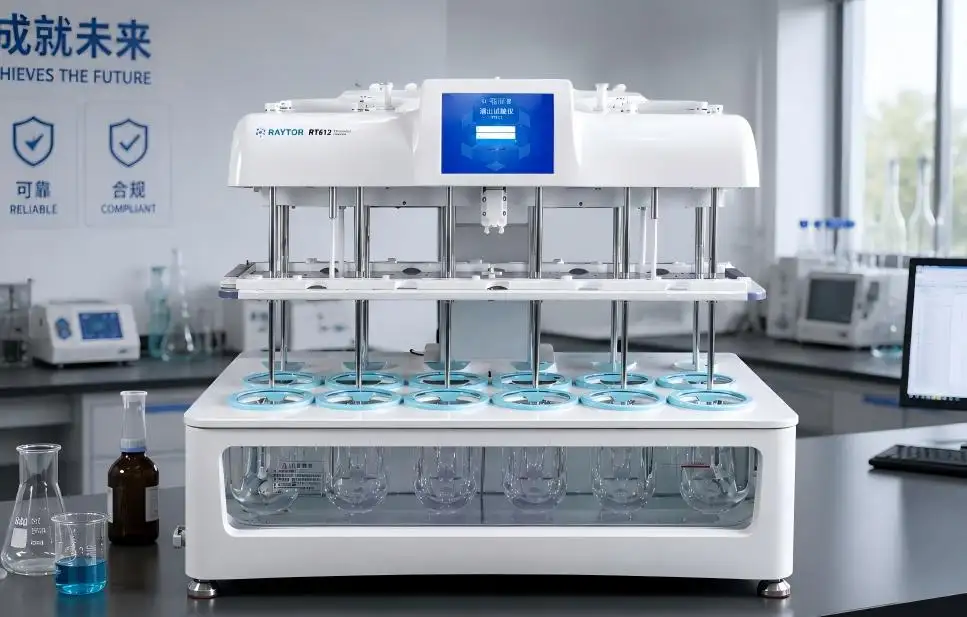
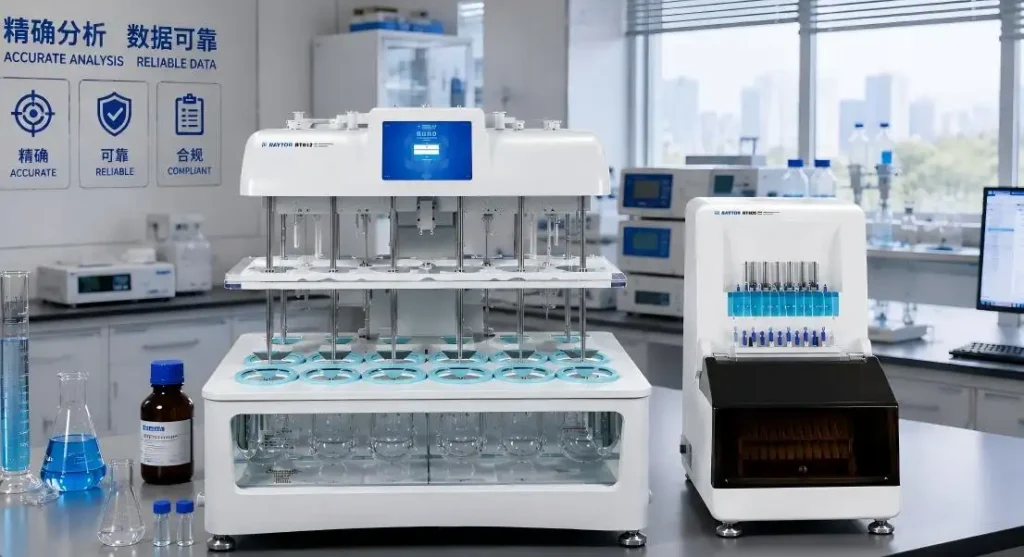
Raytor's RT612-ST Automated Dissolution System combines 12 dissolution positions with automated sampling, synchronized dosage introduction, and configurable filtration.
Corrosion-Resistant Sampling Components
The RT612-ST incorporates anti-corrosive sampling needles and a Teflon pipeline system. Raytor specifies the tubing for chemical stability and reduced sample adsorption.
These design choices address two potential sources of analytical error: deterioration of wetted components and analyte loss during transfer.
The product also offers a high-precision sampling pump with sampling precision of ≤±1%, alongside optional dual online filtration.
That sampling specification describes the manufacturer's stated volumetric performance; it should not be interpreted as proof of API recovery accuracy across different formulations.
5. How Should Laboratories Verify Long-Term Sampling Reliability?
Initial equipment qualification confirms performance under defined conditions. It does not establish that the sampling path will remain analytically suitable after repeated exposure to every proposed dissolution medium.
A practical evaluation should combine analytical recovery testing with component inspection.
Verification Sequence
- Establish Baseline Recovery
To determine baseline recoveries, run the reference solutions through the sampling system. Adjust sample preparation and/or method controls as needed.
- Assess Carryover
A blank collected after a high level sample should contain no residue. Any residue would need to be investigated to determine the cause and effect corrections.
- Challenge Media and Cleaning Conditions
Repeat exposure, during operating and cleaning cycles, should be evaluated along with the integrity of tubing, connectors and seals.
- Challenge Filter
Assess filtration by comparing reference solutions that have and have not been filtered. Determine the binding capacity of the filter.
- Compare Automated and Manual Sampling
Two methods (a) and (b) in USP General Chapter <1092> are on automated dissolution sampling and address adsorption, carryover, filtration, and sampling. Laboratories are required to demonstrate, by method validation, that the sampling procedures meet the intent of the procedures.
Acceptance criteria are based upon the requirements of the analytical method being performed. A severe chemical exposure test is not always representative of long-term, routine operations.
What Determines the Real Cost of a Durable Dissolution Apparatus?
The total cost of ownership of two similar dissolution apparatuses with different purchase costs can vary greatly depending on the frequency of tubing replacements and the extent of sample recovery investigations.
FAQs
Q1. What makes Raytor's dissolution equipment corrosion-resistant?
The Raytor RT612-ST uses anti-corrosive sampling needles and a Teflon pipeline to reduce chemical deterioration in the sampling path.
Q2. Why does Raytor use Teflon tubing in the RT612-ST?
Teflon provides broad chemical resistance and helps limit sample adsorption. API-specific recovery testing is still necessary.
Q3. How many dissolution vessels does the Raytor RT612-ST support?
The RT612-ST supports 12 dissolution positions, making it suitable for routine pharmaceutical QC testing and multi-position sampling workflows.
Q4. What is the sampling precision of the Raytor RT612-ST?
Raytor specifies sampling precision of ≤±1%. This volumetric specification does not independently establish drug recovery accuracy.
Q5. Does Raytor RT612-ST support automatic filtration?
Yes. The RT612-ST supports optional dual online filtration. Filter compatibility and API recovery should be verified for each dissolution method.