





Drug Testing Laboratory Setup: Online UV vs. Offline Dissolution Testing
2026-10-26


A pharmaceutical QC laboratory has validated a dissolution method using HPLC analysis of manually withdrawn samples. Management wishes to change the HPLC analysis to online UV detection to shorten turnaround time. The dissolution apparatus can be kept unchanged, but the analytical results will not.
A flow cell measures absorbance without chromatographic separation. Systems that include automation to control sample transport may be at a disadvantage compared to systems that include automation to control sample filtration. The major factor in the difference in result between the two systems may be the difference in temperature and agitation of the dissolution vessel.
Thus, for a Drug Testing Laboratory Setup, when dealing with online UV or offline analysis, the major consideration is method suitability, not instrument throughput.
1. Can Online UV Reliably Quantify the Dissolved API?
Online UV dissolution systems withdraw solution from the vessel and measure absorbance using an optical flow cell. Concentration is calculated using a validated calibration equation, generally based on the Beer–Lambert law.
This method is useful when the API of interest shows adequate UV absorption and the formulation matrix doesn't interfere significantly.
Spectral Interference and Optical Path Length
Also, direct UV measurements can be challenged by capsule shells, excipients, and degradation products that may also absorb at the analytical wavelengths. Turbidity and suspended particles can also cause light scattering.
Movement of the measuring wavelength or application of a background correction may be helpful, however, they will not always address analytical specificity.
The flow-cell path length is also a compromise. Generally, a longer optical path results in improved absorbance and greater sensitivity.
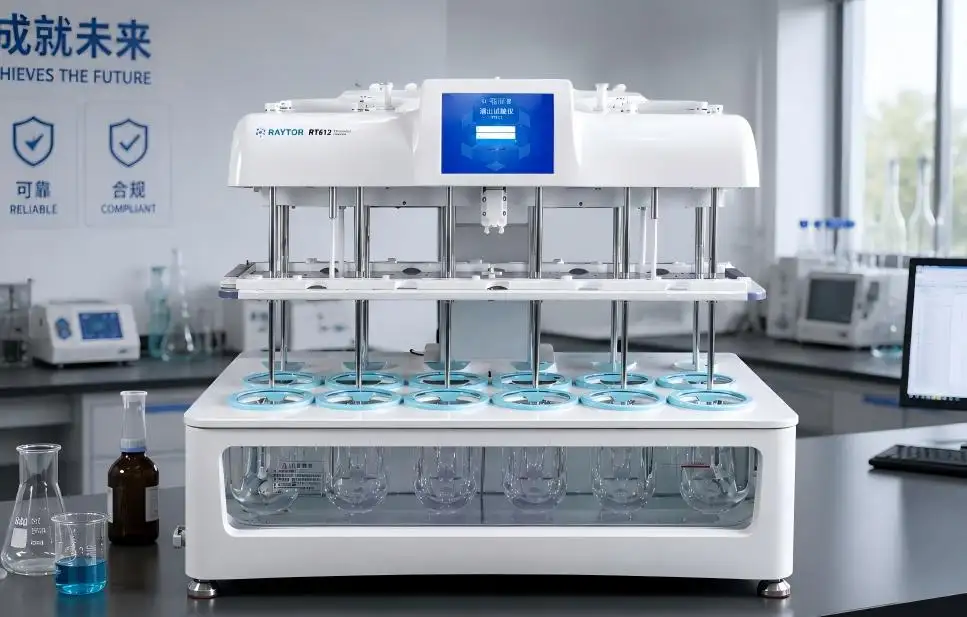
The Raytor RT612-UV Online UV Dissolution System supports online UV analysis of dissolution samples. When selecting a flow-cell optical path length, laboratories should consider the expected concentration range, the UV absorption characteristics of the API, and the dissolution medium. The suitability of the selected path length should be verified for the intended analytical method.
Prior to selecting a detector, laboratories should assess UV absorption spectra of the active pharmaceutical ingredient (API) in question, a placebo, and samples of dissolution. The determination of a line's calibration can't prove analysis specificity.
2. Where Do Online Sampling Errors Enter the System?
Online measurement removes some manual handling, but it introduces a fluid-transfer circuit between the dissolution vessel and detector.
The circuit may contain sampling probes, pumps, tubing, filters, valves, and flow cells. Each component can influence the measured concentration.
Transport Delay and Sample Recovery
A sample requires time to travel from the vessel to the flow cell. This delay depends on the internal liquid volume, pump flow, valve sequencing, and any premeasurement flushing.
In the case of rapid drug release, an increased concentration could be due to an earlier time point in the test. This is especially true when there is an initial sharp decline in the dissolution curve.
Other possible sources of failure:
• API adsorption: Drug molecules can adsorb to tubing and/or filter membranes, resulting in artificial dilution and, thus, low concentrations.
• Incomplete filtration: Residual particles in the sample can act as a nucleation site for air bubble formation, resulting in high light scattering.
• Carryover: Residual sample can be in flow cells and valves, and cross-contaminate the next sample.
• Air bubbles: Changes in the optical path can result in instability of the absorbance.
According to Raytor, the use of chemically resistant, low-adsorption sampling pipelines is one improvement to sampling systems. Using the right material for the pipelines will not guarantee a given system is compatible.
Recovery should be assessed by testing the actual formulation of the API, using the dissolution medium and the full sampling path.
3. When Is Offline Dissolution Testing the Better Choice?
Offline testing is preferred when sample analysis is time consuming or requires complex procedures. After the sample has been withdrawn, filtered and, if necessary, diluted, it can be analyzed by UV, Vis/NIR or HPLC.
HPLC is preferred, since chromatographic separation of the API from interfering substances can be achieved, if a validated method is available.
| Decision Factor | Online UV | Offline UV/HPLC |
| API with clean UV spectrum | Well suited after validation | Suitable, potentially more handling |
| Complex excipient matrix | Requires demonstrated spectral selectivity | HPLC often preferable |
| Frequent early sampling | Supports automated measurement intervals | Requires precise collection scheduling |
| Degradation-product interference | Potentially problematic | Stability-indicating HPLC may resolve interference |
| Sample dilution or preparation | Dependent on system configuration | More flexible preparation workflow |
| Routine operating burden | Fluid-path cleaning and optical maintenance | Sample handling, consumables and analyzer maintenance |
It is not a given that offline testing is more accurate. Manual samplings may lead to timing fluctuations, disruption of vessel hydrodynamics, and even further dissolution prior to efficient filtration.
For poorly soluble APIs, sample preparation may be risky. Cooling and storage may lead to loss of solubility and precipitation. These must be taken into account in the proposed analytical conditions.
The more useful question is whether online UV can provide the required analytical selectivity without introducing unacceptable sampling-system bias.
4. How Should Online and Offline Methods Be Compared?
An existing HPLC method shouldn't be replaced just because online UV yields a similar final percentage dissolved.
Intermediate time points can complicate profile interpretation, especially with modified release products. Modified release products may have more than one stage of release, and initial time points may be affected by a different mechanism of release.
USP <1092> The Dissolution Procedure: Development and Validation, provides guidance on aspects of automation and process validation. ICH Q2(R2) describes the performance characteristics that should be validated for analytical methods.
A suitable comparison protocol should include the following:
• Specificity: Evaluate placebo and degradation product interference. Assess effect of the dissolution medium.
• Recovery: Compare direct and indirect samples.
• Timing: Determine total analysis time.
• Profile Agreement: Analyze all time points and concentrate on early time points.
Challenge the system with a high level sample and then a blank to evaluate carryover. Evaluate the rinse of the flow cell.
Corrections for the volume of dissolution medium withdrawn must be addressed if the medium is replaced, discarded or returned to the vessel.
Acceptance criteria must be pre-established, justified and explained for the purpose of the method. Equivalence for one formulation does not apply to other formulations.
5. Which Raytor Configuration Matches the Laboratory Workflow?
Raytor offers dissolution configurations for both online UV analysis and automated offline sample collection.
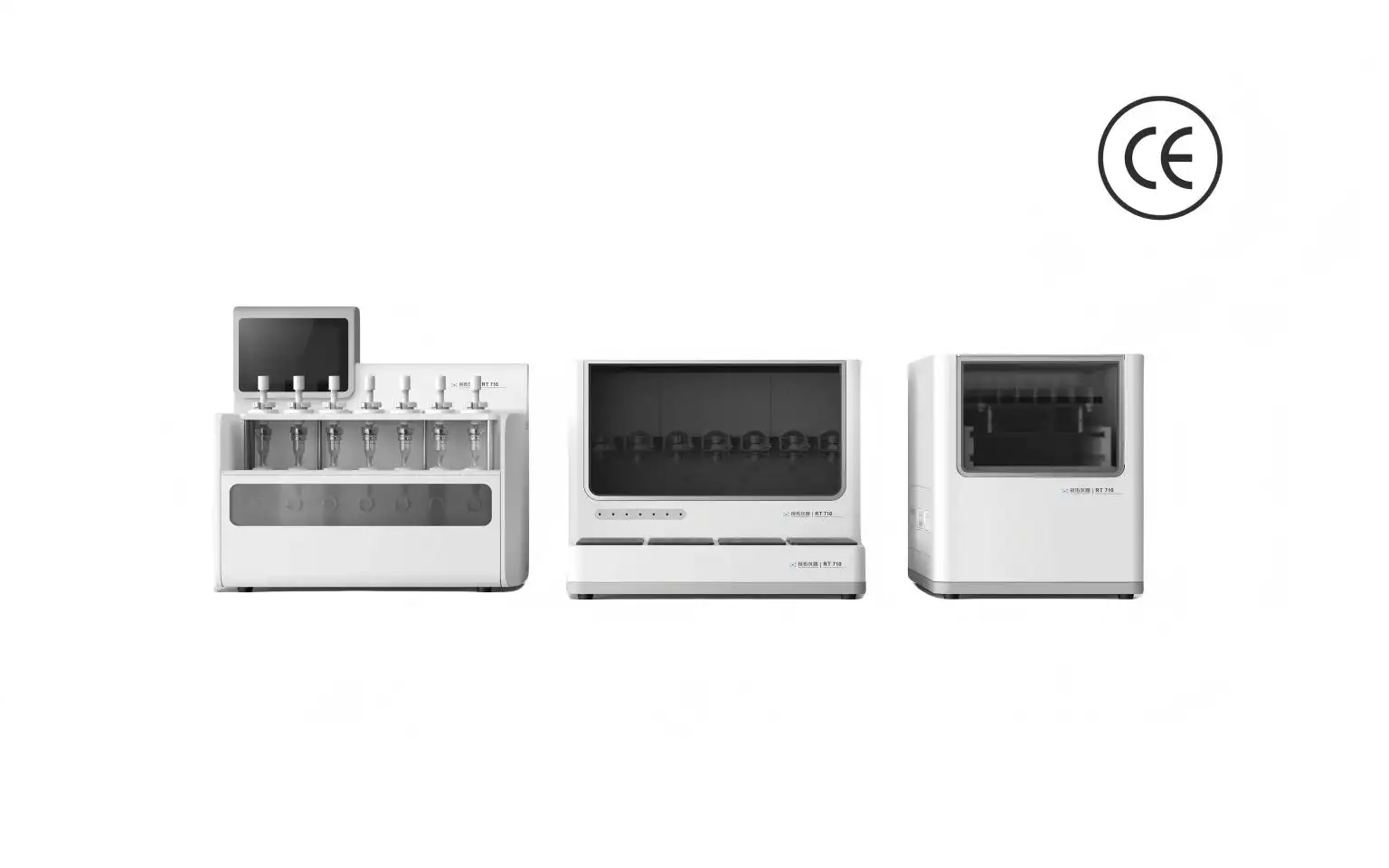
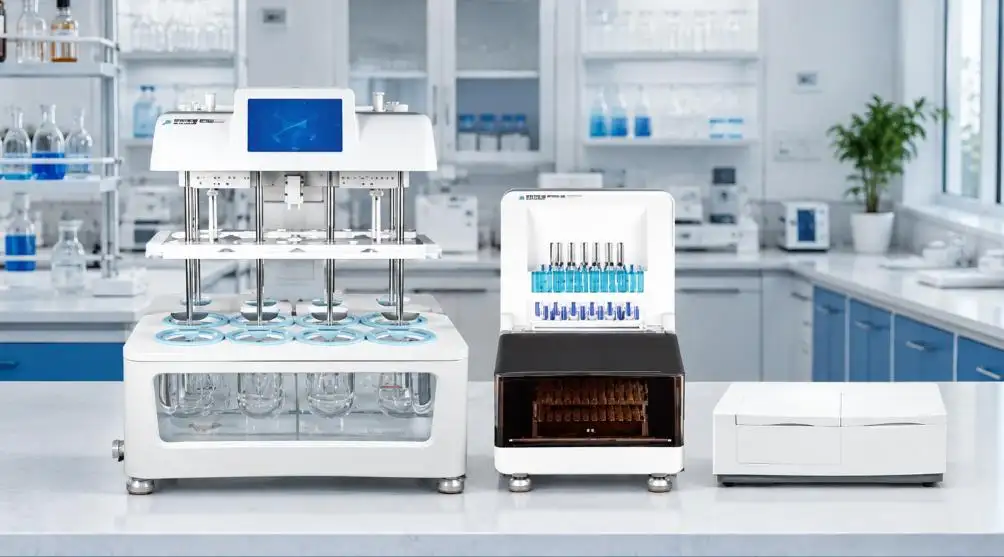
The RT600-UV Online UV Dissolution System integrates dissolution testing, automated sampling, UV-Vis analysis, and associated data processing. Raytor specifies individual sampling lines and flow cells for separate dissolution vessels, a design intended to reduce cross-channel contamination.
For laboratories retaining a separately validated UV or HPLC assay, the RT612-UV Automated Dissolution System provides automated sampling and sample collection, with filtration capabilities and optional online dilution.
The procurement review should establish three points before equipment approval:
• Whether the chosen analytical method can distinguish the API from formulation-related interference.
• Whether the proposed fluid path supports the required sampling intervals, concentration range, and analyte recovery.
• Whether the supplier can provide suitable equipment qualification documentation, software information, and configuration details.
Raytor publishes support for electronic-record controls associated with 21 CFR Part 11. Actual compliance still depends on configured functionality, laboratory procedures, and documented computerized-system validation.
For a new Drug Testing Laboratory Setup or dissolution laboratory upgrade, Raytor can help evaluate online UV and automated sampling configurations against the intended dosage forms, analytical methods, and testing workflow.
FAQs
Q1. What equipment is essential for a Drug Testing Laboratory Setup?
A pharmaceutical dissolution laboratory typically requires dissolution apparatus, sampling equipment, filtration systems, and UV or HPLC analysis. Raytor offers dissolution instruments with manual and automated sampling configurations.
Q2. What is the difference between online UV and offline dissolution testing?
Online UV measures dissolved API through an integrated UV detection system. Offline testing collects samples for separate UV or HPLC analysis. Raytor offers equipment supporting both workflows.
Q3. Which Raytor system supports online UV dissolution testing?
Raytor's RT600-UV Online UV Dissolution System integrates automated dissolution sampling, UV-Vis detection, and data processing for pharmaceutical dissolution analysis.
Q4. Can Raytor equipment support offline HPLC analysis?
Yes. Raytor's RT600-ST Automated Dissolution System supports automated sampling and sample collection. Collected samples can undergo separately validated HPLC analysis.
Q5. What flow-cell path lengths are available on Raytor's RT600-UV?
Raytor specifies flow-cell path lengths from 1 to 10 mm. Selection depends on API absorbance, expected concentration, and the validated analytical range.