

Pharmaceutical Lab Solution Provider for Oral, Transdermal & Drug Delivery Testing
2026-08-26


A tablet, topical gel, transdermal patch, and poorly soluble new compound do not fail for the same reason. One may be limited by dissolution, another by membrane transport, while a third may precipitate after a gastrointestinal pH change.

That is why selecting a Pharmaceutical Lab Solution Provider should start with the mechanism that must be measured—not simply with a list of instruments. A well-designed pharmaceutical laboratory connects dosage form, release mechanism, analytical endpoint, apparatus configuration, and validation into one testing strategy.
Dissolution, Release, and Permeation Answer Different Questions
For conventional oral products, dissolution testing measures the rate and extent at which the API enters solution. Basket and paddle methods remain practical for many tablets and capsules because their controlled vessel geometry provides reproducible hydrodynamic conditions.
The result is dependent on a number of variables:
• Rotation speed changes the shear and the diffusion layer thickness, and
• Temperature affects the solubility, diffusion, and viscosity.
• pH of the medium will affect the ionization of drug and its apparent solubility, and
• Sampling may affect the vessel volume and the calculated cumulative profile.
• Shaft alignment and centering will affect the flow symmetry around the dosage form.
Precision Control in Automated Oral Dissolution Testing
Raytor Model: RT612-ST
Product Type: 12-Position Automated Dissolution System
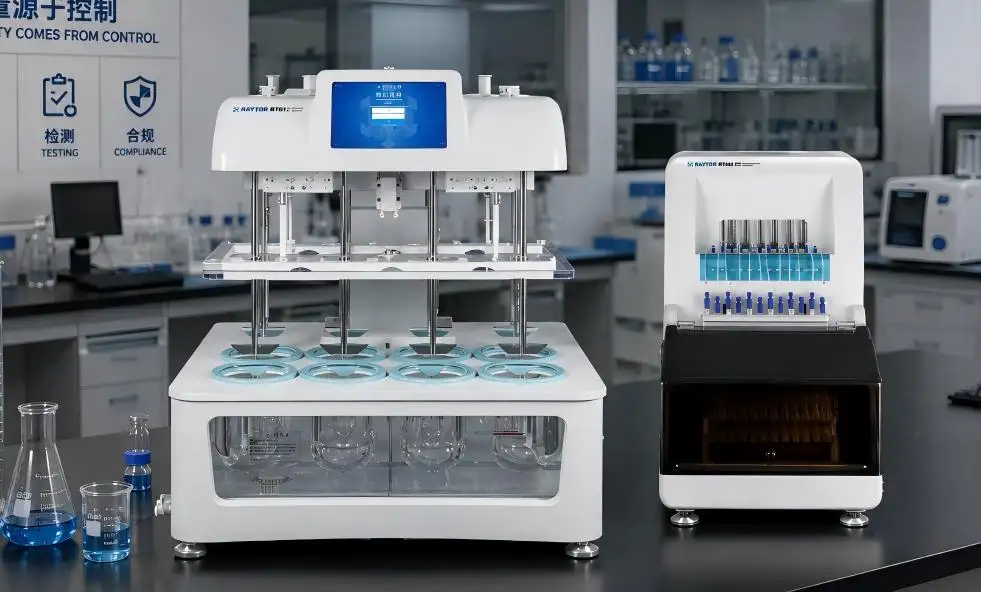
Raytor uses the RT612-ST automated dissolution apparatus to control these mechanical variables. The manufacturer states that the range of rotational speed is 0–300 rpm, the resolution is 0.01 rpm, the steady-speed error is ≤±0.3 rpm, the temperature accuracy is ≤±0.2°C, and the temperature resolution is 0.01°C.
These figures are not simply instrument specifications. For a Pharmaceutical Lab Solution Provider, stable speed and temperature control reduce apparatus-generated variation before differences between formulations are interpreted as real product behavior.
Mechanical geometry is equally important. For the RT612-ST, Raytor specifies:
• Instrument level below 0.5°
• Vessel and shaft verticality at 90°±0.5°
• Centering deviation below ±2.0 mm
• Depth-positioning deviation below ±1.0 mm
• Shaft and basket wobble below ±1.0 mm
Poor centering or excessive shaft wobble changes local hydrodynamics around the dosage form, which can weaken reproducibility during formulation comparison, method transfer, or QC testing.
Paddle and Flow-Through Systems Are Not Interchangeable
A conventional paddle or basket apparatus is often sufficient for immediate-release oral products. Poorly soluble drugs, powders, modified-release systems, and formulations requiring changing media may need a different fluid environment.
| Testing Approach | Main Control Mechanism | Typical Application |
| Basket / Paddle | Agitation in fixed medium volume | Tablets, capsules, routine QC |
| Flow-Through | Controlled medium flow | Poorly soluble and complex formulations |
| Franz Diffusion | Membrane and receptor transport | Creams, gels, patches |
| Dissolution-Permeation | Dissolution plus barrier transport | Early compound screening |
Controlled Flow for Complex Dissolution Conditions
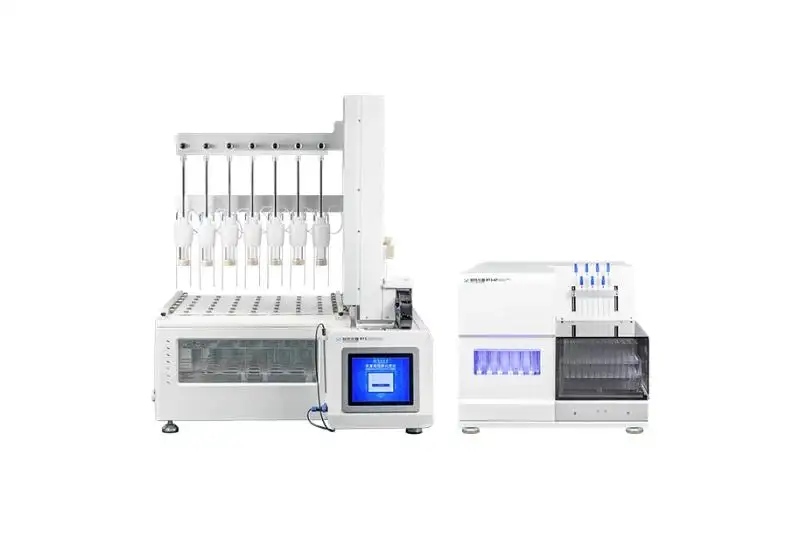
Raytor Model: RT710
Product Type: USP Apparatus 4 Flow-Through Cell Dissolution System
The RT710 uses seven flow-through channels and supports both open- and closed-loop operation. Its medium delivery system operates over 1–38 mL/min, while temperature-control error is specified below ±0.5°C. Sampling-volume error is stated as ≤±2% in closed-loop mode and ≤±5% in open-loop mode.
For poorly soluble drugs, continuous medium renewal can help maintain sink conditions. Open-loop operation can also expose the dosage form to fresh medium continuously rather than relying on a fixed vessel volume.
This illustrates why a Pharmaceutical Lab Solution Provider should match hydrodynamics to formulation behavior instead of assuming that one dissolution architecture is suitable for every dosage form.
IVRT and IVPT Require Different Experimental Logic
Topical and transdermal testing shifts the scientific question from dissolution toward diffusion.
• IVRT asks: How quickly does the API leave the formulation?
• IVPT asks: How quickly and how much API passes through a biological barrier?
Membrane type, effective diffusion area, receptor medium, temperature, stirring, sampling replacement, and trapped air can all influence the resulting profile.
Controlling Variability in Franz Cell Testing
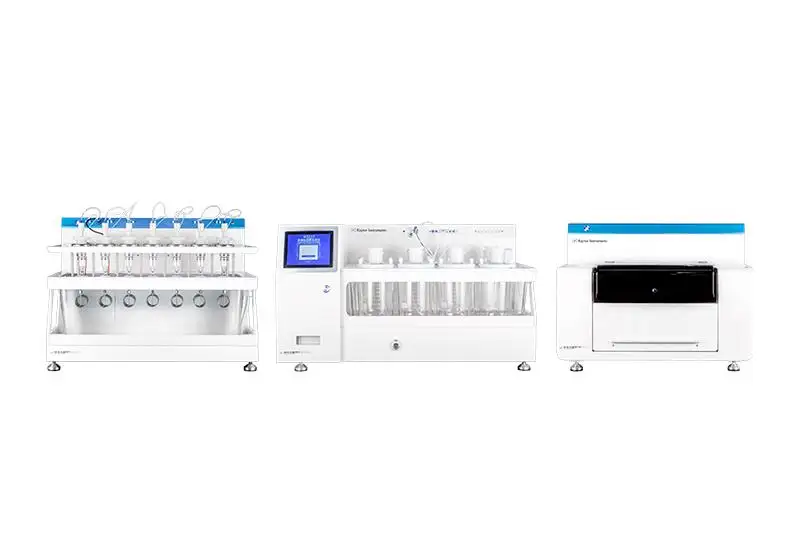
Raytor Model: RT814
Product Type: 14-Position Automated Transdermal Diffusion / Franz Cell System
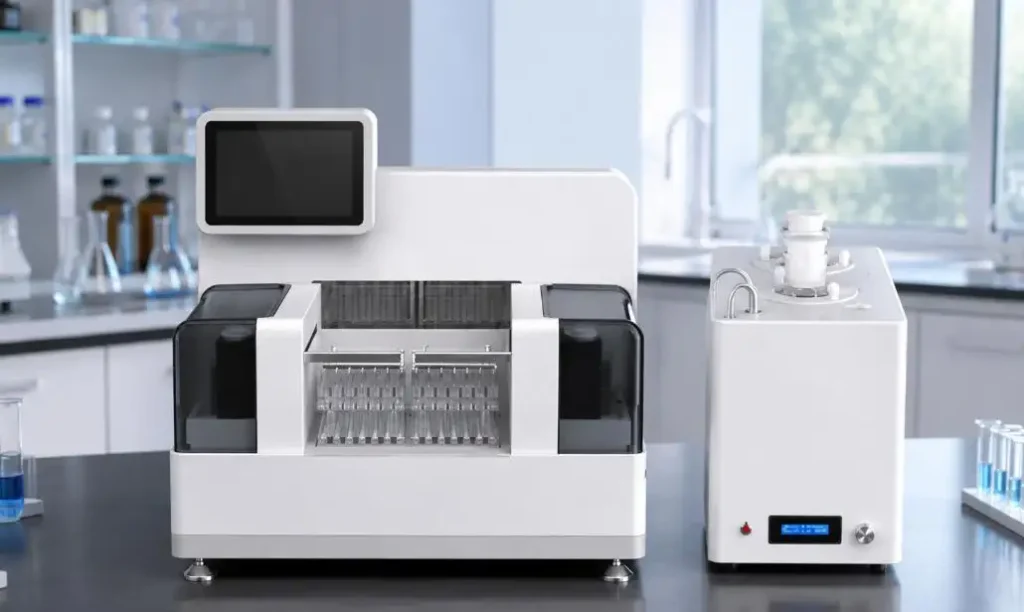
The RT814 uses a 7×2 configuration with 14 sampling channels and supports diffusion-cell volumes of 9, 10, and 12 mL. Its operating specifications include:
• Sampling range: 1–10 mL
• Temperature range: room temperature to 50°C
• Temperature error: <±0.5°C
• Stirring range: 200–900 rpm
• Up to 24 sampling points
• Automatic bubble removal
The system also divides the 14 positions into independent groups and uses automatic cell tilting to assist bubble removal.
This matters because an air bubble beneath a membrane reduces effective contact area and can distort calculated flux. For a Pharmaceutical Lab Solution Provider, automation has value when it controls these real experimental variables—not merely when it reduces manual labor.
Advanced Drug Delivery Requires More Than Dissolution Data
A compound may dissolve rapidly but permeate poorly. Another may form a supersaturated solution and then precipitate following a pH transition.
For early development, a more useful question is:
Is exposure limited by dissolution, precipitation, or permeability?
Linking Dissolution With Barrier Transport
Raytor Model: NCE DP
Product Type: Micro Dissolution and Permeation Analyzer / New Compound Analyzer
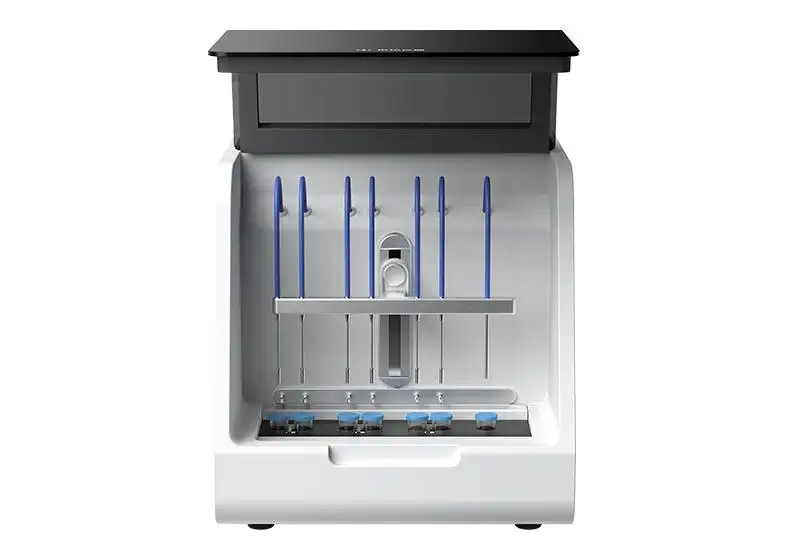
Raytor's NCE DP integrates dissolution and simulated permeation measurements for pre-formulation research. The system contains six reactor channels and six fiber-optic channels and monitors concentration changes without relying solely on discrete manual sampling.
Technical specifications include:
• Wavelength range: 200–750 nm
• Absorbance linear range: 0.01–3 AU
• Absorbance accuracy: ±0.001 AU
• Minimum acquisition interval: 1 second
• Temperature error: ±0.5°C
• Stirring range: 100–1000 rpm
• Liquid-addition accuracy: <1%
The platform can also perform pH-shift studies and use a bionic membrane to investigate permeation behavior.
One-second acquisition is particularly relevant when supersaturation, rapid dissolution, or precipitation occurs between conventional manual sampling points. This enables a Pharmaceutical Lab Solution Provider to examine dynamic formulation behavior rather than relying only on an endpoint dissolution percentage.
Sampling Automation Must Preserve the Test Environment
Automation should not disturb the experiment it is intended to measure.
For the RT612-ST 12-Position Automated Dissolution System, Raytor specifies an automatic sampling range of 1–20 mL with sampling precision ≤±1%. The system also uses non-resident sampling needles and high-chemical-stability pipelines to reduce continuous interference and sample adsorption.
Reliable workflows should also control:
• Sample-line adsorption and carryover
• Replacement-medium calculations
• Filter recovery
• Sampling timing
• Temperature stability
• Cleaning between batches
A capable Pharmaceutical Lab Solution Provider therefore evaluates the complete analytical workflow rather than comparing throughput alone.
Pharmacopoeial Design Does Not Replace Method Validation
Hardware conformity and analytical-method validation are separate requirements.
Raytor's portfolio includes conventional dissolution systems, USP Apparatus 4 flow-through testing, automated IVRT/IVPT platforms, and dissolution-permeation analysis. Its systems are designed around relevant Chinese, U.S., and European pharmacopoeial methods, while selected software functions include account control, authority management, audit tracking, backup, and other functions intended to support 21 CFR Part 11 workflows.
Laboratories must still establish:
• Apparatus qualification
• Drug-specific method suitability
• Analytical specificity and precision
• Filter and recovery studies
• Sampling-volume corrections
• Data-integrity procedures
• IQ/OQ/PQ where applicable
Choosing a Pharmaceutical Lab Solution Provider by Testing Capability
The procurement sequence should remain:
Dosage Form → Rate-Limiting Mechanism → Test Method → Apparatus → Detection → Automation → Validation
Rather than supplying only one category of dissolution equipment, Raytor combines oral dissolution, flow-through testing, transdermal diffusion, new-compound analysis, and laboratory automation within its pharmaceutical testing portfolio.
For laboratories developing oral, transdermal, or advanced drug-delivery products, the practical next step is to define the formulation, pharmacopoeial method, expected throughput, analytical endpoint, and required level of automation first. Raytor can then be evaluated as a Pharmaceutical Lab Solution Provider against those specific testing requirements, helping laboratories build a technically appropriate workflow without unnecessarily over-specifying the system.
FAQs
Q1: What does Raytor offer as a Pharmaceutical Lab Solution Provider?
A1: Raytor offers pharmaceutical laboratory services covering a range of applications, including dissolution testing, transdermal diffusion testing, evaluation of penetration properties of delivery systems, novel drugs analysis, and laboratory automation. Raytor's solutions cover pharmaceutical R&D and formulation and quality control activities.
Q2: Can Raytor cover oral and transdermal drug testing applications?
A2: Yes, Raytor develops solutions for different applications of drug delivery systems, namely oral drug delivery systems like tablets and capsules, as well as topical and transdermal systems for the drug release and permeation evaluation.
Q3: What types of dissolution testing can Raytor provide?
A3: Raytor offers USP dissolution apparatus 1, 2 and flow-through methods. These techniques enable the testing of dissolution of different types of formulations, such as immediate, modified, and poorly soluble release formulations.
Q4: How does Raytor enhance dissolution testing accuracy?
A4: Raytor emphasizes controlling the main parameters affecting dissolution results, including constancy of rotation speed, temperature, vessel alignment, consistency of sampling, and automated collection of data.
Q5: Does Raytor have solutions for IVRT and IVPT testing?
A5: Yes, Raytor provides a solution for tests on the evaluation of the performance of delivery systems for topical and transdermal drug delivery and for in vitro release (IVRT) and in vitro permeation (IVPT).