





Transdermal Diffusion Testing in India: A 2026 Market Update
2026-06-17


India is at the forefront of the rapidly growing sector for generic medicines. The market for branded generics will be $53.4 billion in 2033 at a CAGR of 7.8%. The topical and semisolid segment is expanding rapidly, and pharmaceutical manufacturers, contract research organizations (CROs) such as NovoBliss Research and Vanta Bioscience, as well as academic and cosmetic R&D labs are increasingly required to generate reliable In Vitro Release Test (IVRT) and In Vitro Permeation Test (IVPT) data.

Regulatory expectations are sharpening: the Central Drugs Standard Control Organisation (CDSCO) requires robust product dossiers and stability data for market approval, and international standards such as USP Chapter <1724> for semisolid drug products (including creams, ointments, gels, and patches) are increasingly referenced in submissions.
In this context, the question is no longer whether Indian pharmaceutical labs should perform transdermal diffusion testing—it is how to choose a Franz cell system that delivers regulatory-compliant performance without unnecessary complexity or cost.
Understanding the Technology: From USP <1724> to Automated Franz Cells
The USP demands both manual and automatic transdermal diffusion cell systems to test semisolid preparations. Franz diffusion cell models are widely accepted as the gold standard for membrane permeation and drug release studies within the in vitro testing. These models facilitate the development of in vitro release and in vitro permeation testing methods for formulations and patches. These models also provide an opportunity to assess the safety and effectiveness of formulations and patches under sink conditions.
When designing a transdermal diffusion system, pharmaceutical scientists should look at the following:
•Compliance with the pharmacopoeia – Do the systems comply with the USP <1724> and EP 9.0 General Rule <2.9.4> on transdermal patches?
•Throughput – How many diffusion cells are required for the development process?
•Level of automation – Does the system facilitate automated sampling with little of no intervention from the operator?
•Data integrity – Does the system provide audit trails to meet the regulatory requirements for data integrity?
•Temperature control – Are cells individually controlled or batch-controlled?
RAYTOR vs. Established Brands: A Feature Comparison
To provide context, below is a comparison of three prominent transdermal diffusion system manufacturers serving the global market: RAYTOR (China), Logan Instruments (US), and Teledyne Hanson (US).
| Parameter | RAYTOR RT814 | Logan Instruments FDC-6 / DHC-6TD | Teledyne Hanson Microette Plus |
| Diffusion cell count | 14 (7 × 2 independent groups) | 6 | 6 |
| Heating method | Dry heating | Water jacket / Dry heat (model dependent) | Water jacket |
| Temperature control | Individual temperature control for all 14 cells | Dual zone (two independent blocks) | Single heating block |
| Sampling automation | Fully automated, ≤24 sampling times | Manual or automated (system dependent) | Fully automated |
| Sampling flexibility | Full or partial sampling (1–10 mL) | Limited | Partial sampling |
| Bubble removal | Automatic real-time tilting mechanism | Tilting mechanism (manual/optional) | Not standard |
| Data integrity | Audit trail functions included | Not standard in base systems | Not standard |
| Cross-contamination prevention | Separate pipelines and pumps per cell | Common pump | Common pump |
| Integrated cell design | Yes (glass integrated structure) | Standard Franz cell | Standard Franz cell |
| Manufacturing origin | China | USA | USA |
| Typical price point | Very competitive | High | Very high |
Sources: RAYTOR internal specifications; Logan Instruments product literature; Teledyne Hanson product documentation.
What Sets RAYTOR Apart: Design That Delivers Results
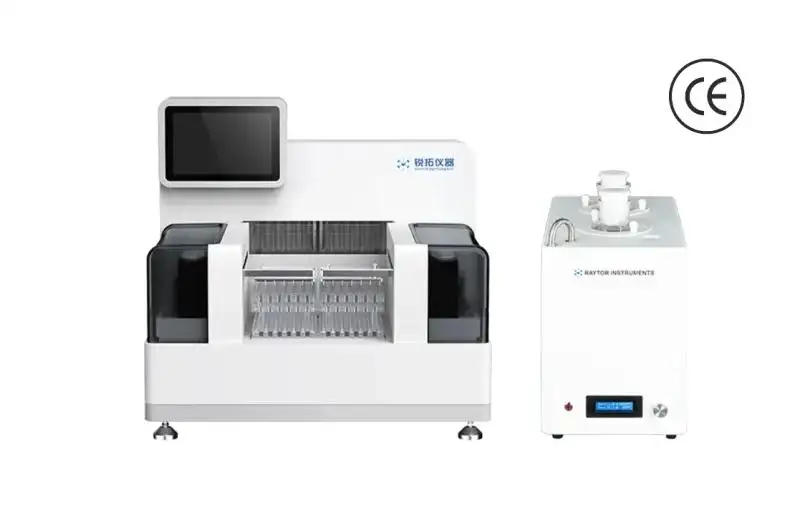
RAYTOR's RT814 Automated Transdermal Diffusion System is a 14-position Franz cell system that meets the test requirements of both USP <1724> for semisolid drug products and EP 9.0 General Rule <2.9.4> for transdermal patches. For transdermal diffusion testing, the RT800 addresses many pain points. These include:
•Less residue, better accuracy – The RT800 is built to reduce specimen residue due to its shorter design while also increasing accuracy and reliability of measurements. The system fully complies with USP Chapter <1724> regarding transdermal drug testing and offers automated sampling.
•Bubble removal, automated – The RT800 has a unique mechanical design that automates the tilt of the diffusion cell to discharge bubbles in real time and greatly reduces errors due to manual operation.
•Integrated, leak-proof design – The diffusion cell's integrated glass design prevents leaks during testing.
•Dedicated pipelining – To eliminate cross-contamination, diffusion cells have dedicated pipelines and pumps.
•Sampling flexibility – Users can fully sample or partially sample (1 – 10 mL increments) based on the needs of the test.
•Unrestricted independent temperature control – Unlike systems that control a single heating block, the RT800 provides independent temperature control for all 14 cells.
•Audit trail capability – To comply with the most rigorous data integrity requirements of the pharmaceutical sciences, the device offers extensive audit trail features.
Key technical specifications:
| Parameter | Value |
| Diffusion cell positions | 7 × 2 (14 total) |
| Sampling channels | 14 |
| Diffusion cell volume | 9, 10, or 12 mL |
| Sampling times | ≤24 |
| Sampling range | 1–10 mL (full or partial) |
| Temperature range | Room temperature to 50℃ |
| Temperature error | < ±0.5℃ |
| Stirring speed range | 200–900 rpm |
| Speed error | < ±10% |
| Maximum sampling time | 9999 minutes |
| Heating method | Dry heating |
Why Indian Pharmaceutical Labs Are Considering RAYTOR
In India's cost-competitive pharmaceutical environment, laboratory equipment decisions must balance three equally important factors:
•Regulatory compliance – The system must produce data that withstands CDSCO scrutiny and international regulatory reviews.
•Operational reliability – Downtime and inconsistent results delay submissions and increase costs.
•Total cost of ownership – Equipment from established US or European brands often carries a significant price premium that may not be justified for Indian R&D budgets.
RAYTOR's approach is straightforward: deliver US and EP-compliant transdermal diffusion systems without the brand-name markup, with:
•Advanced automation that reduces manual labor and operator-induced variability
•Modular design allowing flexible configuration (two independent groups of 7 cells)
•Real-time monitoring and recording for complete experimental traceability
•Application support for creams, ointments, patches, gels, and other semisolid dosage forms
About RAYTOR: Make Scientific Experiments Easier
RAYTOR Instruments is dedicated to the research, development, production, sales, and service of high-quality laboratory scientific instruments. Since its establishment in 2015, RAYTOR has specialized in providing comprehensive solutions for analytical instruments and application testing across key fields, including:
•New compound identification
•Drug permeability assessment
•Drug dissolution / solubility testing
•Transdermal diffusion studies
RAYTOR's product portfolio supports a wide range of dosage forms—oral, transdermal, and subcutaneous delivery—catering to both pre-formulation research and quality control.
For laboratory managers and pharmaceutical scientists in India seeking reliable, regulatory-compliant transdermal diffusion testing systems, RAYTOR offers a compelling alternative to premium-priced Western brands.
Manufacturer contact:
�� Phone: +86 (20)3160 8901
✉️ Email: sales@raytor.com
�� Address: Youchegang Town, Xiuzhou District, Jiaxing, Zhejiang, China
Frequently Asked Questions
Q1. Are both partial and full sampling available in RT814?
Both types of sampling are available up to 1 to 10 mL and RT814 permits both.
Q2. What are IVRT and IVPT?
IVRT (In Vitro Release Testing) allows evaluation of the release of drug substance from a drug product. IVPT (In Vitro Permeation Testing) measures how drug substances pass through membranes. Both methods are used in combination for regulatory filings.
Q3. Is RT814 compliant to USP <1724>?
Yes. RT814 is compliant with both USP <1724>, regarding semisolid dosage forms, and the European Pharmacopoeia (EP) 9.0, General Rule <2.9.4>, on transdermal systems.
Q4. How many diffusion cells are in RT814?
RT814 has a total of fourteen diffusion cell systems, arranged in two sets of seven systems, to allow for the simultaneous assessment of two different formulations.
Q5. What is the heating technology used in RT814?
The RT814 uses Dry Heating technology with individual temperature control (room temperature to 50C, ±0.5C).