



Transdermal Diffusion Testing: A 2026 Field Guide for Reliable IVRT/IVPT
2026-01-19


Transdermal Diffusion Testing is rapidly becoming the backbone of how labs evaluate patches and semisolid drug products. In 2026, it's not enough to "get a curve." Teams need release and permeation profiles that are synchronized, reproducible, and defensible under audit. This guide takes a practical view - how the science works, what regulators expect, where variability creeps in, and how automation and disciplined workflows turn diffusion data into decisions.

What Transdermal Diffusion Testing Actually Tells You
At its core, Transdermal Diffusion Testing answers two questions: how fast an active leaves the formulation and how efficiently it crosses a membrane that models skin. In vitro release testing (IVRT) isolates the dosage form by placing it against an inert membrane and quantifying the release rate. In vitro permeation testing (IVPT) extends the experiment to a biological or skin-mimicking barrier to characterize flux, lag time, and steady-state behavior. Used together, IVRT and IVPT allow you to rank prototypes, set specs tied to clinical performance, and gain confidence that batches behave the same way across time and sites.
- Why Rigor Matters Now
The transdermal and topical category keeps growing, but many teams still fight the same operational demons: inconsistent sampling windows, residues in long tubing, and bubbles that mute or exaggerate diffusion. A few minutes of timing bias or a tiny air pocket can distort an entire time series. Regulators have taken note. Submissions are more persuasive when IVRT/IVPT strategies align to pharmacopeial methods, and when audit trails and data integrity are built in - not bolted on. In 2026, programs that standardize execution and automate critical steps are the ones that reduce repeat work and move faster from bench to filing.
- How the Experiments Run
Most labs use Franz diffusion cells. The dosage form is placed in the donor compartment. The receptor compartment contains a defined medium, held at a controlled temperature and stirred at a verified rate. Samples are drawn at predetermined intervals and analyzed for the active. That sounds simple - until timing slips by 30 - 60 seconds per channel, sampling lines hold onto drug, or a bubble reduces the true diffusion area. Those small operational details drive between-cell variability and can mask or mimic formulation effects.
IVRT vs. IVPT - Choosing the Right Tool
• IVRT: The goal is to probe formulation behavior, not skin. An inert membrane focuses the measurement on release kinetics, helping teams distinguish changes in rheology, microstructure, or manufacturing parameters. IVRT is the workhorse for lot release, scale-up, and post-approval changes because it sensitively picks up formulation differences.
• IVPT: The aim is to understand permeation through a skin surrogate - whether ex vivo skin, reconstructed tissue, or a validated synthetic option. Here, you care about flux, lag, and steady state to inform clinical relevance and potential label claims. IVPT complements clinical design and supports comparative assessments when done under strict sink conditions and temperature control.
n Sampling Discipline That Keeps Bias Out
• Synchronize sampling across all cells so each time point represents the same exposure window.
• Keep sampling paths compact and linear; extra length elevates adsorption and carryover.
• Proactively clear bubbles. Eliminate them pre-seal and verify a stable meniscus. Air inclusions skew the effective area and mass transfer.
• Verify receptor conditions: temperature on target and stir rate verified - not inferred.
• Log meticulously. Time stamps, user IDs, and versioned methods form your defense in audit and review.
Standards That Shape Expectations: EP 9.0 and USP <1724>
European Pharmacopoeia 9.0 and United States Pharmacopeia <1724> define apparatus, conditions, and documentation for performance testing of transdermal systems and semisolids. Aligning to these chapters improves method portability and accelerates regulatory acceptance.
- EP 9.0 Highlights
EP 9.0 stresses consistent receptor geometry, precise temperature control, and validated sampling. Methods must establish accuracy, precision, and repeatability under prescribed conditions. Practically, measure cell dimensions, confirm sink conditions, and demonstrate that sampling does not alter system behavior.
- USP <1724> Essentials
USP <1724> (Semisolid Drug Products - Performance Tests) describes IVRT and IVPT methods, conformity criteria for diffusion cells, and the scope of documentation. Key principles include synchronized sampling, maintenance of sink conditions, and complete, audit-ready traceability. A secure, reviewable audit trail and controlled method files are not optional - especially in regulated environments.
Data Integrity and Audit Trails in Daily Use
A defensible dataset ties every result to a who, what, when, and how. That requires:
• Role-based access so only authorized users create, modify, or run methods.
• Centrally stored, version-controlled methods prevent outdated SOPs from circulating in the lab.
• Read-only audit logs that chronicle parameter updates, operator actions, and timestamps.
• Secure databases with backup and review functions to satisfy internal QA and external auditing bodies.
• Automation: the most efficient path to lower variability
Manual sampling generates most timing and handling errors. Automation reduces those touchpoints and enforces routine discipline:
• Coordinated actuation across channels keeps time points truly comparable, sharpening curve fits and parameter estimates.
• Shorter fluid paths minimize residue and carryover, resulting in cleaner chromatograms and tighter mass balance.
• Parallel groups allow a blank or interference-control stream to run without pausing your primary study, increasing throughput and interpretability.
• Designing studies that deliver clean conclusions
• Lock decisions that prevent artifacts before the first sample is run.
n Study Design Checklist:
• Decide IVRT or IVPT up front and choose membranes accordingly.
• Build synchronized sampling schedules; confirm the exact lag between channels (if any).
• Evaluate receptor medium suitability for sink conditions and analyte stability.
• Hold temperature tightly and verify stirring via documented calibration checks.
• Clear bubbles before sealing and fill to a consistent visual level to stabilize the diffusion boundary.
• Use the shortest feasible sampling lines and standardize materials across all cells.
• Add a blank/negative-control cohort to reveal matrix interference.
• Set initial acceptance targets and check replicate concordance before locking the specification.
• Preserve a complete audit trail and restrict method creation/approval by user role.
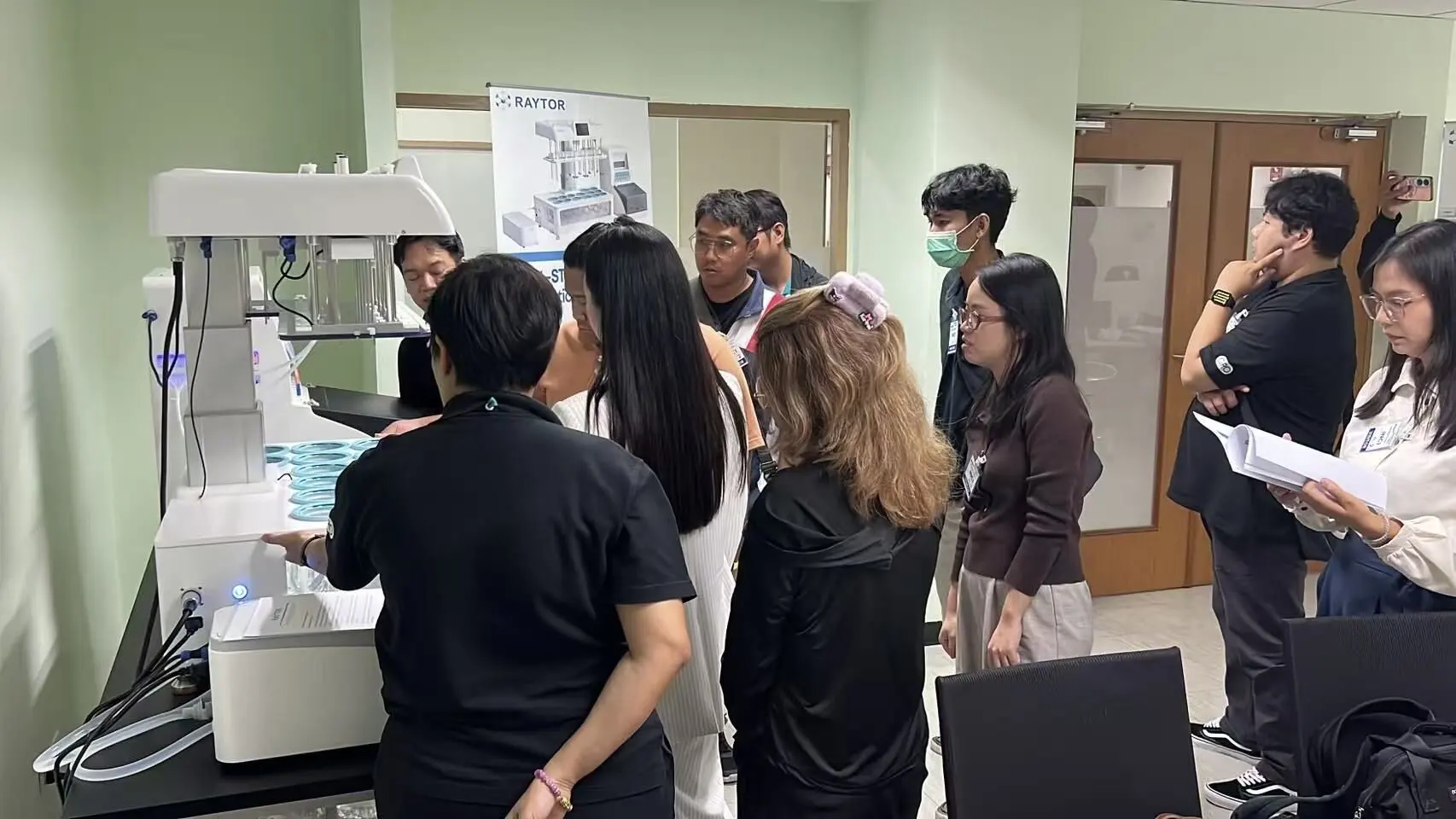
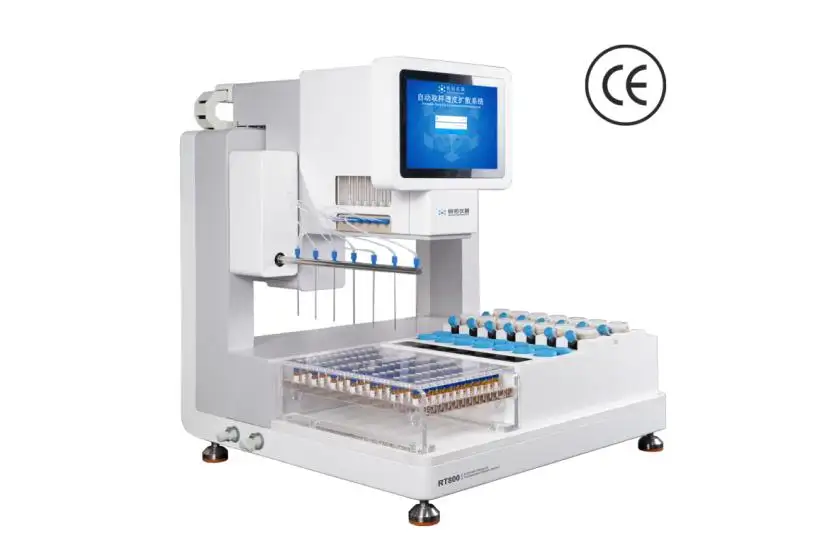
A Practical Platform for Transdermal Diffusion Testing from RAYTOR
RAYTOR's automated transdermal diffusion system is designed around the realities of IVRT and IVPT, translating pharmacopeial guidance into repeatable, audit-ready execution.
n System Highlights:
• True simultaneous sampling on up to seven channels reduces between-cell timing drift and the bias it creates.
• Compact, straight-through sampling paths cut down on residue and carryover for better recovery and cleaner data.
• Two independently controlled diffusion-cell groups run in parallel. Use one as a blank or interference check while the other captures your main profile - no downtime, clearer interpretation.
• Each cell carries a clear fill-level reference so operators inject to the same level after bubble removal, stabilizing diffusion area and promoting sink conditions.
• Tool-less cell removal and re-installation make bubble checks quick, minimizing disturbance to the rest of the array.
• Built-in audit capability tied to a secure SQL database underpins regulated use. The platform supports at least 200 stored methods and 100 distinct users, enabling method libraries, role-based permissions, and auditable, traceable histories.
• Alignment with EP 9.0 and USP <1724> offers a clear route from development to validation consistent with pharmacopeial practice.
• Every feature maps to outcome-focused benefits: fewer manual steps, tighter control of timing, more reliable mass balance, and documentation ready for regulatory review.
n What Transdermal Diffusion Testing Unlocks for Teams
Applied with discipline, Transdermal Diffusion Testing separates authentic formulation differences from noise, identifies rate-limiting steps, and builds confidence for seamless tech transfer. Method libraries codify best practices so new labs can adopt them without ambiguity. Audit-ready trails reduce debate during QA and regulatory inspections. Most importantly, automating the fragile steps - sampling rhythm, bubble management, and consistent geometry - compresses timelines by preventing repeat studies.
Call to Action: See Synchronized Diffusion Done Right
If you're ready to standardize IVRT/IVPT, cut sampling bias, and harden data integrity, RAYTOR can help. Request a guided demo to see synchronized sampling in action, explore how to build a pharmacopeia-aligned method library, and learn how automation can raise throughput while reducing variability. Contact RAYTOR and accelerate your transdermal programs with reliable, audit-ready Transdermal Diffusion Testing for 2026 and beyond.