


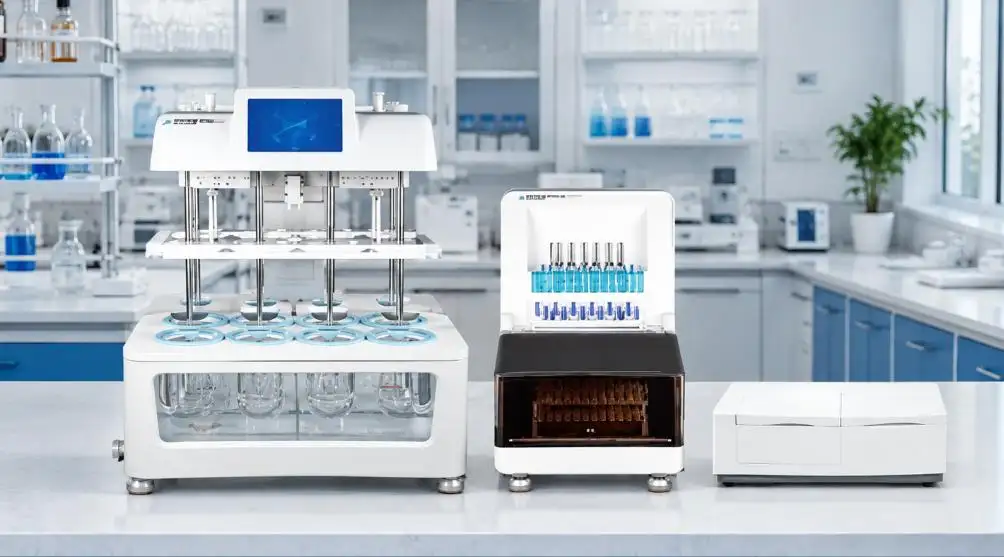
USP 3 Reciprocating Cylinder Dissolution Apparatus for Gastrointestinal pH Simulation
2026-08-20


A USP 3 Reciprocating Cylinder Dissolution Apparatus is designed for dosage forms whose release behavior cannot be adequately characterized in one static medium. It is especially relevant to enteric-coated, delayed-release and extended-release products, where the formulation may encounter substantially different pH, buffer and mechanical conditions as it moves from the stomach into the intestine.
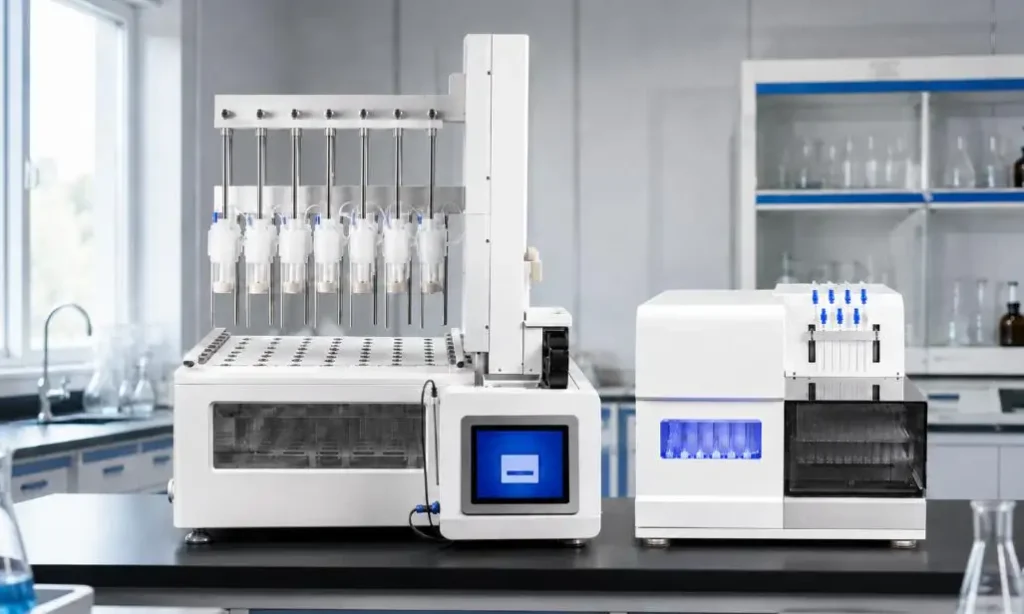
USP Apparatus 3 uses vertically reciprocating cylinders that can be indexed between rows of dissolution vessels. Instead of continuously adjusting one vessel, the dosage form can therefore be exposed sequentially to separately prepared media under controlled temperature, immersion time and reciprocation conditions. USP <711> specifies a test temperature of 37 ±0.5°C and requires the selected dip rate to be maintained within ±5%.
Why pH Transition Matters for Modified-Release Products
A dissolution method should reproduce the formulation challenge that matters analytically. For a pH-dependent coating, a single-medium test may show overall release but fail to reveal whether the dosage form remains intact during an acid stage and begins releasing at the intended higher-pH stage.
Several factors determine the response to be expected:
•API pKa and solubility: There can be substantial changes in observed solubility for weak acids and weak bases with changing pH.
•Polymer ionization: Enteric coatings remain insoluble in acid, but can turn soluble in the region above a defined pH.
•Buffer capacity: The initial pH is inadequate when the medium fails to resist a change in pH after the drug and excipients dissolve.
•Sink conditions: Insufficient medium capacity can suppress dissolution independently of the formulation.
•Exposure time: The duration of each pH stage determines how much acid resistance or subsequent release is actually challenged.
FDA guidance specifically states that when USP Apparatus 3 is used, both the media and the sequence of media-composition changes should be justified, and it highlights buffer capacity, sampling volume and filter compatibility as method-development considerations.
How a USP 3 Reciprocating Cylinder Dissolution Apparatus Builds a Multi-Stage Test
A practical test can be designed as:
Acid Stage → Transition Stage → Intestinal Buffer Stage
The cylinder containing the dosage form reciprocates in the first medium for a defined period. It is then lifted, drained and transferred to the next vessel row. This approach creates a controlled step change in medium composition without requiring a large buffer addition to the original vessel.
For delayed-release products, FDA guidance has historically described testing in 0.1 N HCl for 2 hours, followed by buffer-stage testing in approximately pH 4.5–7.5, although the exact conditions must still be justified for the formulation being studied.
DPM and Stroke Define the Hydrodynamic Challenge
The USP 3 Reciprocating Cylinder Dissolution Apparatus is not defined only by pH transition. Hydrodynamics are equally important.
Reciprocating rate controls how often the cylinder moves through the medium, while stroke determines the vertical travel distance. Together they affect fluid exchange through the cylinder screens, boundary-layer renewal and mechanical interaction with the dosage form.
Raytor's system provides a 4–60 DPM reciprocating-rate range and an adjustable 2–10 cm stroke, with published errors of ≤±5% for rate and ≤±0.1 cm for stroke.
These ranges are useful during method development because different formulations may require different hydrodynamic discrimination. A higher DPM should not simply be interpreted as a "stronger" or "better" test.
USP 3 Compared With Other Multi-pH Strategies
| Approach | Medium Transition | Hydrodynamics | Practical Consideration |
| USP 3 Reciprocating Cylinder Dissolution Apparatus | Dosage form moves between prepared media | Vertical reciprocation | Strong control over sequential exposure |
| USP 1/2 | Buffer addition or medium replacement | Rotational | Familiar, but multi-stage operation can be less direct |
| USP 4 | Flowing medium changes around sample | Continuous flow | Useful when controlled flow-through exposure is required |
| Single-vessel pH adjustment | Buffer added to existing medium | Depends on apparatus | Changes volume and ionic composition during the test |
FDA notes that USP Apparatus 3 facilitates changes in dissolution medium, while Apparatus 4 can also support medium changes during the run.
The choice should therefore follow the formulation mechanism rather than equipment availability.
Matching Vessel Volume, Sampling and Filtration to the Method
For a USP 3 Reciprocating Cylinder Dissolution Apparatus, vessel size affects both solubility and analytical sensitivity. Raytor provides 300 mL vessels with optional 1000 mL configurations and a standard arrangement of 7 vessels × 6 rows for the 300 mL setup.
A larger volume may help maintain sink conditions for high-dose or poorly soluble APIs, but it also lowers analyte concentration and increases media consumption. The appropriate choice should therefore be based on dose, solubility and analytical detection limits.
Sampling Must Be Treated as Part of the Method
Multi-stage modified-release testing often involves numerous sampling points. Raytor's automated sampling architecture supports:
•Up to 30 programmed sampling events;
•1–10 mL sampling volumes;
•Sampling precision of ≤±1%;
•Pre-pump filtration and optional online disk filtration;
•Chemically stable Teflon sampling lines.
These features can improve timing consistency, but laboratories must still qualify filter recovery, tubing adsorption, dead volume, carryover and media replacement. Automation reduces operator variability; it does not remove method-validation requirements.
Mechanical and Thermal Control Before Method Optimization
A sophisticated pH sequence cannot compensate for poor apparatus geometry.
Raytor's system level specification of ≤0.3° and shaft verticality of 90° ±0.5°. Its temperature-control system operates from room temperature to 50°C, with ≤±0.2°C accuracy and vessel-to-vessel temperature difference of ≤±0.5°C.
These specifications matter because temperature differences alter diffusion, polymer hydration and solubility, while misalignment can change the local hydrodynamic environment between test positions.
Automatic vessel covers also reduce evaporation during long modified-release studies, and the one-piece drainable water bath simplifies cleaning and routine maintenance.
What Should Be Verified Before Purchasing?
A USP 3 Reciprocating Cylinder Dissolution Apparatus should be selected from the method backward:
Dosage Form → Required pH Stages → Vessel Volume → DPM/Stroke → Immersion And Drain Time → Sampling → Filtration → Qualification → Data Integrity
Before purchase, laboratories should verify not only nominal ranges but also:
•Reciprocating-rate and stroke tolerances;
•Temperature uniformity across vessels;
•Vessel and shaft geometry;
•Sampling accuracy and filter compatibility;
•Software access control and audit-trail capability;
•IQ/OQ and calibration documentation;
•Maintenance and service requirements.
Raytor integrates adjustable reciprocation, multiple vessel capacities, automated sampling, filtration, evaporation control and an operating system stated to meet FDA 21 CFR Part 11 requirements.
For laboratories developing multi-stage dissolution methods, discussing the intended dosage form, media sequence and sampling strategy with Raytor before configuration selection can help ensure that the USP 3 Reciprocating Cylinder Dissolution Apparatus is matched to the analytical method rather than simply purchased by specification.
FAQs
Q1. What makes Raytor's USP 3 Reciprocating Cylinder Dissolution Apparatus suitable for modified-release testing?
The Raytor system is designed for multi-stage dissolution studies involving formulations that require exposure to varying media. Research laboratories have the ability to study and evaluate release profiles using the different reciprocating motion, multiple vessel configurations, and automated sampling.
Q2. Can Raytor's USP 3 Reciprocating Cylinder Dissolution Apparatus simulate gastric-to-intestinal pH transitions?
Yes. The system allows researchers to develop methods that simulate the changing environment of the gastrointestinal tract, and therefore, the changing conditions in the gastric and intestinal regions for controlled, modified, and prolonged release formulations.
Q3. What reciprocating rate range does Raytor provide for USP 3 dissolution testing?
The Raytor system provides a reciprocating rate range of 4-60 DPM.
Q4. How does Raytor control stroke movement during USP 3 dissolution testing?
The system is designed to allow laboratory users to set stroke length from 2-10 cm and has a published accuracy of ≤±0.1 cm.
Q5. Does Raytor support different vessel volumes for USP 3 dissolution methods?
Yes, Raytor offers 300 mL vessels and optional 1000 mL vessels.