







You Searched a Regulatory Term. You Found Eight Things That Aren't It.
2026-10-15


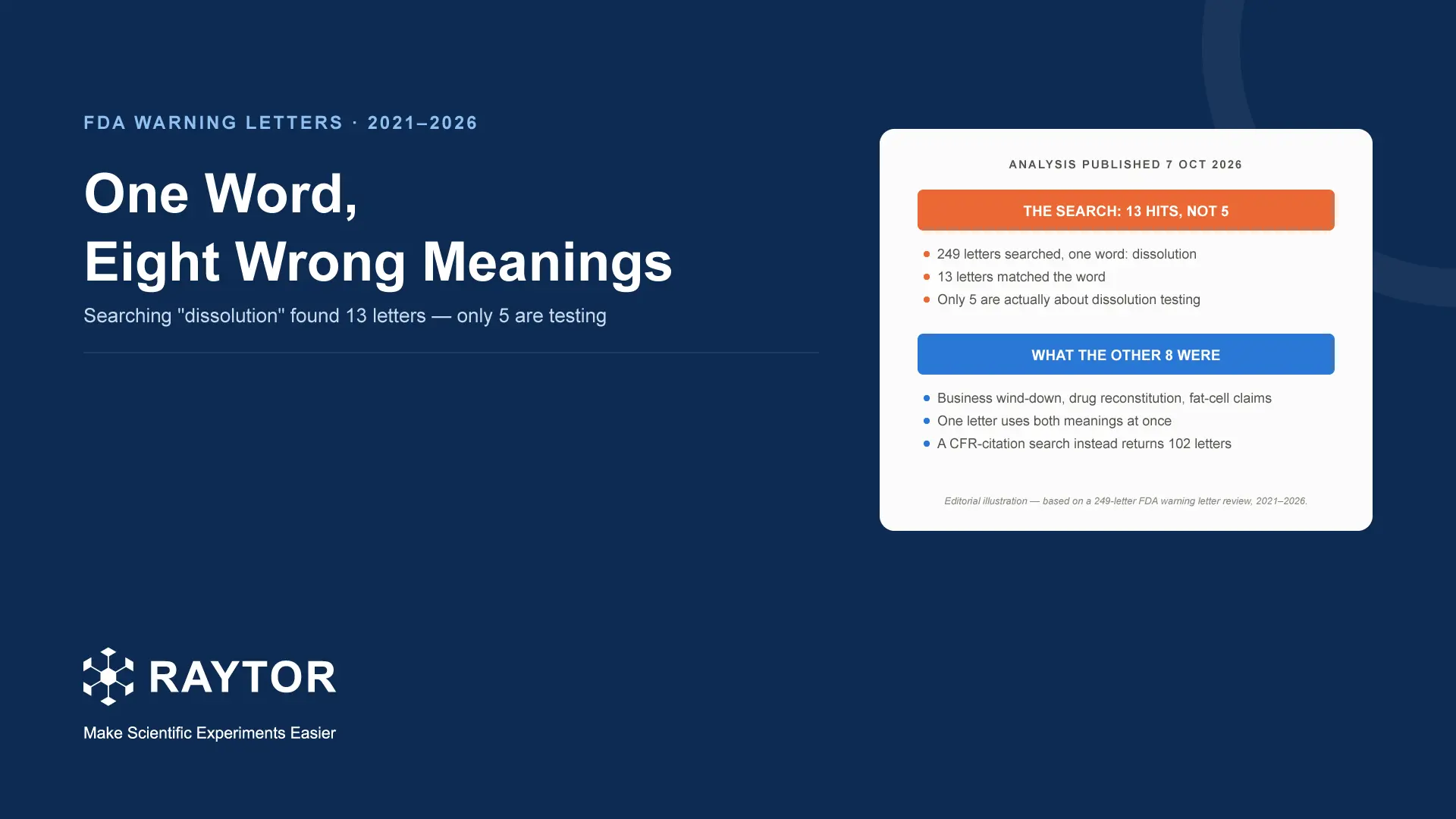
I searched a term I thought I understood, across every FDA warning letter issued between 2021 and 2026. Thirteen letters matched. I read all thirteen. Five were about what I was looking for. The other eight were the same word, meaning something else entirely.
At a glance
- Two hundred and forty-nine FDA warning letters, 2021 to 2026. One search term: dissolution. Thirteen letters matched.
- Five of the thirteen are actually about dissolution testing. The other eight are not — and they are not edge cases.
- The eight split cleanly into three wrong meanings: the dissolution of a business, the dissolution of a drug in a diluent, and a marketing claim about dissolving fat cells.
- Search the same corpus by a CFR citation instead of a word and you get a completely different set: 102 letters, not 13. The hit count belongs to the search term, not to the subject.
- Read the five properly and something more useful appears. Dissolution is never the finding. It is always attached to something else.
One word, several jobs
Start with the number, because it is the part that surprises people.
The FDA publishes every warning letter it issues. Between 2021 and 2026 that is two hundred and forty-nine letters, each one public, each one searchable — that is the set I searched, not a census of every letter FDA has ever issued. I took one word that sits at the centre of formulation work — dissolution — and ran it across the whole set.
Thirteen letters matched.
Here is the part I want to be careful about, because it decides whether the rest of this is worth reading. Thirteen is what the search returns. Five is what I got after reading all thirteen myself. Those are different numbers, and only one of them is a judgement. A tool can count matches. It cannot tell you that "a detailed plan for the dissolution of your business" is a company winding down, and that "complete dissolution of the drug in the diluent" is a technician reconstituting a sterile injection.
Counting is cheap. Reading is what costs.
The eight
The dissolution of a business. One letter, sent in 2021, asks for "a detailed plan for the dissolution of your business" — a wind-down plan, with contact details and de-registration paperwork. The word is exactly right. The subject is corporate law.
The dissolution of a drug. One letter from 2026 concerns vancomycin vials. The firm explained that vigorous shaking of the vials is necessary "to ensure complete dissolution of the drug in the diluent" after reconstitution. That is a sterile preparation step. It shares the physics, not the purpose.
Dissolving fat cells. Two letters from 2025 were issued over claims such as "promote the dissolution of fat cells" and "during fat dissolution, our solution… dissolving fat cells." I am not interested in the firms themselves. The point is narrower and uglier: a search for a technical term returns a marketing claim, and nothing in the result tells you which one you got.
And one letter that is both. A 2023 letter contains a passage about tumour dissolution as a marketing claim — and, elsewhere in the same letter, a genuine dissolution-testing observation about stability samples. Both meanings in one document. No keyword filter separates them, because the filter and the document are working at different levels.
The five
Now the useful part.
The five real hits do not read the way you would expect. Not one of them reports a dissolution failure on its own. Every single one attaches it to something larger:

Five letters. Zero standalone dissolution findings. What you are actually reading, in every case, is a finding about data integrity, an inadequate investigation, or a method with no justification behind it. Dissolution is the carrier, not the charge.
One 2024 letter shows the pattern most clearly, because the dissolution finding sits next to another one in the same document: out-of-trend assay results had been invalidated, an anomalous content uniformity result was attributed to HPLC column leakage, and the equipment's audit trail did not document any such error. Nobody wrote that the dissolution test failed. They wrote that the records around it could not be trusted.
That is a genuinely useful thing to know, and no search count will tell you it.
Why the count misleads
A hit count answers one question: where does this word appear?
The question you almost always need answered is different: how was this matter actually treated?
Run the same corpus the other way and the scale of the problem becomes obvious. Searching those letters for a CFR citation instead of a word — 21 CFR 211.165 or 211.160 — returns 102 letters, not thirteen. Both numbers are true. They are answers to two different questions, and only one of them is the question you had in mind.
Three habits close part of the gap:
- Define the event before you search, not after. "Dissolution testing" and "dissolution" are different searches. Write down what would count as a real hit before you run anything.
- Classify into buckets that cannot overlap. True hit / same word, other meaning. Not "relevant / irrelevant" — that invites the reader's judgement instead of forcing yours.
- Read the sentence, not the document. Every false hit here was obvious within one line. None of them required expertise to spot, and none of them would have survived reading.
The takeaway
Search gives you candidates. It does not give you conclusions.
I would rather have five letters I have read than five hundred I have counted, and the difference between those two numbers was the entire content of this piece. The habit worth keeping is small: when a number decides something, go read the sentences behind it.
FAQ
How many FDA warning letters were issued between 2021 and 2026?
Two hundred and forty-nine in the set I searched. Any count depends on which letters are included, so treat it as the denominator I used, not as a complete census.
Is five of thirteen a tool result or a reading result?
A reading result. Thirteen is what the search returns; five is what survived my own reading of all thirteen. I would not trust an automated classifier to make the same call, because the decision depends on what the sentence is doing, not on whether the word is present.
Does this matter outside FDA warning letters?
The same failure mode appears anywhere a technical term is also an ordinary English phrase — which, in regulatory text, is most regulatory terms. Solvent, dissolution, yield, stability and filter all carry a second meaning that has nothing to do with the laboratory.
Technical observation, not regulatory or compliance advice. Figures come from a fixed set of 249 FDA warning letters issued 2021–2026, read in full; the set is a snapshot and is not a complete census. Quoted language is quoted from those public letters. The author writes from an analytical development background and currently works on the equipment side.