





8-Position Dissolution Apparatus Price: Total Cost of Ownership
2026-10-23


A dissolution tester priced within budget can become the more expensive option after two years of routine QC testing. The difference often comes from sampling labor, qualification work, fluid-path maintenance, and tests repeated because of instrument-related problems.

Consider two eight-vessel systems: one uses manual sample collection, while the other transfers samples automatically through tubing and filters. Both may accommodate the same dissolution method, but their operating costs will differ considerably when the method requires frequent sampling.
For buyers comparing 8-Position Dissolution Apparatus Price, the useful figure is not simply the instrument quotation. It is the cost of producing valid dissolution results over the equipment's working life.
At Raytor, we recommend evaluating that cost against the laboratory's actual testing frequency, sampling schedule, and qualification requirements.
1. What Does the Equipment Quotation Actually Cover?
An eight-position dissolution system includes more than a water bath and eight vessels. Drive alignment, temperature regulation, sampling hardware, software, and installation requirements all affect the final investment.
Two quotations are comparable only when their equipment boundaries are clear.
| Cost Component | Technical Consideration | What Buyers Should Verify |
| Base apparatus | Drive stability, vessel geometry, temperature control | Included vessels, shafts, paddles, baskets |
| Sampling equipment | Manual collection or automated fluid transfer | Pumps, tubing, filters, collection racks |
| Software | Method control, records, user management | Licenses, data export, validation documentation |
| Installation | Utilities, bench space, commissioning | Freight, installation services, site preparation |
| Qualification | Mechanical checks and performance verification | IQ/OQ/PQ scope, protocols, reference materials |
| Maintenance | Wear parts, calibration, technical support | Spare-part prices, warranty, service availability |
Automated sampling is particularly easy to underestimate. A quotation may cover the dissolution assembly but exclude sample collection accessories, replacement tubing, or analytical instrument integration.
Ask for an itemized configuration before calculating the total landed cost.
2. RT600 vs. RT600-ST: How Much Is Automation Worth?
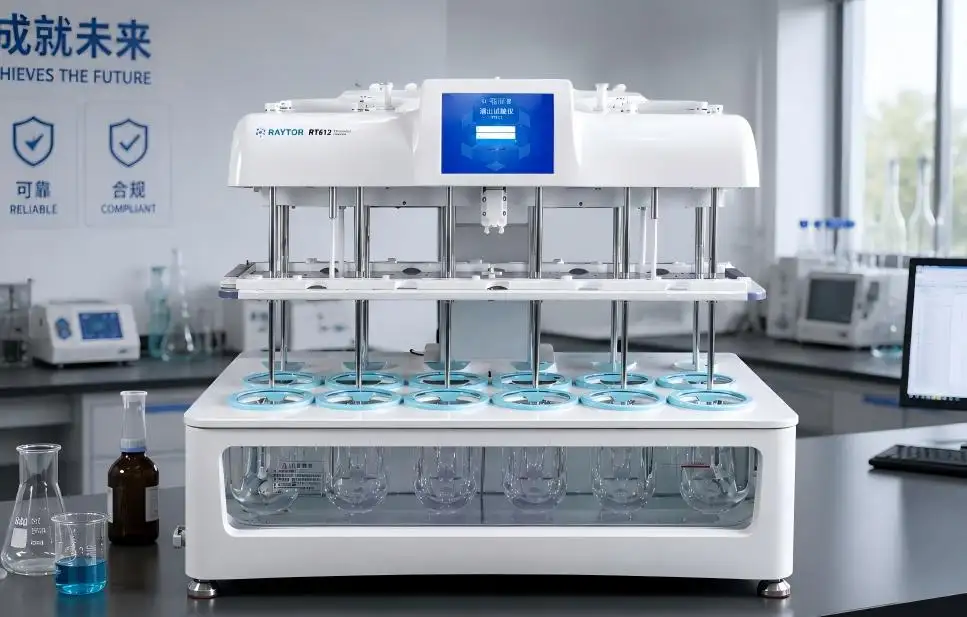
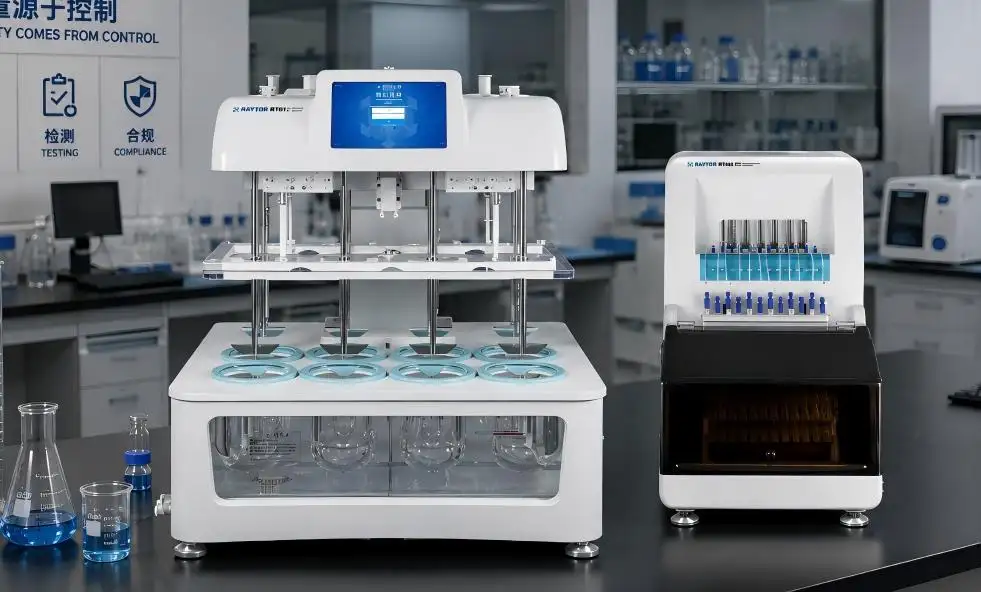
Raytor offers two eight-position configurations for different laboratory workloads.
The RT600 Dissolution Apparatus uses manual sampling while providing automatic synchronous dosing, automatic sampling-needle positioning, and real-time speed and temperature display.
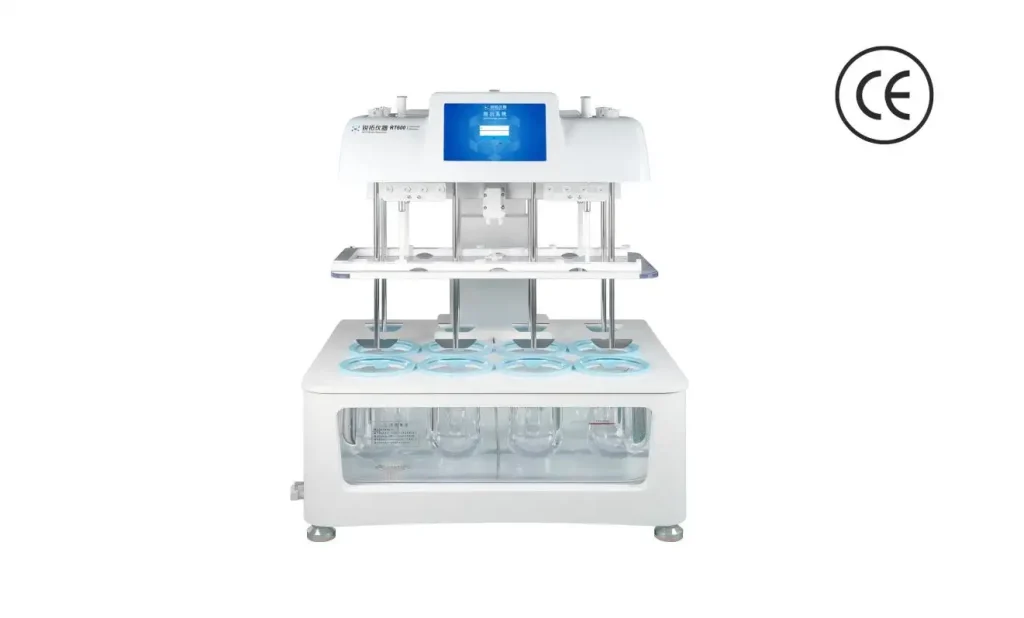
The RT600-ST Automated Dissolution System adds automated sampling and sample collection, with online filtration capabilities and optional online dilution.
Manual Sampling: Lower Complexity, Higher Operator Dependence
Manual sampling avoids automated fluid-transfer maintenance, making it a reasonable choice for laboratories running occasional dissolution profiles.
The limitation appears when sampling intervals become short or multiple dissolution tests overlap.
Each aliquot must be collected at the specified time and sampling position. Delayed filtration may allow undissolved drug to continue dissolving before analysis.
Manual collection therefore carries an operational cost beyond analyst wages: sampling inconsistency can introduce additional investigations and repeat work.
Automated Sampling: Lower Labor Input, More Fluid-Path Controls
Automation can reduce repeated manual intervention, but pumps, tubing, and filtration introduce additional variables.
Raytor's RT600-ST includes a Teflon sampling pipeline. Different materials have been found to behave differently depending on sorption, solubility, chemical compatibility and adsorption. Validation of the method requires demonstration of actual analyte recovery.
Prior to purchase, labs should evaluate:
• Dead Volume: Residual liquid in sampling lines can impact measured concentration at the next sampling interval.
• Filter adsorption: Adsorption of drugs to filters can also lead to assay failure.
• Carryover: Residual drug in the sampling line can lead to contamination of next sample.
• Accurate volume sampling: Volume withdrawn impacts the concentration of drug remaining in the medium.
• Sampling time: Inadequate sampling can lead to inadequate analyte recovery.
Adequate supplier demonstration should include sampling time and sampling volume, and the filtration material, which is representative of the drug.
Sampling automation is justifiable when the cost of the automation system is less than the cost of the labor, consumables, and maintenance for the system.
3. Qualification Costs Depend on Mechanical Performance
There are many inconsistencies and imprecisions with the dissolution apparatus due to differences in temperature, misalignments and large wobble in the vertical and horizontal planes, inconsistencies in vessel geometry, and differences in the flow of fluids in the chambers, etc.
The USP requirement for the apparatus is defined in the USP <711>. For USP Apparatus 1 and 2, performance testing is also required.
What should the qualification budget include?
• IQ: Verification of component identification and installation against approved requirements.
• OQ: Tests to evaluate the operating functions of the apparatus.
• PQ: Evidence that the system, when used according to the qualified plan, is acceptable.
USP Performance Verification Testing (PVT) evaluates the dissolution assembly using a reference standard. In the absence of USP PVT, mechanical checks alone are not a replacement to USP PVT.
Mechanical checks described in Raytor's publications can be used to perform a preliminary assessment and not as a replacement to Site Qualification.
Purchasing teams should request any available qualification documentation and make the determination as to which of the execution services, instruments, and reference materials require a separate purchase.
4. Where do Maintenance and Consumable Costs Accumulate?
The initial purchase usually only represents a small portion of a dissolution tester’s total cost of ownership.
For automated systems, tubing condition can affect sample delivery. Deposits, air bubbles, and restrictions in the fluid path can affect sample withdrawal. Filter blockage can also create a back pressure and obstruct sample collection.
Dissolution vessels also require handling. Scratches and contamination of the dissolution vessels can alter test conditions.
A real-world maintenance budget accounts for the following:
• Routine consumables: filters, tubing, sample containers, cleaning and test media.
• Planned maintenance: Mechanical checks and verification of temperatures, checks and requalification of pumps.
• Unplanned maintenance: Troubleshooting and repair, verification of repairs, interrupted tests.
Availability and costs of replacement components should be considered. The loss of a sampling component can affect many batches and be very costly if the laboratory doesn't have a validated replacement.
It is better to ask your suppliers for service agreements for critical parts, and expected replacement times, rather than rely on warrantees.
5. Can Software Requirements Change the Total Cost?
Raytor's RT600 series provides features relevant to 21 CFR Part 11, including audit trails, user access controls, and data backup capabilities. However, compliance with 21 CFR Part 11 cannot be established solely on the basis of manufacturer-provided features or claims. Laboratories are responsible for validating their installed systems and verifying compliance with applicable regulatory requirements.
For regulated QC laboratories, the evaluation of software should include user controls, audit trails, retention of electronic records, backup and recovery, and the availability of validation documentation.
Software changes may require change control, testing, and/or revalidation.
Thus, the configuration of the software, the agreement and long-term support should be considered when making a purchase.
6. How Should Buyers Calculate Five-Year TCO?
A five-year ownership model should include acquisition, installation, qualification, labor, consumables, maintenance, software, and equipment-related downtime, less any justified residual value.
Five-Year TCO = Acquisition + Installation + Qualification + Operating Costs + Maintenance + Downtime Costs − Residual Value
To compare systems with different operating requirements:
Cost per Accepted Run = Five-Year TCO ÷ Number of Valid Completed Runs
Use actual or forecast operating schedules rather than theoretical vessel capacity.
Usable throughput is determined by method duration, cleaning time, sampling frequency, analyst availability, and repeat-test rates. Don't double count investigation expenses that are already covered by operating or downtime costs.
A manually sampled instrument may offer lower ownership costs for infrequent testing. In laboratories performing repeated multipoint profiles, an automated configuration may justify its higher acquisition cost through reduced hands-on work.
Request a Configuration-Based Quotation from Raytor
Raytor supplies the RT600 manual-sampling and RT600-ST automated-sampling dissolution systems. Share your testing workload, sampling intervals, and qualification requirements to discuss a suitable configuration and quotation.
FAQs
Q1. What is the price of a Raytor 8-position dissolution apparatus?
Raytor offers quotation-based pricing for its RT600 and RT600-ST systems. Final costs depend on sampling configuration, accessories, software, and requested services.
Q2. Which Raytor models support eight-position dissolution testing?
Raytor offers the RT600 for manual sampling and the RT600-ST for automated sampling. Both feature eight dissolution positions and automatic synchronous dosing.
Q3. What is the main difference between Raytor RT600 and RT600-ST?
The RT600 uses manual sampling, while the RT600-ST automates sampling and sample collection. The automated model adds fluid-path maintenance and consumable costs.
Q4. Which Raytor dissolution system has a lower total cost of ownership?
The RT600 may cost less for occasional testing. The RT600-ST may reduce labor costs for frequent multipoint sampling. Actual savings depend on laboratory workload.
Q5. Does Raytor RT600-ST support automatic filtration and dilution?Yes. Raytor lists online filtration capabilities and optional online dilution for the RT600-ST. Buyers should confirm the exact configuration included in their quotation.