





Pre-Formulation Analysis for New Chemical Entities: Screening Dissolution and Permeability
2026-10-22


An NCE may reach a high dissolved concentration in acidic medium yet lose much of that advantage after intestinal pH transition. Another compound may dissolve less completely but maintain sufficient free drug concentration to support membrane transport.
Ranking these candidates by equilibrium solubility alone could lead to the wrong formulation decision.
In the early stages of pharmaceutical development, Pre-Formulation Analysis needs to differentiate between slow dissolution, precipitation, and restricted membrane permeation. Raytor takes a different approach to dissolution and permeation testing and does not solely rely on a single solubility endpoint.
1. Which Physicochemical Properties Determine NCE Screening Priorities?
In order to determine limitations due to dissolution and permeability, one first needs to characterize the API.
Five properties are worthy of consideration:
•Solubility and pH: The solubility and permeability of an ionizable compound are pH dependent and influence the extent to which the compound can dissolve and membrane partition.
•Solid-state Forms: Dissolution of different polymorphs, salts and amorphous forms may result in precipitation.
•Particle-Size Distribution: Decreasing the particle size increases the surface area to volume ratio and may increase the rate of dissolution but may also lead to aggregation or particle weting problems.
•Solubility vs. Dosage: A drug may be sufficiently soluble to be screened but insoluble at the intended dosage.
•Stability: A compound may dissolve but undergo degradation or hydrolysis which may result in precipitation.
•Chemical Stability: Precipitation may be caused by a loss of a counter ion or excess of a reactant resulting from a chemical reaction.
For crystalline compounds, their intrinsic dissolution rate (IDR) is influenced by many of the above properties as well as particle size of the solid. IDR testing allows for better control of exposed solid surface area.
However, IDR cannot independently predict absorption. A favorable dissolution rate does not establish whether the drug will remain dissolved after pH transition or cross an intestinal barrier.
2. How Should Dissolution and pH-Shift Tests Be Designed?
Separate Initial Dissolution From Precipitation Behavior
Weakly basic compounds illustrate why single-medium testing can be misleading.
API dissolution rates may be rapid in acidic conditions. Following equilibration at intestinal pH, the solubility of the API decreases and a supersaturated condition may occur.
Supersaturation may be transient and collapse as a result of nucleation and crystal growth. The time over which the supersaturated condition exists is important. Membrane transport of the drug may occur prior to precipitation if the time to collapse is sufficient.
A useful experimental sequence includes:
•Measuring the concentration of drug in solution during the first phase of dissolution, which occurs under acidic conditions;
•Introducing the intestinal pH medium at a defined time and recording dilution and final pH;
•Monitoring the persistence of supersaturation and the subsequent decrease in concentration of the drug;
•Recovering the precipitate and determining the physical form if it is present.
It is also important that agitation, temperature, and composition of the medium, as well as the time of inter-mixing, be the same for each formulation being tested. Other differences may indicate formulation effects.
Decreases in the optical signal also require examination. Similar profiles may be due to dilution, degradation, and/or interference of the probe.
For Raytor's optical monitoring systems, in the case of suspected interference or degradation, HPLC may be required to verify results.
3. Does Higher Dissolved Concentration Always Lead to Greater Permeation?
Not necessarily.
| Possible Observation | Possible Interpretation | Suggested Next Step |
| Slow Dissolution, Detectable Permeation | Dissolution Rate Limitation | Determine particle size, salt form, or wetting |
| High Concentration, Rapid Decrease | Nucleation and Precipitation | Assess solid state changes |
| Low Membrane Flux, High Donor Concentration | Low Membrane Permeability, Drug Sequestration | Assess free drug, membrane interactions and partitioning |
| Stable Donor Concentration, Gradually Increasing Receptor Concentration | Favorable Transport | Determine reproducibility, mass balance |
Membrane flux is dependent on the concentration gradient, membrane partitioning and transport.
It is critical to distinguish the form in which the drug is dissolved and the permeable drug when comparing excipient systems.
Artificial and biomimetic membranes are useful screening tools, but they do not represent the true intestinal environment. Therefore, results should prompt further biopharmaceutical research and not be used for predicting human drug absorption.
4. How Does Raytor's NCE DP Support Integrated Screening?
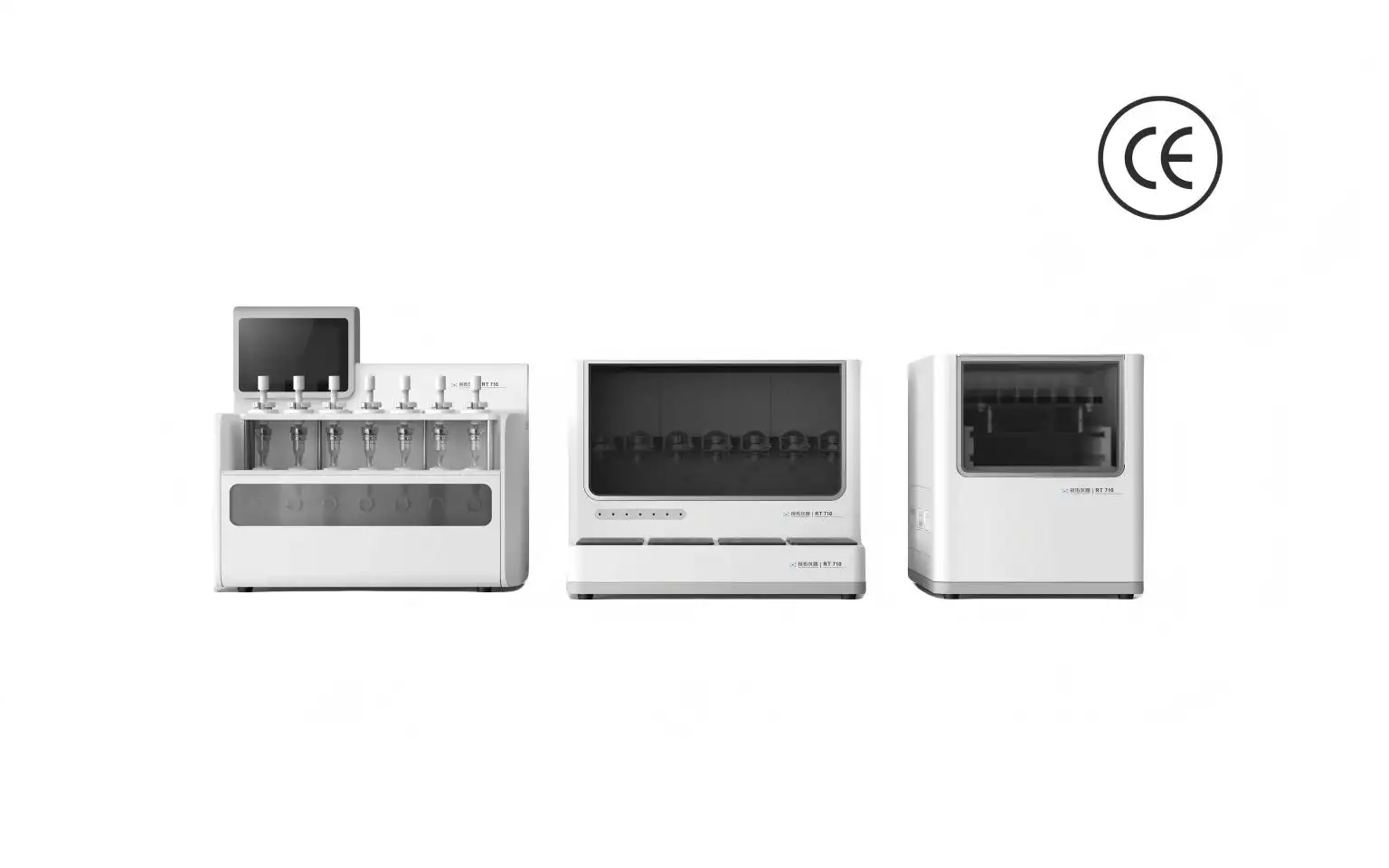
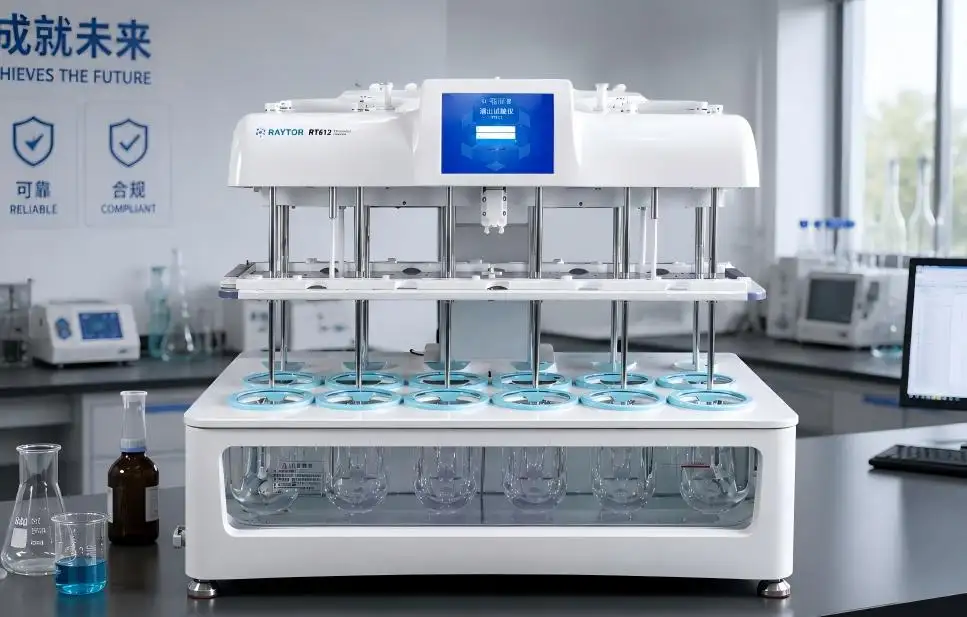
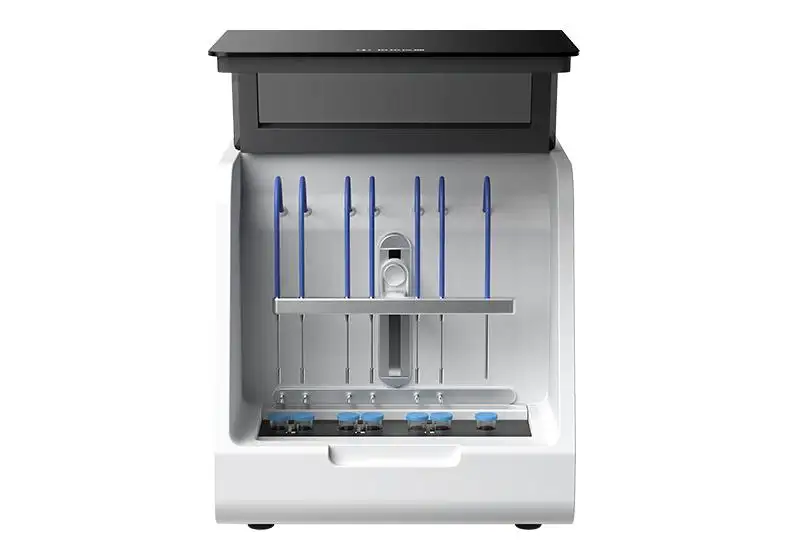
Raytor's NCE DP Micro Dissolution and Permeation Analyzer combines real-time optical concentration monitoring with dissolution and simulated permeation experiments.
The system includes:
•Six reactor channels and six fiber optic channels for process monitoring.
•A spectral measurement window from 200 to 750 nm.
•A minimum acquisition interval of 1 second.
• Automated medium addition for automated experiments involving the transition of the growth medium.
•A bionic membrane model for simulated permeation studies.
•Supports studies on intrinsic dissolution, pH-shift and membrane transport studies.
•Requires method specific compound validation for quantification.
Due to spectral overlap, turbidity, and degradation products, UV based assays may not be able to determine drug concentration accurately. Different medium and concentration conditions may require calibration.
Uncertainty due to adsorption on the membrane, integrity of the membrane, insufficient receptor sink conditions and inadequate mixing may occur.
5. What Should Pharmaceutical Laboratories Verify Before Equipment Procurement?
The failure modes the laboratory needs to distinguish should drive instrument selection.
For Pre-Formulation Studies involving limited amounts of NCE, we suggest evaluating the following prior to investing in a dissolution-permeation platform.
•Analytical Suitability: Is the API quantifiable across the concentration range, through varying matrices, and in the presence of minimal spectral interference?
•Dynamic Response: Are rapid dissolution and/or precipitation events captured by the system without excessive lag time and distortion of the signal?
•Membrane Performance: Are conditions reproducible which evaluate the integrity of the membrane, adsorption of the API, passage of the reference compounds, and receptor sink conditions?
•Mass Balance: Is material balanced which includes dissolved API, precipitated drug, transferred drug, and that which is retained by the apparatus and/or membrane?
•Data Comparability: Have experimental conditions been adequately controlled and documented?
Discuss NCE Screening Requirements With Raytor
Raytor, Inc. supplies instruments for studies of dissolution and simulated permeation during the development of pharmaceuticals. Consider our NCE DP Micro Dissolution and Permeation Analyzer, and contact us through www.raytor.com for further discussion on testing requirements.
FAQs
Q1. What is pre-formulation analysis for new chemical entities?
Pre-formulation analysis evaluates an NCE's solubility, dissolution behavior, solid-state properties, and permeability before formulation development. Raytor's NCE DP supports dissolution and simulated permeation screening.
Q2. How does Raytor's NCE DP support early drug screening?
Raytor's NCE DP combines real-time concentration monitoring, medium-switching experiments, and a biomimetic membrane model to investigate dissolution and permeation behavior.
Q3. Can Raytor's NCE DP perform pH-shift dissolution testing?
Yes. Its automated medium-switching module supports controlled medium addition at specified times, allowing researchers to investigate concentration changes after pH transitions.
Q4. How does Raytor measure dissolution in real time?
The NCE DP uses six fiber-optic channels for absorbance monitoring. Its published minimum acquisition interval is one second, subject to method-specific analytical suitability.
Q5. Can Raytor's equipment evaluate drug permeability?
Yes. The NCE DP uses a biomimetic membrane model for simulated permeation studies. These measurements support screening but do not directly establish human intestinal absorption.