





Company for Pharmaceutical Dissolution: Automated Sampling Accuracy
2026-10-20


A dissolution system withdraws exactly the programmed sample volume, yet the measured drug concentration is consistently lower than manual sampling results. The pump passes its calibration check. The discrepancy appears only after samples travel through the tubing and filtration assembly.
This is a common diagnostic challenge in automated dissolution testing. Accurate liquid delivery does not guarantee representative drug concentration. Residual liquid, API adsorption, filter retention, and sampling delays can each alter the reported dissolution profile without producing an obvious equipment alarm.
For laboratories evaluating a Company for Pharmaceutical Dissolution, automated sampling accuracy should be assessed across the complete fluid path, from withdrawal inside the vessel to analytical measurement.
1. Does Pump Precision Reflect Actual Sampling Accuracy?
A sampling pump delivers a definite volume of liquid and can't judge if the collected solution is representative of the vessel concentration at the specified time.
Three measurements should remain separate:
•Volumetric accuracy: The difference between the programmed and the delivered sample volume
•Timing accuracy: The difference between the scheduled sampling point and the actual time of withdrawal
•Concentration recovery: The quantity of the dissolved API lost during transport, filtration, and collection
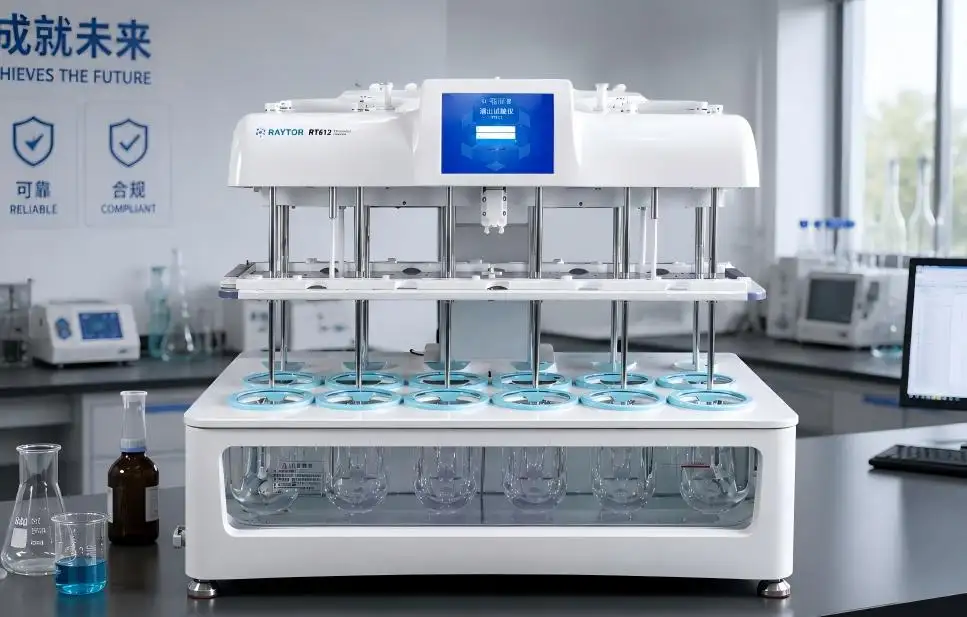
Raytor's RT600-ST and RT612-ST automated dissolution systems state sampling accuracy is ≤±1% and a sampling range of 1 to 20 mL. The RT614-ST specifies sampling range of 0.1 to 20 mL, with ≤±1% accuracy.
The qualification of equipment should include testing the volume of a sample of the dissolution medium (gravimetric volume testing) followed by concentration recovery studies using the same medium and API.
A system can meet its volumetric specification while introducing a bias that affects concentration and affects the interpretation of the dissolution profile.
2. How Do Tubing Design and Dead Volume Affect Recovery?
Some of the liquid remaining in the sampling pathway will mix with the next aliquot to be sampled. The error in concentration will depend on the dead volume, the difference in concentrations of the succeeding samples, and the efficiency of flushing.
This is particularly important during the early phase of the dissolution, when the concentration of the drug may increase rapidly between sampling points.
Effects of Tubing Thickness and Materials
Decreasing the inner diameter of the sampling tubing reduces the effective volume of sampling tubing, but increases the hydraulic resistance. For a given flow rate, the smaller diameter sampling tubing is preferred, but larger diameter tubing is easier to transfer and may require less flushing volume.
The RT600-ST, RT612-ST, and RT614-ST use PTFE sampling pipelines. This material has good chemical stability, and tends to have low drug adsorption.
But under some conditions of analysis adsorption of drug molecules can occur. This is especially true for hydrophobic drug molecules and samples with surfactants. In presence of such samples a compatibility test may be necessary.
The complete wetted pathway also includes connectors, valves, pump components, and filter housings.
| Design variable | Main technical risk | Verification method |
| Internal tubing volume | Previous samples dilute or contaminate new aliquots | Determine hold-up volume and required purge volume |
| Tubing diameter | Pressure loss or excessive flushing demand | Measure flow and delivered volume across the operating range |
| Wetted materials | API adsorption or chemical incompatibility | Compare transported and reference concentrations |
| Valves and connectors | Carryover, leakage, or trapped liquid | Run concentrated samples followed by blanks |
| Sample residence time | Adsorption or API degradation | Evaluate recovery at representative transfer and holding times |
A practical procurement requirement is evidence of recovery under the intended medium composition and concentration range, not merely a low-adsorption material description.
3. Can Online Filtration Change the Dissolution Result?
Filtration must separate undissolved material before further particle dissolution changes the measured concentration.
Delays between withdrawal and particle removal can produce artificially elevated results. Conversely, drug retention on a membrane can produce lower recovery.
The mechanism depends on membrane chemistry, pore structure, API properties, and excipient loading.
Raytor's automated sampling configurations support dual online filters and automatic filter-conditioning operations. The RT614-ST additionally describes automatic discharge of initial filtrate to condition the filter.
Features that enable the standardization of filtration helps to validate conditioning volume.
Three aspects should be addressed:
•Filter recovery: Compare filtered and unfiltered, completely dissolved, reference solutions to assess drug retention.
•Filter loading: Test if suspended excipients increase pressure or affect delivery over successive withdrawals.
•Analytical interference: Assess the extractables from the membrane and potential UV or HPLC interference using the actual analysis method.
Discarded conditioning liquid also contributes to total medium removal and is also to be considered in the calculation of cumulative drug release.
4. Does Sampling Occur at the Programmed Time?
For immediate-release products, concentration may change substantially during the first few minutes. A sample labeled "5 minutes" is meaningful only when the withdrawal event corresponds to the intended dissolution time.
Transport and vial-filling delays do not necessarily change the actual withdrawal time. The critical questions are when withdrawal begins, how long it continues, and whether the collected aliquot represents a concentration changing during that interval.
Raytor publishes a minimum first sampling point of three minutes and a minimum subsequent routine sampling interval of five minutes for the RT600-ST, RT612-ST, and RT614-ST.
Laboratories requiring shorter intervals should confirm whether the instrument can execute the method before purchase.
Probe Position and Hydrodynamic Disturbance
Sampling probes must also respect the applicable USP <711> sampling position requirements.
Permanently immersed probes may cause disruption to hydrodynamics of the vessel. Withdrawal flow may cause local fluid motion and improper probe placement may cause sampling of a nonrepresentative solution.
A qualification exercise may require comparison of manual and automated sampling at the same vessel location, with the same withdrawal time, while ensuring consistency of probe positioning and timing.
5. How Should Automated Sampling Be Qualified?
Isolation and testing of individual components may provide little information about the complete sampling sequence.
The following components of the sampling system may be qualified:
•Volume delivery: Verify the volume delivered using a gravimetric method at the minimum, typical and maximum sampling volumes.
•Recovery: Compare API concentrations before and after the sampling system.
•Carryover: Measure the amount of residual sample left in the sampling system after the system is rinsed with a blank.
•Timing: Record time of sample withdrawal and time duration of sample withdrawal for each vessel being sampled.
•Method equivalence: Compare manual and automated methods at early, intermediate and late sampling points.
Acceptance criteria may be defined based on the intended use of the analytical method.
Medium Replacement, Volume Withdrawal Corrections, Sample Stability, and Filter Losses must also be reported. These cannot be replaced by a successful pump calibration.
6. What is the Right Raytor Configuration for the Sampling Method?
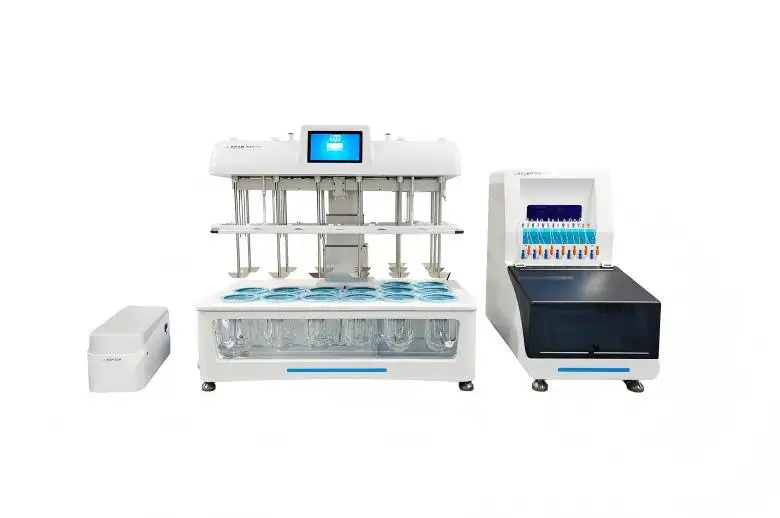
Raytor's RT614-ST features a 210-position HPLC vial tray and supports dual sampling, providing flexibility for sample collection during dissolution testing.
The RT612-UV is configured for online UV analysis of samples with a dedicated sampling line and flow cell for each dissolution vessel.
The sampling configuration required depends on sampling volume, time point spacing, the analytical method, sample filtration, and the number of samples collected per run.
Before confirming a configuration, it is advisable that the customer ensure the proposed sample workflow aligns to their approved method of dissolution, including sample recovery and filtration as well as data logging.
Discuss Your Automated Sampling Needs with Raytor
Raytor offers automated dissolution equipment for use in R&D and QC pharmaceutical labs. Explore our pharmaceutical dissolution equipment to review available configurations and discuss your sampling workflow and other method specific sampling requirements.
FAQs
Q1. Which Raytor systems support automated dissolution sampling?
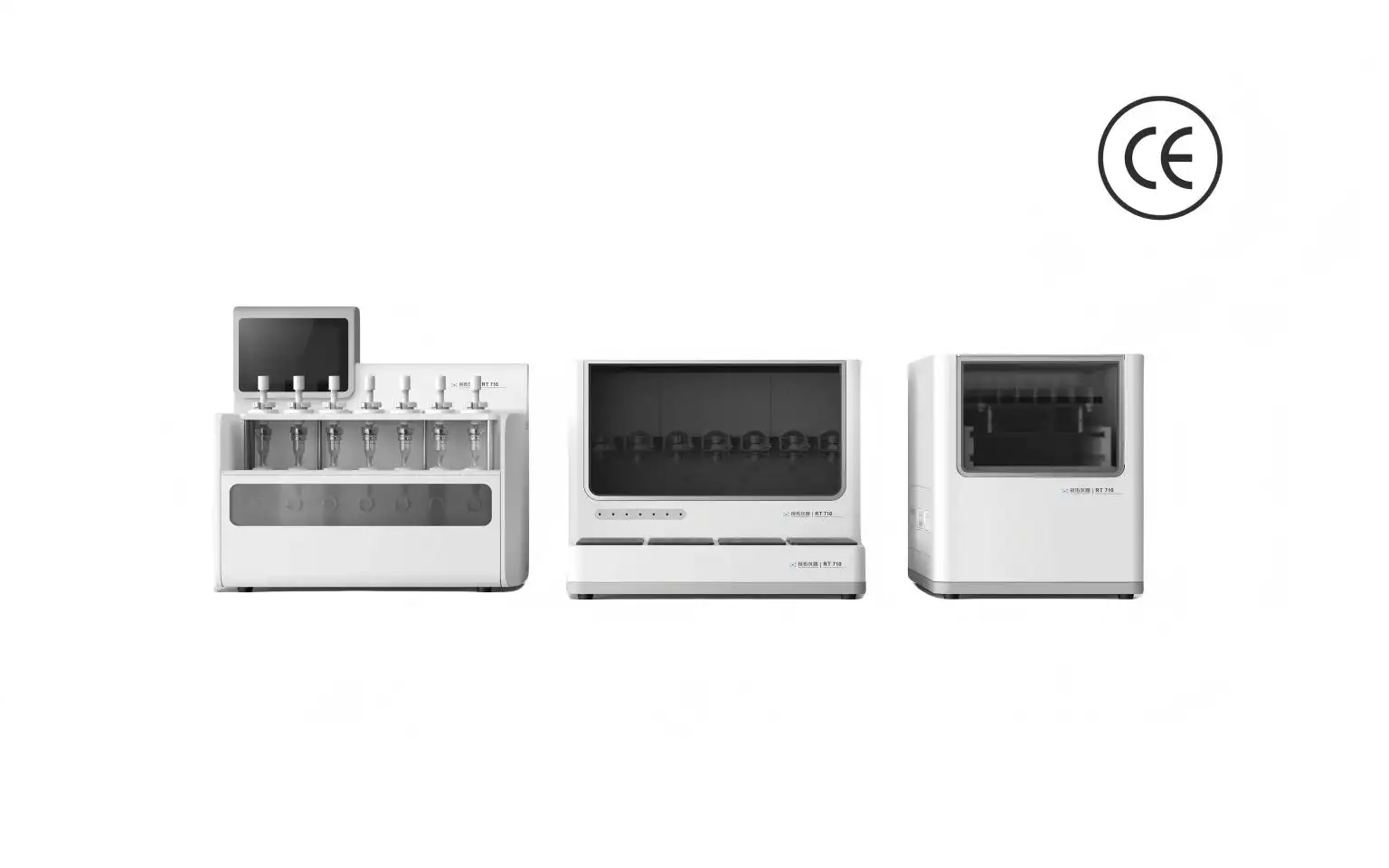
Raytor offers the RT600-ST (8 positions), RT612-ST (12 positions), and RT614-ST (14 positions). The RT600-UV integrates automated sampling with online UV analysis.
Q2. What sampling accuracy do Raytor automated dissolution systems provide?
Raytor specifies sampling accuracy of ≤±1% for the RT600-ST, RT612-ST, and RT614-ST. Actual API recovery requires separate method-specific verification.
Q3. What sampling volumes are supported by Raytor systems?
The RT600-ST and RT612-ST support 1–20 mL sampling volumes. The RT614-ST supports 0.1–20 mL, making smaller aliquots possible.
Q4. What is the minimum sampling interval for Raytor automated systems?
For the RT600-ST, RT612-ST, and RT614-ST, the earliest first sampling point is 3 minutes, and the minimum interval between subsequent sampling points is 2 minutes.
Q5. How does Raytor reduce drug adsorption in sampling pipelines?
Raytor's RT600-ST and RT614-ST use PTFE sampling pipelines with low-adsorption characteristics. Laboratories should still verify API recovery under their actual dissolution conditions.