


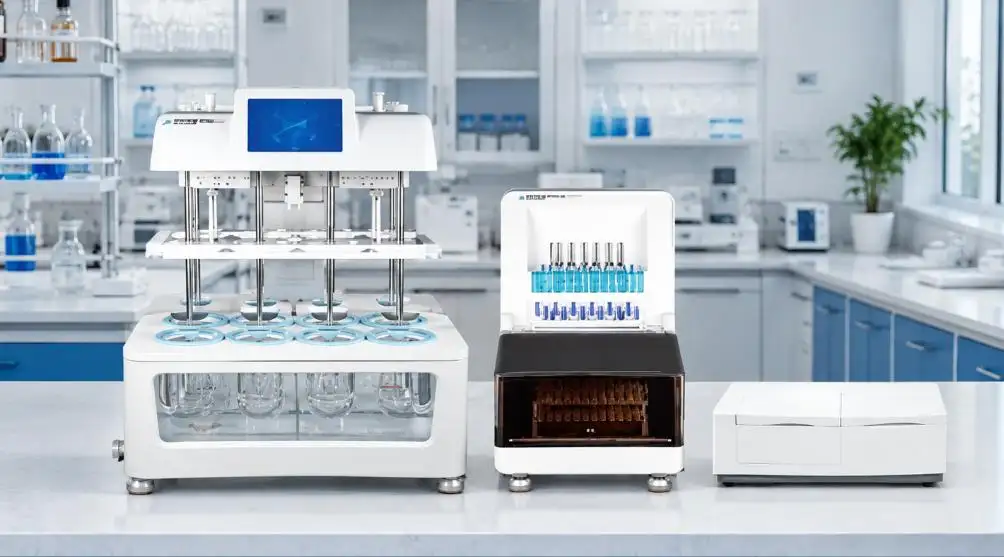
Flow Through Cell Dissolution System Supplier for Long-Acting Injectables
2026-08-19


Long-acting injectables (LAIs), PLGA microspheres, nanosuspensions, liposomes, and other complex drug products can release API over days, weeks, or months. For these formulations, the analytical challenge is not simply to accelerate dissolution. The method must remain discriminatory, reproducible, and sensitive to formulation or process changes.
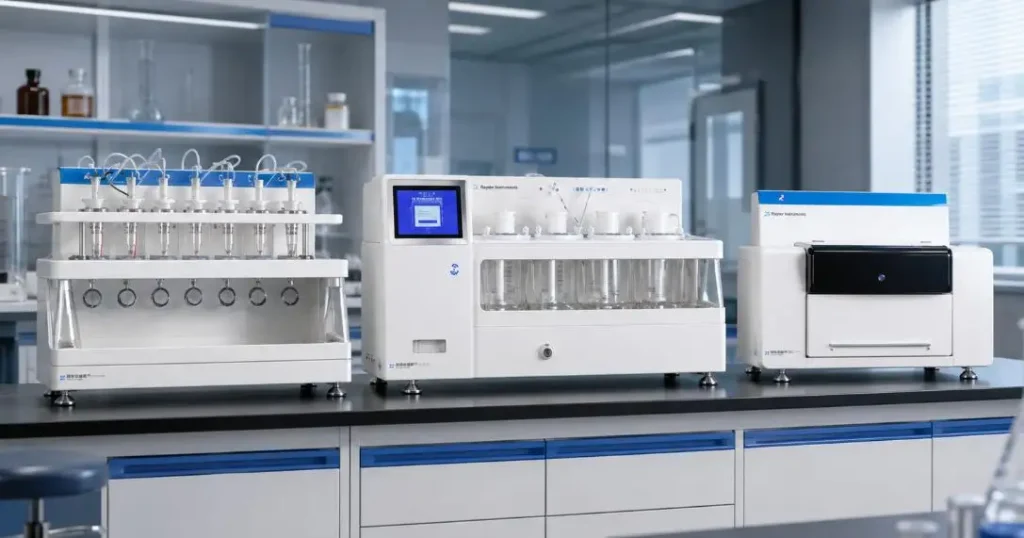
This changes how laboratories should evaluate a Flow Through Cell Dissolution System Supplier. Flow accuracy, hydrodynamics, sink conditions, filtration back pressure, temperature control, sampling recovery, and qualification support matter more than a long list of nominal specifications.
Why LAI Release Testing Needs More Than a Conventional Vessel
USP Apparatus 1 or 2 works well for many conventional dosage forms, but a fixed-volume vessel may be less suitable when drug release is controlled by low solubility, particle properties, diffusion, or polymer degradation.
LAI method development commonly has to distinguish changes in:
• Particle size and particle-size distribution;
• Polymer molecular properties and degradation rate;
• Manufacturing conditions;
• API solubility and medium composition;
• Burst release versus sustained-release phases.
FDA research on risperidone microspheres found that a USP Apparatus 4 in vitro release method showed strong discriminatory ability for formulations sensitive to manufacturing differences, with potential relevance to IVIVC development.
The practical objective is therefore not the fastest release curve. It is a release profile that can reveal meaningful differences between formulations.
Flow Rate Controls the Experimental Environment
In USP Apparatus 4, dissolution medium passes through a defined cell rather than relying on paddle rotation inside a large vessel. This makes flow rate a method variable with direct influence on medium renewal and mass transfer.
Increasing flow may:
• Strengthen sink conditions;
• Increase medium replacement around the dosage form;
• Alter the diffusion boundary layer;
• Increase apparent release rate;
• Reduce discrimination if hydrodynamic stress becomes excessive.
For this reason, a Flow Through Cell Dissolution System Supplier should provide more than broad pump capacity.
Raytor's RT700 operates from 1–40 mL/min, with 0.1 mL/min flow resolution and published velocity error below ±5%. Its seven-channel system can run two flow-rate conditions simultaneously, allowing formulation scientists to compare hydrodynamic conditions without changing the overall test platform.
Open Loop or Closed Loop?
The operating mode determines how drug concentration develops around the sample.
| Method Variable | Open Loop | Closed Loop |
| Medium supply | Continuous fresh medium | Defined volume recirculated |
| Sink maintenance | Generally easier | Solubility/volume dependent |
| Medium consumption | Higher | Lower |
| Concentration buildup | Limited | Progressive |
| Key calculation issue | Flow and fraction collection | Sampling and mass balance |
Open-loop operation can be valuable for poorly soluble LAIs where maintaining sink conditions is difficult. Closed-loop operation can reduce medium consumption and increase measurable analyte concentration.
The RT700 supports both open- and closed-loop operation on one platform, giving a laboratory greater flexibility during method development.
Filtration Cannot Be Separated From Flow Accuracy
Particulate formulations create another technical problem: the filter needed to retain microspheres or other particles also creates hydraulic resistance.
A common interaction is:
Smaller Pore Size → Higher Filtration Resistance → Greater Back Pressure → Possible Flow Deviation
Filter material can also influence API recovery through adsorption. FDA dissolution guidance therefore identifies filter compatibility as an important part of dissolution method development.
Raytor uses a patented multi-stage filtration design intended to reduce back pressure. Different membrane materials and pore sizes are available, while Teflon tubing is used for chemical stability and adsorption resistance. Each RT700 syringe-pump channel also includes independent overpressure protection and leakage detection.
These are relevant engineering controls for a Flow Through Cell Dissolution System Supplier serving suspension, microsphere, or other particulate-drug applications.
Temperature and Sampling Determine Long-Test Reproducibility
For polymer-controlled LAIs, temperature can affect API solubility, diffusion, polymer hydration, and degradation simultaneously. An accelerated test performed at an elevated temperature, therefore, needs scientific justification rather than assuming that a faster profile represents the same release mechanism.
RT700 provides:
• Room temperature +5°C to 50°C control range;
• <±0.2°C temperature-control error;
• <±0.5°C cell-to-cell temperature difference;
• Seven independent temperature sensors for real-time channel monitoring.
Sampling becomes equally important during multi-day profiles. The automatic sampling workstation supports seven channels, with up to 45 sampling events in closed-loop mode and unlimited sampling-point settings in open-loop mode. Published sampling-volume error is ≤±2% closed-loop and ≤±5% open-loop.
These values should be considered together because sampling error in a closed circulating volume directly affects concentration correction and cumulative mass balance.
Matching USP Apparatus 4 to Complex Drug Products
A professional Flow Through Cell Dissolution System Supplier should help laboratories match system configuration to the release mechanism rather than prescribe one setting for every formulation.
| Drug Product | Main IVR Risk | System Variable to Control |
| LAI suspension | Particle-size discrimination | Flow and particle retention |
| Nanosuspension | Poor solubility | Sink condition and flow rate |
| PLGA microsphere | Long, multiphase release | Temperature and sampling |
| Liposome | Adsorption/recovery loss | Tubing and filter compatibility |
Raytor lists suspensions, liposomes, sustained-release products, soft capsules, and other complex formulations among RT700 applications. The system also accommodates different flow cells, membranes, and sample racks, allowing configuration around the method rather than forcing the method around a single hardware arrangement.
Qualification Must Continue Beyond Instrument Installation
USP Apparatus 4 performance is increasingly treated as a complete mechanical system issue. The 2026 USP guideline for Apparatus 4 mechanical performance qualification addresses equipment assembly, alignment, temperature control, component certification, preventive maintenance, physical measurements, and operational checks.
Method development and validation should also align with current ICH Q14 and ICH Q2(R2) principles, which emphasize science-based analytical procedure development and evidence that the validated procedure is fit for its intended purpose.
Therefore, when qualifying a Flow Through Cell Dissolution System Supplier, buyers should request evidence for:
• Flow and temperature verification;
• Sampling-volume performance;
• Component and calibration documentation;
• IQ/OQ support;
• Preventive-maintenance procedures;
• Software access, audit-trail, and electronic-record controls.
Raytor states that the RT700 operating system is designed to meet FDA 21 CFR Part 11 requirements; regulated laboratories must still validate their complete computerized workflow and internal procedures.
Why Manufacturer Capability Matters in Supplier Selection
Raytor was established in 2015 and reports that it developed and launched its first flow-through dissolution apparatus in 2019. Today, the company integrates pharmaceutical-instrument R&D, application testing, production, pilot testing, equipment inspection, and precision testing. Its published company profile lists 50+ researchers and engineers, 30+ patents, 1,000+ clients, 3,000+ cooperative partners, and 10,000 projects.
Manufacturing is managed under a 6S production-management system, while Raytor maintains dedicated application and production centers. This direct manufacturer structure can be useful when a project requires changes in flow-cell configuration, membranes, sample handling, or testing workflow rather than an off-the-shelf instrument alone.
For pharmaceutical laboratories selecting a Flow Through Cell Dissolution System Supplier, the final comparison should therefore combine instrument performance, method adaptability, qualification documentation, application support, and lifecycle service.
Raytor's RT700 provides a technically configurable USP Apparatus 4 platform for LAIs and complex drug products. Laboratories can discuss their formulation type, expected release duration, flow conditions, filtration strategy, and qualification requirements with Raytor before defining the final system configuration.
FAQs
Q1. How does Raytor tackle filtration backpressure?
Raytor utilizes a multi-stage filtration design with selectable membranes and pore sizes. Each channel has independent, individual overpressure defenses to identify filter blockage resistance.
Q2. Is the RT700 usable with long-acting injectable tests?
The RT700 can assist with method creation for long-acting suspensions, microsphere, and other long-acting, sustained release types of formulations which require precision, control, temperature, filtration, and sampling.
Q3. Does the RT700 provide both open and closed tests?
It does. The RT700 provides supports both, enabling the user to choose continuous supply of fresh medium or recirculation based on the length of tests, sink conditions, solubility, analytical sensitivities, and other factors.
Q4. What flow-rate range does Raytor have available?
The range for the RT700 operation is from 1-40 mL/min. with a resolution of 0.1 mL/min. and a published flow-rate error of less than ±5%. Simultaneous operation of two different flow-rate conditions is also possible.
Q5. How does Raytor control temperature during USP Apparatus 4 tests?
The RT700 controls the temperature from 5°C to 50°C with a published control error of less than ±0.2°C. The temperature of adjacent cells is also controlled to remain less than 0.5°C during a test.