



Topical Formulation Release Testing in India: RPM Control and QC System Selection
2026-08-18


In Topical Formulation Release Testing in India, inconsistent release profiles are often blamed on formulation variability. In practice, part of that variation may originate from the test system itself.

For creams, gels, ointments, patches and other topical dosage forms, rotational speed influences the hydrodynamic environment surrounding the dosage form or release interface. However, reproducibility depends on more than setting the instrument to 50 or 100 rpm. Actual speed stability, temperature, shaft geometry, medium properties, dosing time and apparatus selection all interact.
This is why RPM should be treated as a method-control variable, not simply an equipment specification.
How RPM Changes the Release Environment
Agitation affects fluid movement near the drug-release interface. As local fluid velocity changes, the effective stagnant boundary layer and mass-transfer resistance may also change.
The practical relationship is:
RPM → Hydrodynamic Conditions → Boundary-Layer Behavior → Mass Transfer → Measured Release Profile
Increasing RPM may intensify mixing, but higher speed is not automatically better. An excessively aggressive condition can reduce the discriminatory ability of a method, while insufficient mixing may make results overly sensitive to local concentration gradients.
For Topical Formulation Release Testing in India, the correct RPM should therefore be established during method development and challenged during robustness testing.
FDA's draft IVRT guidance identifies stirring/agitation rate as a method parameter that should have theoretical or experimental justification and recommends evaluating variations in mixing rate during robustness studies.
RPM Resolution Is Not RPM Stability
A frequent procurement mistake is to compare instruments only by their displayed resolution.
| Control Variable | What It Actually Tells the Lab | Why It Matters |
| RPM range | Available method-setting window | Determines whether required methods can be run |
| RPM resolution | Smallest selectable/displayed increment | Useful for setting control, not proof of accuracy |
| Steady-speed error | Ability to hold the selected speed | Directly related to hydrodynamic consistency |
| Shaft wobble | Rotational geometry stability | Can disturb local fluid flow despite stable RPM |
| Temperature accuracy | Real thermal control | Influences viscosity, solubility and diffusion |
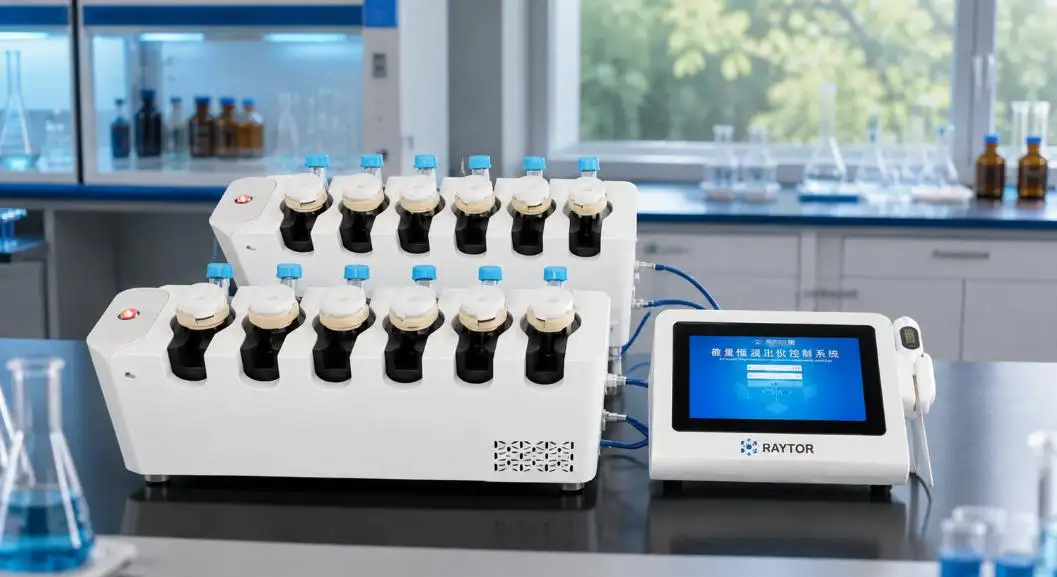
Raytor's eight-position drug-release platform demonstrates the distinction clearly. The manufacturer publishes a 20–250 rpm operating range and 0.01 rpm resolution, but the relevant steady-speed specification is ≤±1 rpm. The 0.01 rpm display increment therefore should not be interpreted as ±0.01 rpm operating accuracy.
Why Stable RPM Alone Does Not Guarantee Reproducibility
Two test positions can rotate at the same measured RPM and still generate different hydrodynamic conditions.
Mechanical Geometry Changes the Flow Field
Shaft position relative to the vessel is particularly important. An off-center or tilted rotating element creates asymmetric flow even when motor speed is perfectly stable.
Raytor addresses these mechanical variables with manufacturer-published tolerances of:
• System level <0.5°, helping maintain consistent vessel geometry;
• Vessel and shaft verticality of 90°±0.5°, limiting angular deviation;
• Centering deviation <±2.0 mm, reducing asymmetric stirring;
• Depth-positioning deviation <±1.0 mm, controlling paddle or basket position;
• Shaft and basket wobble <±1.0 mm, limiting rotational disturbance.
These values are more meaningful when interpreted together. A laboratory evaluating Topical Formulation Release Testing in India should therefore assess the motor, shaft, vessel and temperature-control system as one hydrodynamic assembly.
Temperature and RPM Must Be Controlled Together
Temperature can alter:
• Receptor-medium viscosity;
• API solubility;
• Diffusion coefficients;
• Formulation microstructure;
• Apparent release rate.
Raytor specifies a temperature adjustment range from room temperature to 50°C, with ≤±0.5°C temperature accuracy and 0.01°C resolution.
Again, resolution and accuracy should not be confused. A 0.01°C display increment does not mean the physical medium is controlled within ±0.01°C.
Select the Test Architecture Before Selecting RPM
One of the most important decisions in Topical Formulation Release Testing in India is whether the selected apparatus is scientifically appropriate for the dosage form.
A buyer should not start with:
"Which tester has better RPM performance?"
The correct sequence is:
Dosage Form → Applicable Method → Apparatus → Agitation Condition → Qualification
| Testing Requirement | Technical Direction |
| Basket or paddle compendial method | Vessel-based release system |
| Transdermal patch | Confirm the applicable pharmacopoeial method |
| Cream, gel or ointment IVRT | Diffusion-cell architecture may be required |
| Routine multi-position QC | Prioritize position-to-position consistency |
| Method development | Require adjustable and reproducible test conditions |
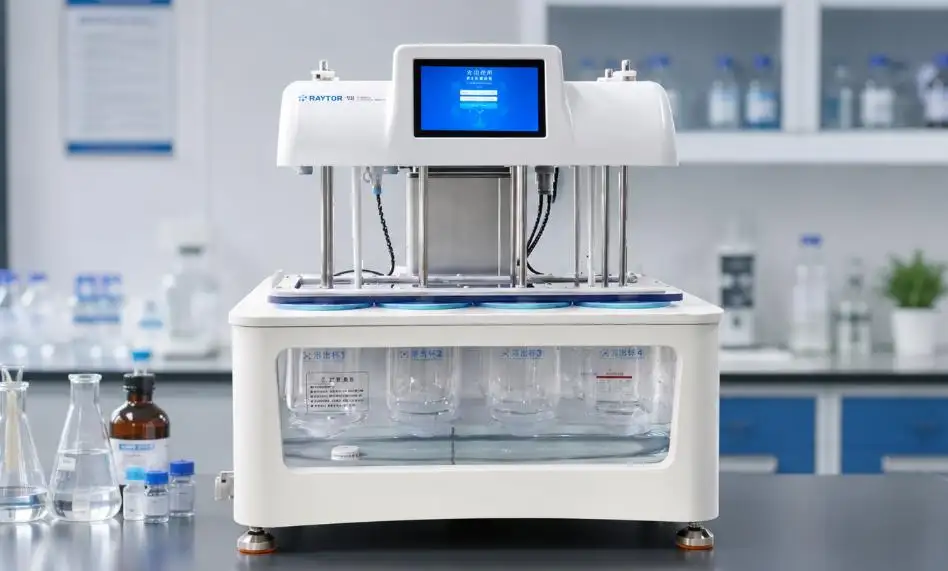
Raytor's eight-position platform is designed for basket and paddle operation and is manufacturer-stated for ChP 0931, USP 711/724 and EP 2.9.3/4 applications, including patches and semi-solid preparations.
However, topical IVRT methods based on USP <1724> may use diffusion-cell configurations. Therefore, an Indian laboratory should confirm the applicable monograph or regulatory method before assuming that one apparatus can cover every cream, gel or ointment study.
Dosing Time Can Create Variability That RPM Control Cannot Correct
Good motor control cannot compensate for poor timing.
When eight positions are dosed sequentially by hand, the last position may start later than the first. For time-dependent release measurements, that difference can distort calculated release rates.
Raytor incorporates manual synchronized dosing specifically to reduce dosing-time differences across multiple positions. Its one-piece vessel-cover structure is also designed to reduce medium evaporation, while built-in operation guidance can help standardize routine procedures and operator training.
These controls are relevant because reproducibility in Topical Formulation Release Testing in India depends on reducing both mechanical and operator-induced variability.

Qualification Should Verify Real Operating Conditions
Before routine QC testing, laboratories should confirm more than the displayed RPM.
A practical qualification approach should examine:
• Actual rotational speed at method-relevant setpoints;
• Temperature accuracy and stability;
• Levelness, verticality and centering;
• Shaft or basket wobble;
• Dosing and sampling timing;
• Medium preparation and evaporation;
• Membrane contact and air bubbles when diffusion systems are used;
• Robustness to controlled changes in stirring rate.
FDA specifically includes mixing-rate variation among the variables relevant to topical IVRT robustness assessment.
For Indian pharmaceutical laboratories, the applicable Indian Pharmacopoeia 2026, product-specific requirements and relevant USP/EP procedures should also be checked during method and equipment qualification. IP 2026 is the current tenth edition and supersedes IP 2022.
Final Words
Raytor, based in Jiaxing, Zhejiang, China, combines controlled rotational performance, temperature management, eight-position testing, mechanical geometry control and synchronized dosing within its drug-release platform. These characteristics are most valuable when they are matched to the actual method rather than treated as isolated product specifications.
For laboratories planning Topical Formulation Release Testing in India, the strongest selection principle remains simple: define the method first, verify the required apparatus second, and then evaluate RPM stability within the complete test system.
Indian pharmaceutical manufacturers and QC laboratories can discuss their dosage form, testing method and qualification requirements with Raytor before equipment selection. This method-driven approach provides a more technically defensible basis for choosing a release-testing system while helping laboratories avoid paying for specifications that do not solve their actual reproducibility problem.
FAQs
Q1. How does Raytor address mechanical variability in test positions?
Raytor controls system-level errors to below 0.5°, vessel and shaft verticality to 90°±0.5°, centering deviations to ±2.0 mm and positioning deviations to ±1.0 mm. These controls offer more uniform conditions when tested.
Q2. Does Raytor offer equipment for Topical Formulation Release Testing in India?
Yes. Indian pharmaceutical laboratories can procure Raytor drug release testing equipment directly from the manufacturer in China. The final configuration should be decided based on the dosage form and the test method and applicable pharmacopoeia.
Q3. What is the RPM range for Raytor drug release testing equipment?
Raytor's drug release equipment is capable of 20-250 rpm for the eight position apparatus. This range accommodates a variety of conditions of paddle and basket release testing.
Q4. What is the range of Raytor's drug release testing equipment for RPM stability?
Raytor lists an error in steady speed of ≤±1 rpm and a resolution of 0.01 rpm. Potential buyers should understand the difference between resolution and actual operating stability when comparing different systems.
Q5. How does Raytor control temperature for release testing?
From room temperature to 50°C, Raytor's system has temperature adjustment with temperature accuracy of ≤±0.5°C and a resolution of 0.01°C. With the system, stable temperature can control the behavior of a medium's viscosity, solubility, and diffusion.