






GLP Compliant Diffusion Apparatus in India – Compliance Made Easy
2026-06-18


The Indian pharmaceutical market is expanding quickly and is projected to be worth approximately Indian 130 billion by 2030. There are about 3000 pharmaceutical companies in India. This rapid growth has increased the need for trustworthy drug testing services. If your laboratory testing equipment has not met the guidelines set by the CDSCO, FDA, or EMA, unfortunately, your laboratory testing data will not get validated.

In India, for transdermal testing, GLP compliance diffusion apparatus will not be an additional value offering. It will be a critical requirement for offering validated services.
What is GLP Compliance?
Good Laboratory Practice is an essential element in the quality systems that nonclinical safety studies rely on. In India, the National GLP Compliance Monitoring Authority (NGCMA) is the GLP Authority in India and is responsible for the Indian national GLP program and the monitoring of compliance with GLP in India in an OECD member country.
Some of the crucial elements of GLP compliance for Indian laboratories are:
•An organizational structure with qualified and trained personnel.
•Equipment that is qualified and calibrated with maintenance history.
•SOPs for all laboratory activities.
•Adoption of study protocols.
•Integrity of raw data.
•An independent Quality Assurance unit.
Undocumented results will lead to the rejection of preclinical studies. For testing of Topical and Trans-dermal formulations, diffusion apparatus must meet the pharmacopoeia requirements.
The Need for Diffusion Apparatus in India
The Indian pharmaceutical testing service market is witnessing rapid expansion driven by a variety of factors, such as:
•Intensified oversight by the CDSCO resulting in higher demands for testing accuracy
•An increase in the number of generic transdermal patches requiring bioequivalence testing
•Increased R&D investment in topical and semi-solid formulations
•Global harmonization and the need to comply with the USP and EP
The global market for drug dissolution apparatus is predicted to reach USD 9.69 billion by 2025 with India projected to be one of the primary growth markets.
For Indian CROs and Pharma labs, the purchase of GLP compliant diffusion apparatus is fast becoming a market requirement. The issue is no longer if they should procure these systems, but rather, which systems provide the optimal return on investment.
Criteria for Selection of GLP Compliant Diffusion Apparatus
Acquisition of a diffusion system involves assessment of the following key criteria:
| Criterion | What to Look For |
| Regulatory Compliance | USP <1724>, EP 9.0, 21 CFR Part 11 |
| Automation Level | Manual vs. automated sampling and cleaning |
| Data Integrity | Audit trails, SQL databases, user access control |
| Sampling Accuracy | Synchronized channels, short sample transport pipelines |
| Temperature Control | Individual cell control with a tolerance of ≤±0.5℃ |
| Scalability | Number of Cells and independent test groups |
In the Indian market for GLP compliant diffusion systems, the following three systems dominate:
Manual systems, while the least expensive to purchase, result in significantly variable results. GLP compliance is compromised due to the risks associated with bubble formation, inconsistent sampling, and manual data entry.
Some of the manual systems' problems are resolved with semi-automated systems. However, having a longer sample transport pipeline can lead to a greater risk of sample residue and cross-contamination. These systems also frequently have an incomplete audit trail.
RAYTOR's fully automated GLP-compliant systems reduce manual error with synchronized sampling and automated cleaning with full data visibility.
RAYTOR RT800: GLP and Pharmacopoeia Compliance
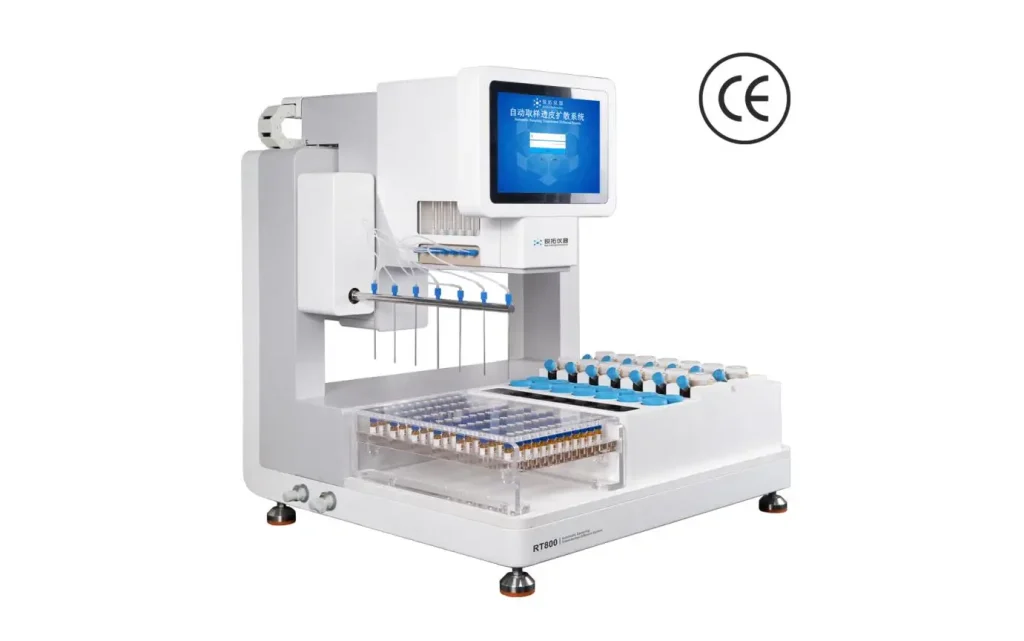
The RT800 Automated Transdermal Diffusion System was custom designed by RAYTOR Instruments for laboratories looking for GLP compliant diffusion systems in India and around the world. The RT800 provides the precision and the traceability that the current regulators expect.
1. Built-In Regulatory Compliance
The RT800 is compliant with USP <1724> for assessment of the performance of semi-solid dosage forms and the new EP 9.0 General Rule <2.9.4> for transdermal patches. The RT800 supports IVRT (In Vitro Release Testing) and IVPT (In Vitro Permeation Testing) for creams, ointments, patches, and gels.
2. Key Features for GLP Compliance
Complete audit trail functionality with SQL database storing no fewer than 200 test methods and 100 user accounts—each and every action is logged and traceable.
•7-channel synchronized automatic sampling eliminates timing discrepancies across diffusion cells.
•A shorter sample pipeline results in a significant reduction of sample residue and the risk for sample cross-contamination.
•A 6 + 1 diffusion cell setup allows for the exclusion of experimental interferences by a blank group.
•Due to the arrangement of the diffusion cell groups, two independent groups allow for the testing of different formulations at the same time.
•An adequately marked filling point allows for a completely bubble free filling, which is critical for accurate permeation analysis.
3. Precision Specifications
•Diffusion cell positions: 7 x 2
•Temperature: Room temperature to 45℃ with ≤± 0.5℃
•Rate: 200 to 900 rpm with <±10% error
•Sample Size: 0.2 to 1.5 ml with up to 24 sampling times
•Dry heating with manual bubble removal
What Makes RAYTOR Unique in the GLP-Compliant Market in India
Established in 2015, RAYTOR Instruments is among the new trusted suppliers of scientific instruments in the laboratory. The company's mission—Make Scientific Experiments Easier—defines their design philosophy.
Here's what sets RAYTOR apart for Indian laboratories seeking GLP compliant diffusion apparatus:
1. Engineered for Real Lab Challenges
Many diffusion systems fail because of small but critical flaws—bubbles on the membrane altering the early slope, temperature drift shifting solubility, shared tubing causing cross-contamination. RAYTOR engineers solutions around these real-world problems. Their integrated diffusion cell structure minimizes leak risk over long profiles, and real-time bubble removal preserves the mass-transfer interface for stable early time points.
2. Designed for Compliance From Day One
Accuracy is only part of the GLP equation. Documentation is equally critical. The RT800's complete audit tracking function and SQL database ensure every temperature reading, every sampling event, every operator action is recorded and retrievable. When CDSCO or FDA inspectors arrive, you have defensible, time-stamped data ready.
3. Two Independent Groups, One Efficient Workflow
The RT800's dual-group design is a significant productivity advantage. One group can test an innovator formulation while the other tests a generic version—under identical conditions, without cross-contamination. Both groups sample at once, so your testing time shrinks, and your R&D pipeline goes through fewer bottlenecks.
4. Flexible Sampling to Match Your Method
Transdermal studies can be quite different. The RT800 can be set to either partial sampling or full sampling, depending on what your study requires. This means you won't need to compromise your method to match the limitations of the device.
Making the Right Investment for Your Indian Laboratory
For Indian pharmaceutical businesses, Contract Research Organizations, and research-related businesses, choosing a GLP compliant diffusion apparatus is a strategic decision. The optimal system enables:
•Assurance your studies will stand up to regulatory review
•Cost savings from decreased study-related personnel costs
•Data your studies will protect, safeguarding your intellectual property
•Global acknowledgment for your research laboratory
RAYTOR Instruments merges engineering know-how with a deep understanding of regulations. Their RT800 Automated Transdermal Diffusion System is not just compliant—it's designed to make complex transdermal testing simpler, faster, and more accurate.
About RAYTOR Instruments
RAYTOR Instruments is dedicated to the research, development, production, sales, and service of high-quality laboratory scientific instruments. Since 2015, the company has specialized in providing comprehensive analytical solutions across key fields including drug permeability, dissolution/solubility, and transdermal diffusion.
�� Phone: +86 (20) 3160 8901
✉️ Email: sales@raytor.com
�� Address: Youchegang Town, Xiuzhou District, Jiaxing, Zhejiang, China
When it comes to GLP compliant diffusion apparatus, RAYTOR delivers. Our international quality standard products and highly developed technical support are focused on your needs.
Make your research easier. Select RAYTOR for all your transdermal testing.
FAQs
Q1: How does RT800 align with GLP in India?
With its SQL database and audit trail, and its compliance with USP <1724>, RT800 meets the NGCMA's GLP requirements.
Q2: Which does RT800 support IVRT, IVPT, or both?
RT800 is able to support USP <1724> IVRT, IVPT for creams, ointments, gels, and patches for both IVRT and IVPT as well as different dosage forms for IVPT.
Q3: Explain the advantage of the 7-channel sampling.
The advantage of a 7-channel sampling system is that there is no timing inconsistency among the diffusion cells observed.
Q4: What is favorable about a short pipeline?
Regulatory agencies are concerned about residual sample amounts, and shorter pipelines help to decrease the residual sample amount and reduce the risk of contamination.
Q5: Is there a provision for a blank group allowance within the system?
Yes, the 6+1 cell configuration in this case allows for a blank cell to demonstrate or reduce the interferences.