





IVRT System for Topical Drug Products: Full vs Partial Sampling Explained
2026-10-16


A topical cream produces a nearly linear release profile during early IVRT measurements, but the cumulative release curve begins to flatten after successive sampling intervals. The formulation may be releasing drug more slowly. Alternatively, the receptor medium may be accumulating enough dissolved API to reduce the concentration gradient across the membrane.
These mechanisms require different corrective actions. Replacing more receptor fluid can address accumulation, but it cannot correct drug depletion in the donor compartment or membrane binding.
For laboratories selecting an IVRT System for Topical Drug Products, the choice between full and partial sampling affects sink conditions, cumulative mass calculations, analytical sensitivity, and the reproducibility of release-rate measurements.
1. What Changes When Receptor Fluid Is Replaced?
In a vertical Franz diffusion cell, drug moves from the topical formulation through a synthetic membrane into a stirred receptor solution. The measured release rate depends partly on maintaining a suitable concentration gradient across the membrane.
Sampling changes that gradient by removing dissolved drug.
Partial Sampling: Drug Accumulation Between Collections
Partial sampling withdraws a defined aliquot and replaces it with fresh receptor medium.
Assuming a receptor chamber volume of 10 mL and a sampling volume of 1 mL. Then we isolate, substitute and repeat. We end up with about 90% of the previously mixed receptor solution.
Repeated collections create a dilution-and-accumulation process. If drug enters the receptor faster than sampling removes it, receptor concentrations continue rising.
Partial sampling is useful when:
• Receptor solubility is sufficient to maintain sink conditions.
• Released drug concentrations are low and benefit from accumulation.
• Frequent collections would otherwise consume substantial receptor medium.
Its limitation becomes apparent when retained API approaches a concentration that reduces the driving force for release.
Full Sampling: Removing Accumulated Drug
Full sampling removes essentially the entire receptor solution and replaces it with fresh medium.
This limits carryover of dissolved API between sampling intervals and can improve sink-condition control for compounds with limited receptor solubility.
Even with the use of fresh medium, shakes may not always lead to sink conditions during the next interval. Concentrations of the drug may rise considerably before the next collection.
Replacing the medium fully also implies having reliable drainage, refilling and mixing. Residual medium and trapped air may affect the integrity of the sampling process.
2. Full Sampling Vs Partial Sampling Which One Is More Trustworthy?
| Technical Criterion | Partial Sampling | Full Sampling |
| Sink-condition control | Depends on accumulated drug concentration | Reduces accumulation after each replacement |
| Analytical sensitivity | Retained drug can increase detectable concentrations | Lower concentrations may approach the quantitation limit |
| Mass-balance calculation | Correct for previously removed drug | Sum drug masses from complete collections |
| Fluid disturbance | Smaller exchange generally causes less disturbance | More extensive exchange may disturb mixing and temperature |
| Primary failure mode | Receptor accumulation or incorrect correction | Incomplete drainage, carryover, or bubble formation |
| Operating cost | Lower medium consumption | Higher medium and handling requirements |
Full sampling is not inherently more accurate. It is preferable only when its benefits for receptor conditions outweigh the additional fluid-exchange risks.
A partial-sampling method that maintains adequate sink conditions may provide equally suitable release-rate measurements with less disturbance.
3. How Sampling Mode Affects Cumulative Release Calculations
The analytical instrument measures drug concentration, not the cumulative drug release directly. Conversion of concentration to released mass requires consideration to the receptor volume as well as the sampling losses.
Partial-Sampling Correction
For a well-mixed receptor chamber maintained at constant volume:
Qₙ = [VᵣCₙ + Σ(vᵢCᵢ)] / A
Where:
• Qₙ: Cumulative released drug per unit diffusion area at time n
• Vᵣ: Receptor working volume
• Cₙ: Receptor concentration immediately before sampling
• vᵢ: Volume removed at an earlier sampling point
• Cᵢ: Concentration of that earlier sample
• A: Effective membrane diffusion area
The summation includes samples collected before time n.
Omitting previously removed drug underestimates cumulative release. This error increases as more sampling events occur.
Full-Sampling Calculation
When the entire receptor volume is collected and replaced at every interval:
Qₙ = Σ(VᵢCᵢ) / A
Here, each term represents the drug mass recovered during a complete collection, including the current interval.
Both equations assume representative sampling and accurate volume measurements. Incomplete fluid exchange, unswept tubing volume, adsorption, or sample carryover can invalidate those assumptions.
For conventional semisolid IVRT, cumulative release per unit area is commonly plotted against the square root of time. The slope of the justified linear region is used to characterize the drug release rate.
4. How Should Sampling Mode Be Selected for Creams, Gels, and Ointments?
The sampling decision should follow receptor-solution qualification and preliminary release experiments.
Solubility and Sink Conditions
A poorly soluble API can accumulate in the receptor compartment and restrict further release.
Before selecting full replacement, laboratories should determine the API's solubility in the receptor medium at the test temperature and compare it with measured concentrations during the study.
If concentrations remain sufficiently below saturation, partial sampling may be appropriate. Receptor composition, membrane compatibility, and analytical suitability must also be considered when increasing the sample volume.
Low-Concentration Samples
Sample concentrations close to the method's lower limit of quantitation may be expected for a slow-releasing ointment for which the entire dose is replaced.
Partial sampling may improve measurement sensitivity by removing less drug from the receptor. However, this increases the drug concentration on the receptor for subsequent sample intervals.
Apparent Release-Rate Decline
A downward-curving release profile does not always reflect inadequate sampling.
Some reasons for a release profile that curves downward include:
• Receptor saturation with API.
• Depletion of API, or change in the formulation of the donor.
• Adsorption of the API to the membrane, or to the transfer lines.
• Not mixed well or air bubbles underneath the membrane.
5. What Should Laboratories Verify Before Method Transfer?
It is better to qualify sampling performance based on actual operating conditions rather than to assume performance based on nominal instrument settings.
A number of checks are instructive.
• Accuracy of removal/replacement volumes: Sampling systems should be qualified to remove and replace the desired sample volumes by weighing the removed and replaced samples, respectively.
• Carryover and recovery: Residual liquid and tubing retention should be checked with a known tracer.
• Stability: Find the temperature at which the sample recovers, look for bubbles in fluid samples.
• Reproducibility of release-rate: The variation in the profile of a cumulative mass balance of a sample should be assessed, and between-cell variability should be evaluated.
Sampling should provide well-mixed rather than stagnant fluid from a sampling arm.
6. Raytor RT814: Sampling Flexibility Without Changing Platforms
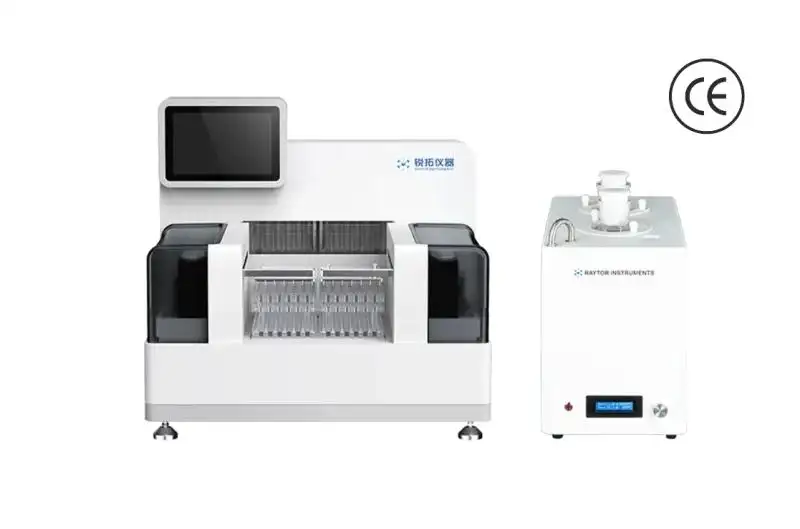
Raytor's RT814 Automated Transdermal Diffusion System supports both full and partial sampling for IVRT and IVPT workflows.
The product specifications include:
• 14 diffusion-cell positions arranged in two independent groups.
• 9, 10, and 12 mL diffusion-cell volume options.
• 1–10 mL sampling range, with up to 24 sampling events.
• Separate sampling pipelines and pumps for individual cells.
• Automatic bubble removal and independent cell temperature control.
The sampling range should not be interpreted as confirmation that every nominal receptor volume can be completely replaced in a single operation. Laboratories using larger cells should confirm the full-sampling sequence, actual working volume, and residual-volume handling with Raytor.
For IVRT laboratories comparing sampling protocols, Raytor can provide further information on RT814 configurations and operating requirements.
Explore the Raytor RT814 Diffusion Cell Apparatus.
FAQs
Q1. Does the Raytor RT814 support both full and partial sampling?
Yes. Raytor RT814 supports automated full and partial sampling, allowing laboratories to select a receptor-fluid replacement method based on their IVRT protocol.
Q2. When should partial sampling be used in topical IVRT testing?
Partial sampling is suitable when receptor concentrations remain within validated sink-condition limits. It reduces medium consumption and retains measurable drug concentrations between collections.
Q3. When is full sampling preferable for topical drug products?
Full sampling may be preferable when accumulated drug threatens sink conditions. Complete receptor-fluid replacement reduces retained API but requires verification of drainage, refilling, and temperature recovery.
Q4. What diffusion cell volumes are available with the Raytor RT814?
Raytor RT814 lists 9 mL, 10 mL, and 12 mL diffusion cell options. The selected volume must match the sampling protocol and receptor-medium requirements.
Q5. Can the Raytor RT814 perform full sampling with a 12 mL diffusion cell?
The RT814 sampling range is 1–10 mL. Laboratories should confirm with Raytor how complete receptor-fluid replacement is performed when using a 12 mL diffusion cell.