





What Can Be Customized in OEM Dissolution Testing Equipment?
2026-10-09


A laboratory can install a 12-vessel dissolution tester and still miss its first valid sampling point. If the pump must purge a long line before collecting an aliquot, the concentration reaching the vial may represent a later moment than the method specifies. Increasing vessel count will not fix that problem.
When buyers specify OEM Dissolution Testing Equipment, we start with the dissolution method, then work outward to the apparatus, liquid path, detector, and control system. Raytor offers several published configurations and instrument customization services; bespoke combinations, interfaces, and qualification deliverables require project-level confirmation.
1. Which Parts of the Test Method Are Fixed?
For an established method, apparatus type, vessel geometry, paddle or basket position, agitation speed, medium volume, and sampling location are not arbitrary design variables. Changing them can alter local shear, coning beneath a paddle, or exposure of the dosage form to fresh medium. A different release profile may reflect changed hydrodynamics rather than formulation behavior.
Raytor's platforms cover different needs:
| Equipment Path | Raytor Platform | Decision to Resolve |
| Parallel paddle/basket tests | RT600-ST (8 vessels), RT612-ST (12), RT614-ST (14) | Simultaneous units versus sampling capacity |
| Flow-through testing | RT700, USP Apparatus 4 | Cell type, flow rate, open- versus closed-loop operation |
| Online UV measurement | RT600-UV | Spectral selectivity, optical pathlength, analytical range |
| Repeated unattended batches | RT9 series | Media preparation, cleaning verification, sequence control |
A 14-vessel layout is useful only if the autosampler can service the proposed time points without delaying one vessel relative to another. For noncompendial development methods, mechanical adaptations may be feasible, but their effect on the release profile must be demonstrated.
2. What Can Change in the Sampling Circuit?
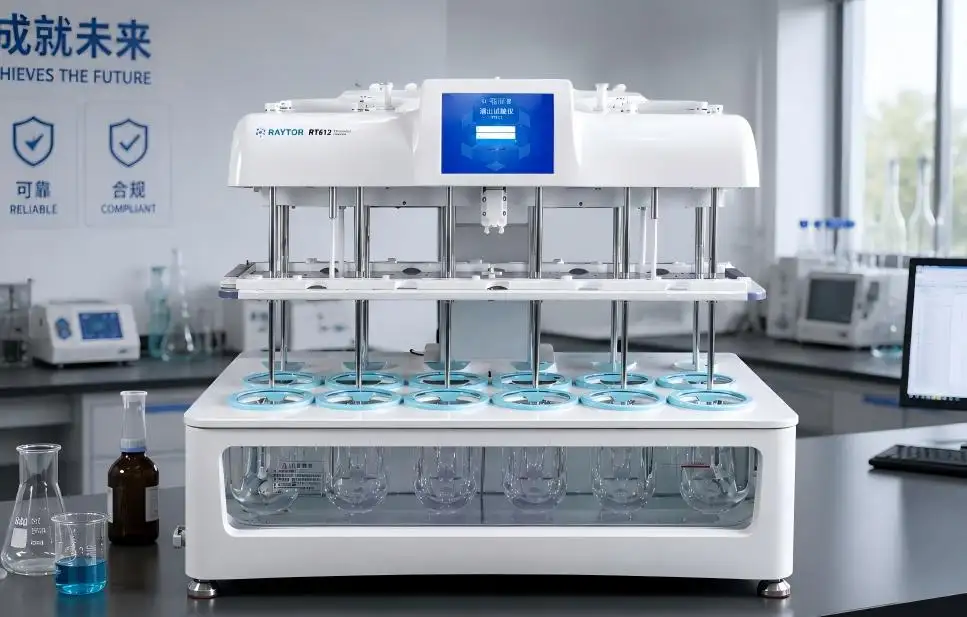
Raytor's RT612-ST uses a Teflon sampling path, an automated pump, online filtration, and sample collection. The published specification lists a minimum first sampling interval of three minutes and five minutes for subsequent routine points. A method requiring one-minute samples therefore needs an explicit feasibility review, not a software assumption.
Four primary considerations generally determine the success of a sampling arrangement:
Dead volume and timing: The length and internal diameter of the lines, the volume of the priming pump, and the speed of the pump, all influence the timing of when a representative sample is collected. Verify actual collection times on all sampling vessels.
•Adsorption: PTFE resists many solvents, but drug loss onto tubing, membranes and/or fittings, is compound dependent. Compare recovery through the complete fluid path.
•Filtration: Smaller pore filters will capture smaller particles, but can clog or retain the analyte. Test the filter recovery and pressure behavior in the dissolution medium.
Withdrawal and Replacement: Repeated aliquots from a particular volume will alter the volume of the sample if the medium is not replaced. Medium replacement can also alter the temperature and concentration of the sample. The calculations must be in balance with the real world effects of the sample.
A practical acceptance test compares automated versus manual sampling using the same method and examines early time points, carryover, and vessel-to-vessel variation—not pump precision alone.
3. Can Detection and Data Handling Be Adapted?
The RT612-UV integrates dissolution testing with UV-Vis analysis and offers alternative optical pathlengths. Shorter paths can help keep a high-absorbance sample within the instrument's working range; longer paths improve response at lower concentrations. Neither adjustment removes interference from absorbing excipients or degradation products.
For formulations with overlapping spectra, analyzed samples with a validated chromatographic method may be more defensible than direct UV quantification. Buyers should check detection limits, linear range, and agreement with their reference method before specifying online analysis.
Raytor offers 21 CFR Part 11 functions in its products. For a regulated installation, the customer still has to verify user permissions, audit trail, the behavior of electronic records, and the electronic records export, and back up and restore the records. Also, the connection of the LIMS and any requested interface or modified software workflow is to be confirmed by Raytor.
4. How Much Automation Is Worth Specifying?
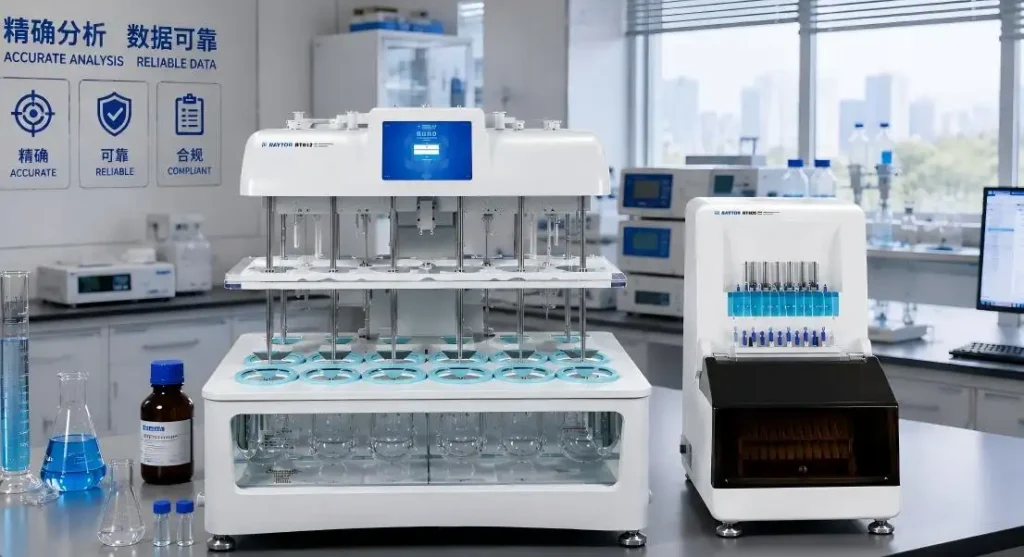
Raytor's RT9 series is designed for consecutive automated dissolution batches, including medium dispensing and vessel cleaning. That changes the procurement question: throughput depends not just on a test's duration but on filling, thermal equilibration, cleaning, and readiness for the next batch.
Residual surfactant, poorly dissolved API, or droplets trapped around a vessel outlet may contaminate the next run. Cleaning should be challenged with a representative difficult-to-remove formulation, followed by blank or residue testing against predefined limits. Media degassing and temperature stability also need assessment after dispensing, not only at the preparation tank.
For a laboratory running a few distinct methods daily, a simpler automated sampler may be easier to qualify than a fully unattended sequence with multiple recipes and cleaning cycles.
5. What Evidence Should Accompany a Custom Configuration?
Customization changes the qualification burden according to what was modified. Adding a vial rack is not equivalent to replacing a flow path or changing a vessel assembly.
Before factory acceptance, buyers should agree on:
•Mechanical and thermal checks: Shaft centering, wobble, speed, vessel temperature, and applicable apparatus dimensions.
•Liquid-path tests: Sampling volume, time-point accuracy, carryover, analyte recovery, and filtration performance.
•Software challenges: Interrupted runs, altered methods, access controls, audit records, and data retrieval.
•Method performance: Comparison with the existing validated procedure and applicable USP performance verification testing or an accepted qualification alternative.
•Mechanical checks cannot, on their own, establish whole-system dissolution performance. Any method transfer or revalidation decision belongs in the laboratory's change-control assessment.
6. What Should Go into the OEM Inquiry?
Send Raytor the dosage form, applicable pharmacopoeial method, target vessel count, medium composition and volume, sampling schedule, anticipated concentration range, detection method, and electronic-record requirements. Mark which requirements are fixed by the approved method.
Then we can talk about a suitable published platform and identify necessary modifications that will require an engineering review. Software interfaces, qualification documentation and private labeling will have to be verified separately.
Check out Raytor's OEM Dissolution Testing Equipment solutions or contact our engineering team to discuss your testing requirements.
FAQs
Q1. Does Raytor offer customized OEM dissolution testing equipment?
Yes. Raytor provides dissolution instrument customization services. Specific hardware modifications, software functions, and OEM arrangements require engineering confirmation.
Q2. What vessel configurations are available from Raytor?
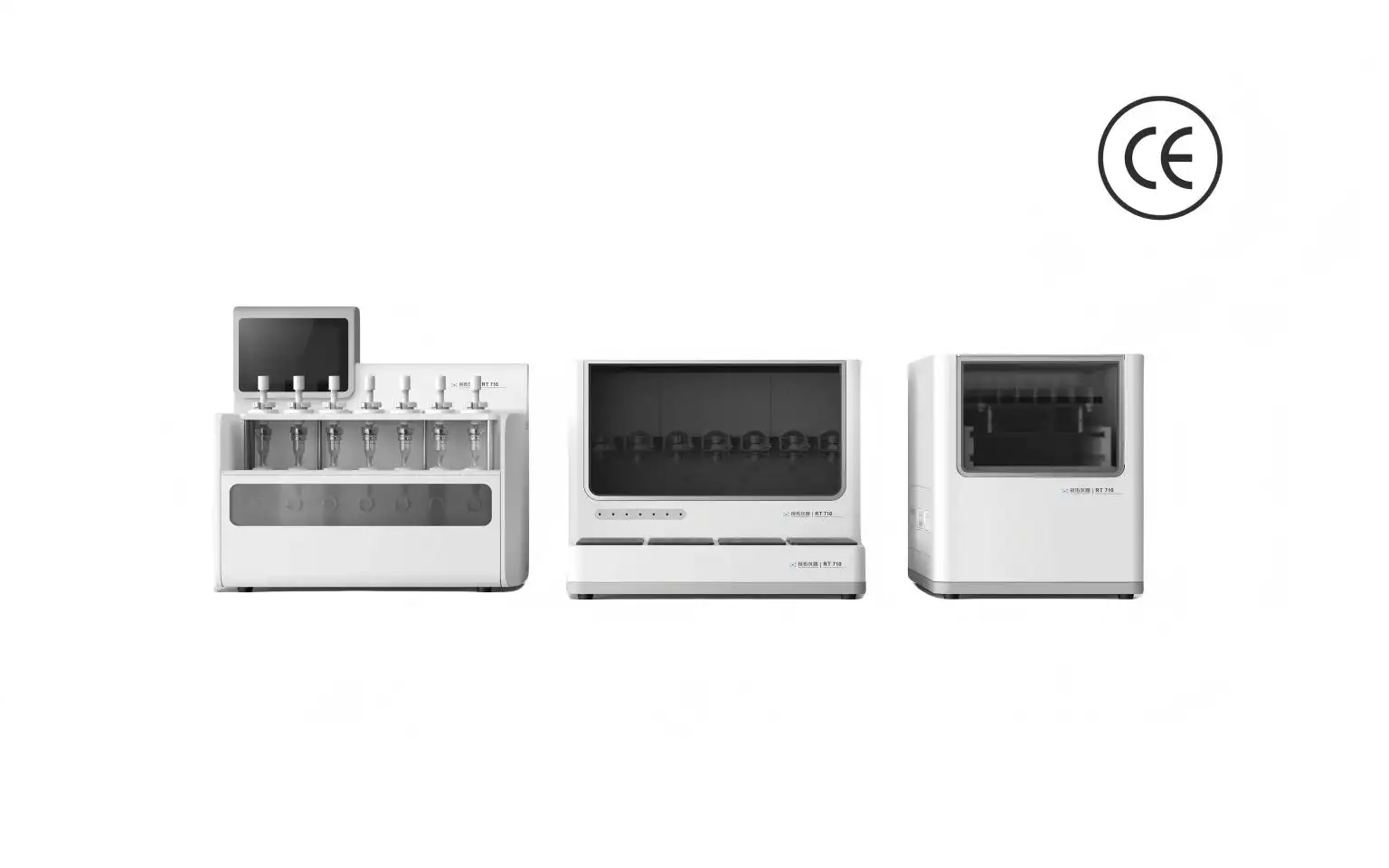
Raytor offers the 8-vessel RT600-ST, 12-vessel RT612-ST, and 14-vessel RT614-ST automated dissolution systems. Selection depends on testing throughput and sampling requirements.
Q3. Which USP dissolution methods does Raytor support?
Raytor provides paddle and basket dissolution systems for USP Apparatus 1 and 2, as well as the RT700 flow-through cell system for USP Apparatus 4.
Q4. Can Raytor customize automated sampling parameters?
The RT612-ST supports adjustable sampling parameters. Its published minimum intervals are three minutes for the first sample and five minutes for subsequent routine samples.
Q5. Does Raytor provide automated sampling and filtration?
Yes. Raytor's automated dissolution systems support automatic sample collection, high-precision pumping, and online filtration. Specific filtration configurations depend on the selected model.