





What Does USP <711> Require for USP Compliant Pharmaceutical Dissolution Equipment?
2026-10-08


A dissolution apparatus may hold its programmed temperature and rotational speed yet fail performance verification. A paddle positioned too close to the vessel bottom can alter liquid circulation. Shaft misalignment creates uneven flow, while poorly controlled sampling introduces concentration errors that the instrument's display cannot detect.
For laboratories purchasing USP Compliant Pharmaceutical Dissolution Equipment, the critical question is not whether a supplier advertises USP compatibility. It is whether the installed apparatus, sampling arrangement, and operating procedures can meet the applicable compendial requirements.
At Raytor, we examine these requirements in relation to mechanical design, automated sampling, and the practical limitations of dissolution methods.
1. What Apparatus Setups Does USP <711> Suggest?
USP <711> describes various types of apparatus and procedures for the determination of the dissolution of pharmaceutical dosage forms. For traditional oral solid dosage forms, Apparatus 1 (basket) and Apparatus 2 (paddle) are usually specified.
Usually the applicable monograph or validated method determines the selection, not operator preference.
• Apparatus 1 (basket): The dosage unit is contained within a rotating wire-mesh basket. Undissolved material can block the basket mesh, and limit the medium from coming in contact with the dosage unit.
• Apparatus 2 (paddle): The dosage unit is in the vicinity of the vessel bottom. For poorly soluble drugs, the particles can accumulate beneath the paddle, and can result in coning and overestimation of the dissolution rate.
Floating drug dosage units present another problem. For systems that use a sinker, the sinker can be introduced in the apparatus as allowed by the method, but evaluating the effect of the introduction can alter the hydrodynamic conditions of the system.
For the user, modularity of the equipment to use different basket and paddle assemblies is an advantage. Mechanical fit of the apparatus and suitability must be checked after conversion.
2. What Mechanical Tolerances Must the Equipment Meet?
USP <711> specifies dimensional tolerances and operating requirements to define the hydrodynamic conditions.
Even slight alignment errors can impact the release of the drug, especially for formulations which are sensitive to the distribution of the particles or to the degree of agitation.
| Parameter | USP <711> Requirement for Apparatus 1/2 | Risk or Verification Method |
| Medium temperature | Typically 37 ± 0.5°C | Measure temperature in each vessel, do not rely on bath sensor temperature |
| Shaft rotation | Within ±4% of specified speed | Verify actual RPM using a calibrated tachometer |
| Shaft centering | Within 2 mm of vessel vertical axis | Verify position of shaft relative to vessel geometry |
| Basket/paddle clearance | 25 ± 2 mm above vessel's inside bottom | Verify clearance using a calibrated gauge |
| Medium volume | Within ±1% of specified volume | Verify accuracy of medium dispensed and prepared |
| Sampling time | Generally within ±2% of specified time, unless otherwise directed | Verify actual time sample is withdrawn |
These requirements pertain to the assembled apparatus, operating under specific conditions, and not to the individual elemental components thereof.
Why Vessel Geometry and Vibration Matter
A worn vessel, excessive basket wobble, or external vibration can change fluid movement without causing an obvious rotational-speed error.
Before qualification, laboratories should inspect vessel surfaces, shaft verticality, stirring-element condition, and bench stability. Mechanical checks become especially relevant after replacing vessels, paddles, or baskets.
The temperature controller also requires separate scrutiny. A stable bath reading does not prove that the dissolution medium in every vessel remains within the specified range.
3. Impact of USP <711> on automated sampling design?
Automated sampling introduces additional variables between dissolution and analytical measurement.
For Apparatus 1 and 2, the conventional sampling zone lies midway between the medium surface and the top of the rotating basket or paddle blade, at least 1 cm from the vessel wall.
Sampling-probe placement matters because concentration may not be uniform throughout the vessel, particularly during early dissolution.
Three potential failure mechanisms require consideration:
• Transfer line adsorption: Some APIs can interact with and adsorb onto the walls of tubing. While PTFE tubing can solve for chemical compatibility, sample recovery must still be demonstrated for the formulation.
• Filter retention and blockage: Membrane filters can adsorb the drug and excipients can block the filters. Suitability of filters must be tested through a recovery and compatibility study.
• Sampling delay and carryover: Tubing dead volume and incomplete flushing can contribute sample material from a previous sample or introduce a considerable sampling delay.
For an early sampling point, a small delay can represent a large proportion of the total sampling interval.
Laboratories should compare automated and manual sampling using representative formulations and concentrations. The comparison should address sampling-time accuracy, filter recovery, carryover, and the possible hydrodynamic effect of an immersed probe.
Repeated withdrawals also require appropriate medium replacement or validated volume corrections.
Automation cannot be considered suitable simply because the sampling pump delivers a repeatable volume.
4. How is Dissolution Apparatus Suitability Verified?
Mechanical calibration verifies measurable parameters. It does not confirm that an entire apparatus functions acceptably to produce dissolution results.
Qualification generally consists of the combination of installation, operational and performance verification, and may include:
• IQ: Verification of installation of apparatus, utilities, and documentation
• OQ: Verification of mechanical alignment, temperature control, and rotation
• PQ: Demonstration of apparatus performance under specified testing conditions, which may include the Performance Verification Test (PVT).
For the USP apparatus 1 and 2, the PVT employs the USP Dissolution Performance Verification Standard - Prednisone RS.
Acceptance is determined by the geometric mean and the coefficient of variation, and is compared to limits assigned to the reference-standard lot. The results of PVT may be impacted by the condition of the dissolution vessels, mechanical alignment, the medium, analyst technique, and vibration.
USP General Chapter <711> Dissolution requires periodic verification of dissolution apparatus suitability but does not prescribe a specific verification interval. The frequency of mechanical calibration and Performance Verification Testing (PVT) should be established and documented by the laboratory based on a risk assessment, equipment performance history, and applicable quality procedures, taking relevant USP guidance into consideration.
Requalification should also be performed after significant repairs or the replacement of critical components.
While USP recommends mechanical calibration and PVT at six month intervals, failure of a PVT should be investigated beyond recalibration of the motor.
5. How Does Raytor RT600-ST Support USP Dissolution Testing?
Raytor's RT600-ST Automated Dissolution System combines eight dissolution positions with automated dosing, sampling, and sample collection.
The system provides:
• 0–300 rpm speed range, with stated steady-speed error of ≤±0.3 rpm.
• Temperature accuracy of ≤±0.2°C, supporting controlled dissolution conditions.
• Coaxial paddle-basket design, intended to simplify apparatus conversion without routine height readjustment.
• 1–20 mL automated sampling range, with stated sampling precision of ≤±1%.
• PTFE sampling pipelines and dual online filtration, with optional online dilution.
This is manufacturer supplied information, not substitutes for site-specific qualification or analytical method validation.
Limitations warranting attention include: the earliest first sampling point is 3 minutes (including tubing pre-rinsing), and the minimum interval between subsequent sampling points is 2 minutes. Methods requiring an earlier first sampling point or shorter sampling intervals should be assessed against the sampling capabilities of the system.
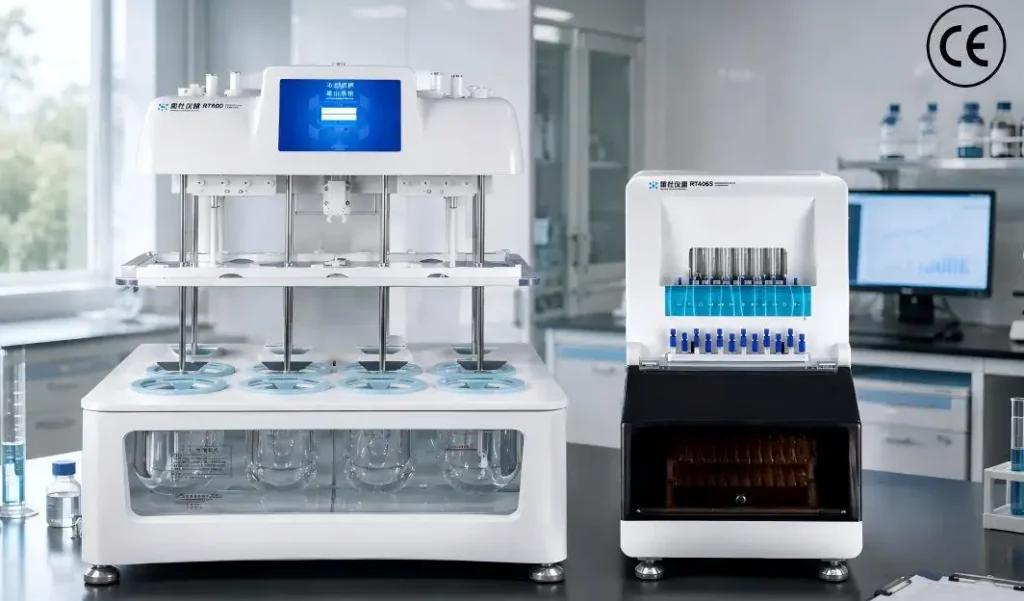
Prior to purchase, laboratories should request qualification data, calibration records and/or procedures, and other information concerning the instrumentation to be supplied. Laboratories should also confirm their own sample recovery, sampling equivalence and method validation.
For USP compliant Pharmaceutical Dissolution Apparatus, Raytor can provide RT600-ST configuration and instrument specifications and support the selection and qualification of the instrument.
FAQs
Q1: Is Raytor RT600-ST designed for USP <711> dissolution testing?
Yes. Raytor specifies the RT600-ST for USP <711> dissolution testing. The installed system must still undergo appropriate qualification and performance verification.
Q2: Does Raytor RT600-ST support USP Apparatus 1 and Apparatus 2?
Yes. The RT600-ST supports basket and paddle methods through a coaxial design. Mechanical alignment must be verified after configuration changes.
Q3: How many dissolution vessels does Raytor RT600-ST have?
The RT600-ST features eight dissolution positions with a single-drive configuration for pharmaceutical QC testing.
Q4: What rotational speed and temperature accuracy does Raytor RT600-ST provide?
Raytor specifies a 0–300 rpm range, steady-speed error of ≤±0.3 rpm, and temperature accuracy of ≤±0.2°C.
Q5: Does Raytor RT600-ST support automated dissolution sampling?
Yes. The RT600-ST provides automated sampling from 1–20 mL with a stated sampling precision of ≤±1%.