





Transdermal Diffusion Apparatus Manufacturer for IVPT
2026-10-13


An IVPT study may show substantially different permeation profiles from skin sections exposed to the same topical formulation. One section produces an early flux peak; another shows delayed permeation despite identical drug loading and nominally identical Franz cell conditions.
This may be due to the stratum corneum, preparation of the tissue, receptor fluid contact, or the sampling procedure. Without separating these effects, the interpretative artifacts of formulation performance may be misconstrued.
As a Transdermal Diffusion Apparatus Manufacturer, Raytor addresses the portion of this uncertainty related to equipment by means of controlled temperature, automated sampling, and designs of diffusion cells to minimize handling errors. Biological variability requires the appropriate qualification of the skin and study design.
1. Which Skin Characteristics Cause the Greatest IVPT Variability?
The stratum corneum may be a major barrier to passive permeation of many topically active drugs. Variability in this component may influence drug partitioning and diffusion.
Laboratories should distinguish three sources of variability:
Donor characteristics include anatomical site, intraindividual variability of the stratum corneum, and the type of previous tissue handling.
• Skin thickness: Varies with dermatoming and may affect the path of diffusion and drug retention time.
• Preparation damage: Mechanical abrasion, storage, freeze-thaw, etc., may also damage the barrier.
Skin integrity testing may help exclude damaged tissue. These tests include TEWL and electrical resistance or absorption of tritiated water.
However, passing an integrity test does not ensure that a membrane satisfies the acceptance criterion of a barrier.
For comparative IVPT studies, donor-matched allocation is therefore preferable to distributing unrelated skin samples between formulations. Replicates from each donor should be assigned according to a predefined, appropriately randomized or balanced design.
2. How Can Diffusion Cell Design Prevent Additional Variability?
Even qualified skin may generate misleading results if individual diffusion cells expose it to different conditions.
A Transdermal Diffusion Apparatus Manufacturer should explain not only how parameters are controlled but also how laboratories can verify those controls under actual experimental conditions.
| Equipment factor | Mechanism affecting IVPT data | Practical verification |
| Temperature variation | Changes drug diffusivity, partitioning, and membrane transport | Measure temperature at representative mounted skin positions |
| Entrapped air | Interrupts receptor fluid contact beneath the membrane | Inspect for bubbles before dosing and during operation |
| Cell sealing | Leakage or uneven clamping changes effective exposure conditions | Check seals, exposed area, and receptor volume stability |
| Sampling variation | Incorrect timing or volume distorts concentration and flux profiles | Verify sampling intervals, recovery, and volume accuracy |
Temperature Control Must Reflect Skin Temperature
OECD Test Guideline 428 describes maintaining skin near 32 ± 1°C for in vitro skin absorption testing. The instrument heater may need a different setpoint to achieve the required temperature at the membrane.
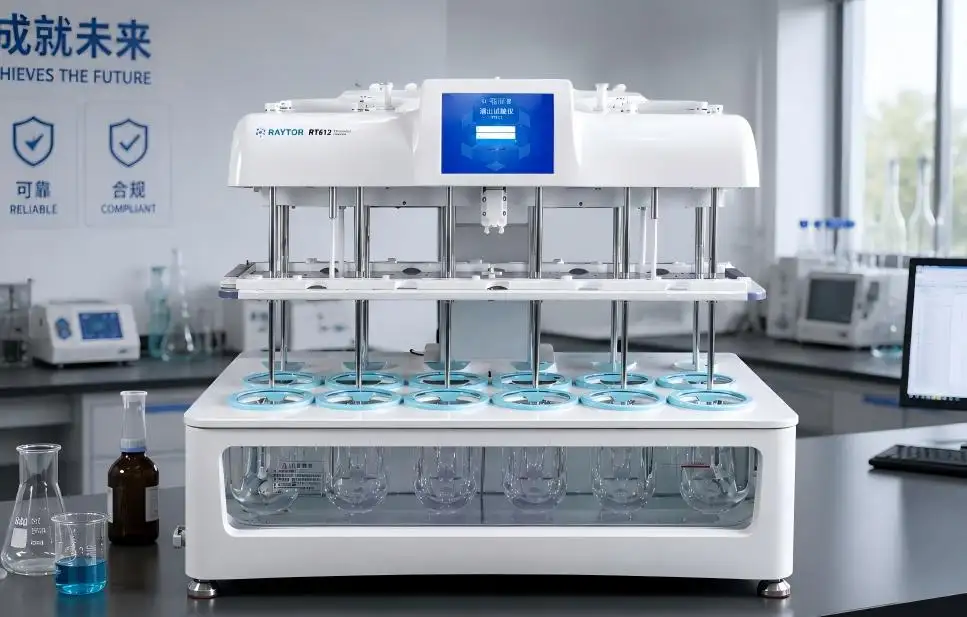
Raytor's RT814 provides system-level temperature control through a thermostatically controlled water bath, with temperature monitoring and calibration capabilities for individual diffusion cells. Laboratories should still verify skin-side temperatures using their actual receptor medium, cell geometry, and operating conditions.
Air Bubbles Can Resemble Poor Skin Permeability
A bubble beneath the membrane reduces liquid contact over the affected region. The apparent permeation rate may decrease without any change in the skin's intrinsic barrier properties.
Raytor's RT814 uses automatic diffusion cell tilting to discharge residual bubbles. Its integrated glass cell construction also addresses leakage risk.
Neither feature eliminates the need to inspect membrane seating and confirm that the receptor compartment is properly filled.
3. Can Receptor Fluid and Sampling Conditions Distort Skin Permeation Results?
Receptor fluid selection affects both drug solubility and the concentration gradient driving permeation.
For poorly water-soluble compounds, if the capacity of the receptors is inadequate, the drug could accumulate causing a backlog which may lead to an apparent decrease in drug flux. Increasing the concentration of the surfactant and/or the cosolvent may increase the drug solubility, but may also change the characteristics of the skin barrier.
The selected composition therefore needs to demonstrate adequate solubility, drug stability and skin compatibility.
Sampling introduces further uncertainty.
In partial sampling, removing receptor solution and replacing it with fresh medium increases the total drug mass remaining in the cell. Cumulative permeated amount should be adjusted for previously removed samples.
This may be further compounded by dead volume, incomplete mixing and drug residue in the transfer lines.
Raytor alleviates the risk with the following designs:
• RT800: Sampling pipelines for each cell are kept as short as possible to minimize opportunities for sample residue, and synchronized sampling reduces collection-time differences for the samples in a group.
• RT814: The use of separate pipelines and pumps for each cell reduces cross-contamination. Partial and full sampling are available.
Sampling recovery and carryover must be established with the drug of interest and the receptor media.
4. Which Raytor System Fits Different IVPT Study Designs?
The degree of required automation is dependent on the number of test conditions, the sampling frequency and donor allocation.
| Raytor system | Configuration | Suitable laboratory use |
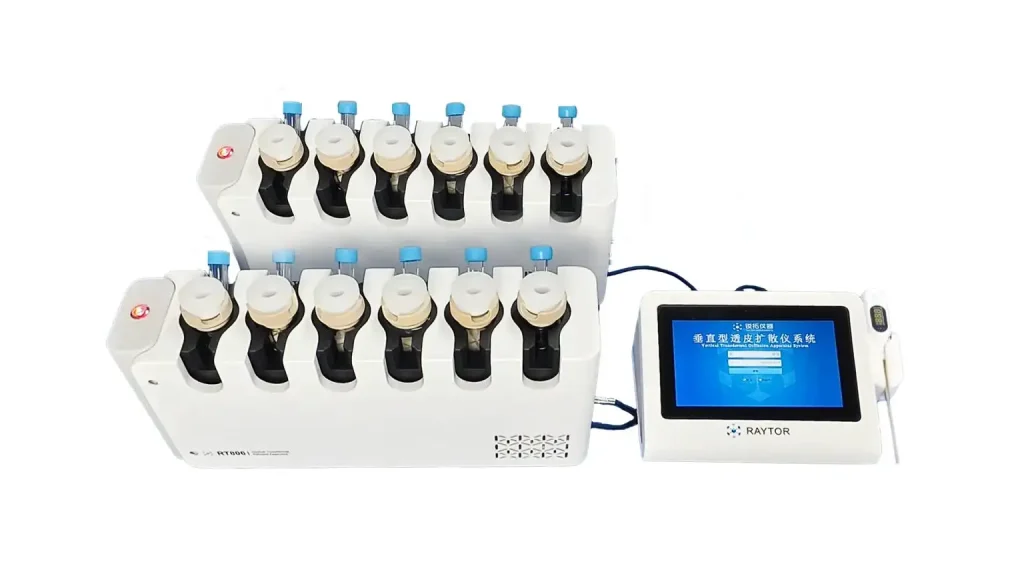
| RT806 | Manual sampling; six diffusion cells per group | Early method development and small experimental series |
| RT800 | Seven synchronized sampling channels; two diffusion cell groups | Repeated sampling with reduced operator timing variation |
| RT814 | Fourteen positions; independent cell temperature control; automatic bubble removal | Higher-throughput studies requiring more extensive automated control |
Manual sampling provides flexibility when procedures are being adjusted frequently. Its limitation is the additional operator involvement in collection timing, sample replacement, and cell inspection.
Automation becomes more useful when short sampling intervals or numerous parallel cells make manual consistency difficult.
However, 14 test positions do not necessarily equate to 14 independent biological replicates. Multiple sections from the same donor are biologically related, and this relationship must be taken into consideration with the design and analysis of the study.
5. What Should Buyers Verify Before Qualifying an IVPT Apparatus?
The specifications given establish the operating range of the IVPT apparatus, and not the reproducibility of the IVPT method.
Laboratories must submit a request for the relevant technical documentation and perform method qualification prior to the acquisition of the IVPT apparatus.
The qualification of the method includes the following:
• Membrane Compatibility: Verify the diffusion area and cell dimensions and confirm the clamping arrangements and suitability of the skin preparation.
• Thermal Performance: Measure the temperature across loaded cells, and equilibrium the system.
• Sampling Qualification: Determine analyte recovery and carryover, and assess the effect of partial or complete receptor replacement.
• Biological Reproducibility: Compare intra-donor and inter-donor variation of Jmax.
Because of sampling variability, unexpectedly high flux through a single membrane should prompt a review of integrity tests, sample records, sampling calculations and analyses before assigning the difference to a formulation issue.
The scope of a given regulation impacts assessment and decision-making. The FDA's October 2022 Draft IVPT guidance limited consideration to specified topical drug products submitted in ANDAs, and explicitly excluded transdermal patch systems. In the absence of product-specific regulatory guidance, IVPT laboratories must assess and decide for themselves the suitability of IVPT for a given dosage form.
Partnering with Raytor for IVPT Equipment Selection
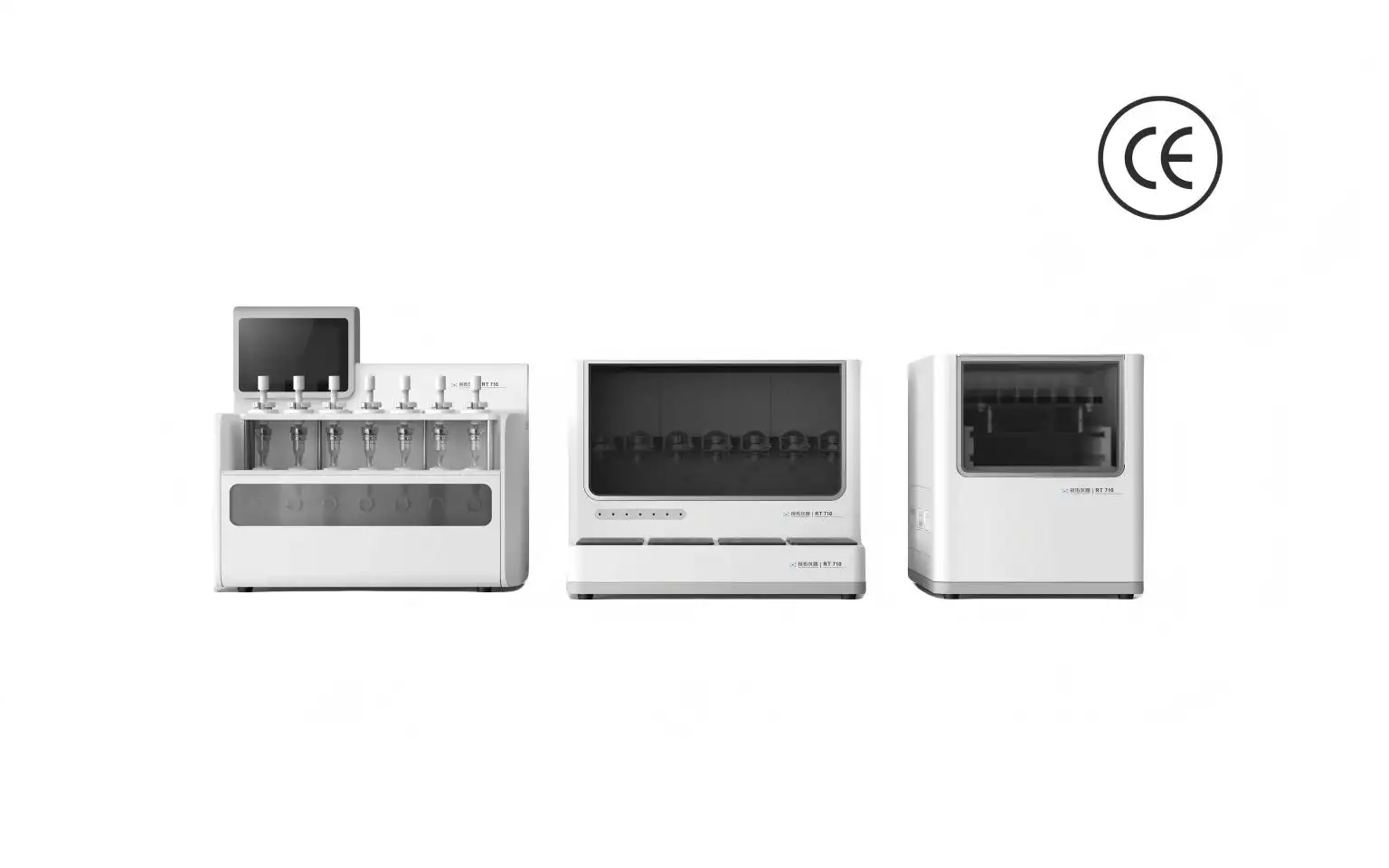
Raytor has diffusion systems (RT806, RT800 and RT814) which are suited to various sampling and experimental control requirements. Share your skin model and receptor medium, as well as your planned sampling schedule and donor allocation with our technical team to evaluate the optimal configuration.
Details of Raytor's Transdermal Diffusion Apparatus can be found here.
FAQs
Q1. How does Raytor address skin variability in IVPT studies?
Raytor provides diffusion systems with controlled heating, sampling, and receptor fluid management. These features reduce equipment-related variation but cannot eliminate biological differences between skin samples.
Q2. Which Raytor apparatus is suitable for skin permeation testing?
Raytor offers the RT806 for manual testing, RT800 for synchronized automatic sampling, and RT814 for automated multi-cell IVPT studies.
Q3. How does the Raytor RT814 reduce air bubble interference?
The RT814 automatically tilts diffusion cells to remove trapped air bubbles, helping maintain receptor fluid contact beneath the skin membrane.
Q4. Can Raytor's diffusion systems eliminate donor-to-donor skin variability?
No. Biological differences must be addressed through skin integrity screening, consistent tissue preparation, and donor-matched experimental designs.
Q5. How does the Raytor RT814 control temperature during IVPT?
The RT814 provides system-level temperature control for its 14 diffusion cell positions through a thermostatically controlled water bath. Laboratories should verify actual skin surface temperatures under operating conditions.