






Dissolution Apparatus Calibration in India for Pharmaceutical Formulation Labs
2026-07-20


India's dissolution-testing environment is shaped by more than one calibration limit. Generic-drug manufacturers, formulation laboratories, CDMOs, and QC teams often handle large sample volumes while supporting both domestic products and export registrations. India has more than 3,000 pharmaceutical companies and approximately 10,500 manufacturing units, so repeatable laboratory testing is a practical production requirement—not only an inspection task.
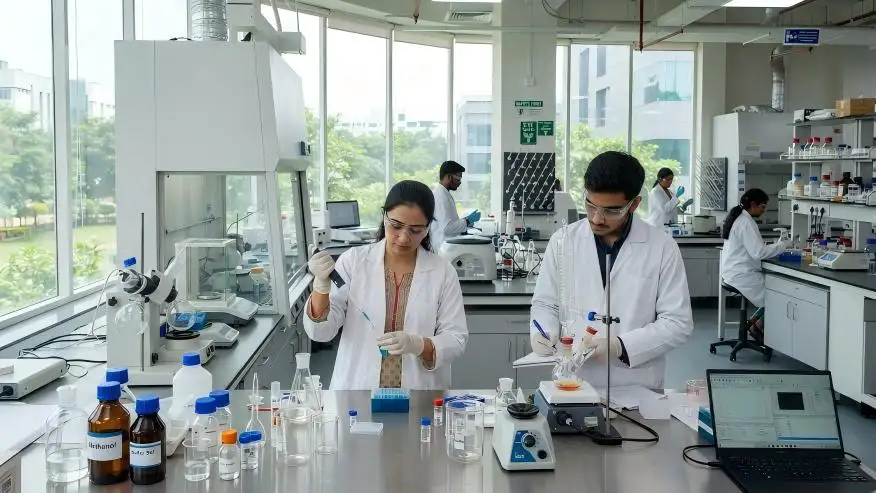
Dissolution Apparatus Calibration in India should address mechanical accuracy, rotational speed, temperature, vessel geometry, dosing and sampling consistency, documentation, and performance verification. Many laboratories also need one platform for Indian Pharmacopoeia methods and export-oriented USP or EP procedures.
What Makes the Indian Market Different?
India does not use completely different calibration principles. Its special requirements come from a combination of:
•High-throughput generic-drug and oral-solid-dose testing;
•IP methods alongside USP, EP, or registered export methods;
•Formulation screening, stability testing, batch release, and method transfer;
•Cost control balanced with traceability and audit readiness;
•Manufacturing sites distributed across India, increasing demand for training, remote support, and accessible spare parts.
| Market | Typical Laboratory Context | Main Priorities |
| India | Domestic generics, exports, CDMO, and multi-client work | Multi-pharmacopoeia use, throughput, documentation, lifecycle cost, and service |
| United States | USP and registered methods | Data integrity, qualification, and change control |
| European Union | EP and cross-border quality systems | Traceability and inter-laboratory consistency |
| China | ChP domestic testing plus exports | Automation and centralized instrument management |
The Indian challenge is usually managing these priorities within the same laboratory workflow.
Indian Pharmacopoeia and GMP Expectations
The Indian Pharmacopoeia Commission released Indian Pharmacopoeia 2026, the 10th edition, and provides IP Prednisone Tablets for dissolution-apparatus verification. The IP dissolution chapter describes performance verification for Apparatus 1 and Apparatus 2 using prednisone tablets. Laboratories should confirm the current chapter, product monograph, lot-specific instructions, and acceptance range before testing.
The CDSCO inspection guidance favors documentation of a calibration program and corresponding records along with defined calibration intervals and calibration status identification. Dissolution Apparatus Calibration in India should therefore support compliance through controlled procedures and documented evidence rather than relying only on a supplier certificate.
Calibration Is Not Qualification
| Activity | Purpose | Typical Scope |
| Calibration | Measure deviation from defined values | RPM, temperature, level, height, centering, and wobble |
| IQ/OQ | Confirm installation and operation | Environment, controls, alarms, and operating ranges |
| PQ | Demonstrate routine performance | Product methods and laboratory conditions |
| Performance Verification | Assess the assembled system | Reference tablets and acceptance ranges |
| Preventive Maintenance | Reduce drift and failure | Drive, shafts, heater, pump, filters, and tubing |
Temperature and speed checks alone do not confirm the complete system. Calibration records also do not replace method validation, filter studies, or laboratory IQ/OQ/PQ responsibilities.
Key Parameters for Dissolution Apparatus Calibration in India
| Parameter | Possible Impact | RT600 Manufacturer-Stated Specification |
| Rotational speed | Changes release rate and hydrodynamics | 0–300 rpm; 0.01 rpm resolution |
| Speed stability | Affects repeatability | ≤±0.3 rpm |
| Temperature | Changes dissolution rate | Accuracy ≤±0.2°C |
| Levelness | Influences system geometry | <0.5° |
| Vessel/shaft verticality | Affects flow symmetry | 90°±0.5° |
| Centering deviation | Creates vessel variability | <±2.0 mm |
| Depth positioning | Changes paddle or basket location | <±1.0 mm |
| Shaft/basket wobble | Produces unintended agitation | <±1.0 mm |
These values should be confirmed through agreed acceptance tests, qualification documents, and laboratory calibration procedures.
Why Autosampling Should Be Included
For high-throughput Dissolution Apparatus Calibration in India, the sampling system should not be overlooked. Pump volume, channel consistency, sampling time, dead volume, medium replacement, dilution ratio, filter recovery, API adsorption, and carryover may all affect reported results.
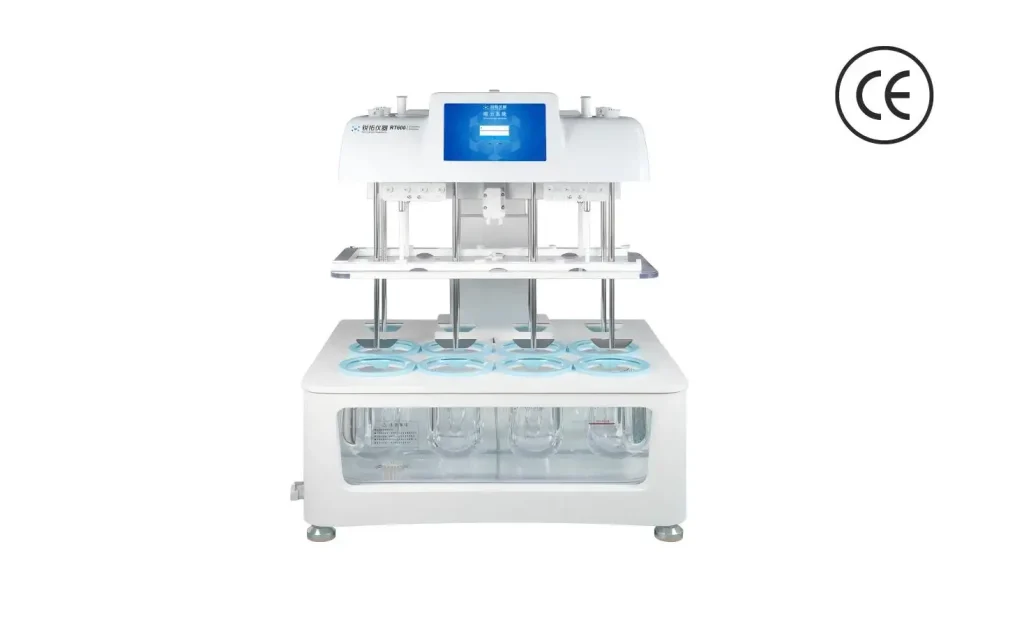
RAYTOR's RT600 is an eight-position, single-drive automated dissolution system with synchronous dosing, automatic positioning, precise sampling, optional online dilution, and real-time speed and temperature display. Its Teflon pipeline, anti-adsorption design, dual online filters, and 120-position sample tray support multi-time-point testing. These features are relevant to high-throughput laboratories.
Multi-Pharmacopoeia Readiness
The RT600 is designed around ChP 0931, USP <711>/<724>, and EP 2.9.3/2.9.4 applications, subject to the dosage form, current pharmacopoeial text, equipment configuration, and registered method.
How RAYTOR Supports Indian Laboratories
Founded in 2015, RAYTOR develops laboratory instruments for drug dissolution, solubility, permeability, and transdermal-diffusion research. Its role in India is to match equipment configuration with the laboratory's method, workload, automation level, and documentation needs.
RAYTOR supports:
•Dissolution-system and autosampling configuration;
•IQ/OQ documentation communication;
•Mechanical and sampling calibration planning;
•Filter and tubing assessment;
•Basket and paddle method switching;
•Operator training and maintenance guidance;
•Remote technical communication for Indian customers.

Final Considerations
Effective Dissolution Apparatus Calibration in India must balance multi-pharmacopoeia testing, laboratory throughput, documentation, and lifecycle support. Indian laboratories can provide RAYTOR with their dosage form, IP/USP/EP method, daily workload, sampling schedule, online-dilution needs, and qualification requirements to evaluate an appropriate RT600 configuration and technical-support plan.
FAQs
Q1. Which RAYTOR product is recommended for dissolution testing in Indian pharma labs?
The RAYTOR RT600 Automated Dissolution System is intended for formulation development and testing of generics and quality control in pharmaceuticals. It has eight dissolution positions and offers sample collection, dosing, speed and temperature control, and monitoring.
Q2. Can the RAYTOR RT600 use basket and paddle methods?
The RT600 allows the use of basket and paddle methods for dissolution testing. Its paddle and basket combination design enables labs to make method changes without the need for height adjustments of the dissolution unit.
Q3. How does RT600 assist with Dissolution Apparatus Calibration in India?
For the RT600, manufacturers set specifications for rotational speed and temperature, as well as for the apparatus's levelness, verticality of the shaft, centering of the vessel, depth, and wobbling. Labs will have to confirm these themselves with their approved methods of calibration and their criteria for installation qualification/ operation qualification.
Q4. Is the RT600 appropriate for multi-pharmacopoeia dissolution testing?
The RT600 is appropriate for dissolution related to ChP 0931, USP <711>/<724>, and EP 2.9.3/ 2.9.4.
Q5. What are the sampling functions of RT600?
The RT600 provides automatic positioning, programmable sampling, high precision pumps, inline dilution, and sample collection, as well as a 120 position tray for 1.5 mL chromatography vials and 10 mL test tubes.