

How to Select Dissolution Testing Equipment for QC Labs: A Practical Buying Guide
2026-07-27


Selecting dissolution testing equipment for a QC lab requires more than comparing vessel capacity and purchase price. The system should comply with pertinent pharmacopoeias, dosage forms, types of apparatus, daily tasks, sampling and analysis methods, qualifications, and requirements for data integrity.
In the consideration of how to choose appropriate dissolution testing apparatus for QC labs, rotational precision, position sampling, alignment with mechanics, filters, and ease of cleaning and maintenance over time should also be assessed. An inappropriate apparatus configuration will contribute to an increase in the workload, variability of the tests, necessity for repeated testing, and the need for numerous investigations of out-of-specification results.
Begin with Pharmacopoeial Requirements
When dealing with new products, the QC Lab must identify the relevant pharmacopoeias, product monographs, validated methods, and applicable internal SOP. The USP, European, Chinese, Japanese Pharmacopoeas, and other national regulatory standards are the most common references.
A compliant USP dissolution apparatus should be evaluated beyond its model name. Important parameters include:
•Rotational speed range and accuracy;
•Water-bath temperature stability and uniformity;
•Vessel dimensions and positioning;
•Paddle or basket shaft verticality;
•Shaft wobble and vessel centering;
•Sampling probe position;
•Mechanical qualification capability.
Laboratories should also distinguish between compendial methods, internal methods, modified-release testing, biorelevant media studies, and methods transferred from R&D to QC.
Match the Apparatus to the Dosage Form
The dosage form and release mechanism should determine the apparatus configuration.
| Apparatus | Typical Application | Main Selection Focus |
| USP Apparatus 1, Basket | Capsules and floating products | Basket mesh, wobble and alignment |
| USP Apparatus 2, Paddle | Conventional tablets and capsules | Paddle height, centering and deaeration |
| USP Apparatus 3 | Extended-release formulations | Dip rate and automatic media changes |
| USP Apparatus 4 | Poorly soluble drugs, implants and special products | Pump accuracy, cell size and flow mode |
| Vertical Diffusion Cell | Semisolids and transdermal products | Diffusion area and receptor conditions |
Apparatus number alone is not sufficient. Laboratories must also consider API solubility, floating or sticking behavior, release duration, medium volume, media replacement, sink conditions, and specialized accessories.
Determine the Required Sample Throughput
An important part of How to Select Dissolution Testing Equipment for QC Labs is calculating the actual workload rather than selecting equipment solely by vessel count.
Daily workload = batches × vessels × sampling points × repeat or verification tests
A six-position system is is well suited to routine testing where sample volume is on the lower end. Eight-position systems include additional positions for method flexibility, as well as controls and blanks. Systems with twelve positions and multichannels are better suited for high-throughput batch release.
Consideration needs to be given to the preparation time, filter change time, cleaning time, time runs of longer duration, and time flexibility for future product expansion. Scheduling bottlenecks may occur with insufficient capacity while excess capacity may lead to increased cost and complexity.
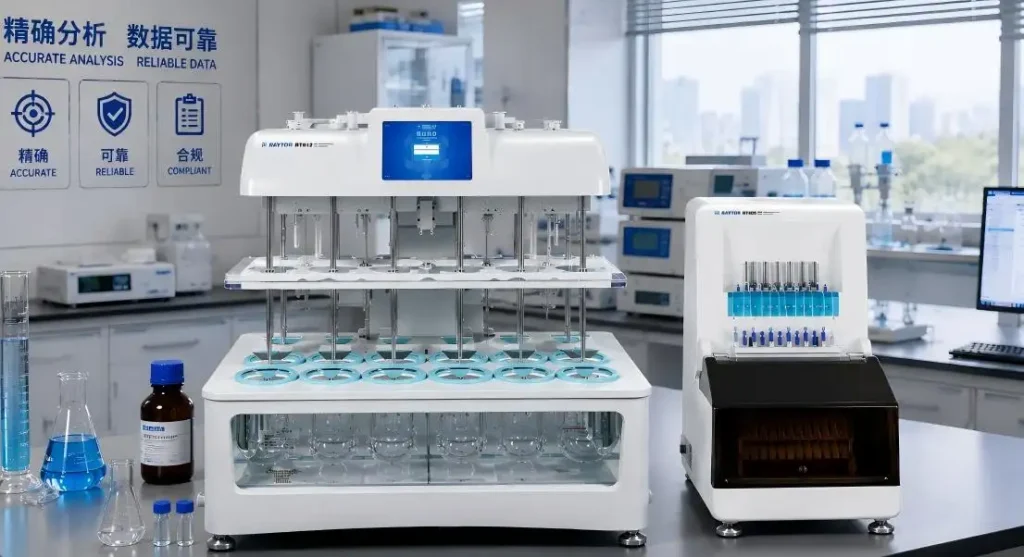
Review Sampling and Testing Procedures
For a limited number of sampling points and a small testing volume, manual sampling is acceptable. Whereas in this case, the analyst is still responsible for controlling the time of each sampling, depth of each sampling, filtration, replacement of the medium, and sample transport.
An automated dissolution testing system should be assessed for:
•Sampling-time accuracy;
•Probe positioning;
•Sampling-volume precision;
•Filter compatibility and recovery;
•Automatic medium replacement;
•Pipeline washing;
•Carryover and adsorption control;
•Sample collection capacity.
The analytical platform is equally important.
| Workflow | Main Consideration |
| Online UV | Rapid analysis but requires adequate spectral selectivity |
| Offline UV | Flexible review with moderate automation |
| HPLC | Suitable for complex samples but requires vial handling and chromatography capacity |
The dissolution sampling system should match the laboratory's existing UV or HPLC process rather than adding interfaces that will rarely be used.
Review Mechanical and Temperature Performance
Reliable dissolution testing equipment for pharmaceutical QC should maintain consistent conditions in every vessel. Small differences in shaft alignment, paddle height, rotational speed, temperature, or vibration can change hydrodynamics and increase result variability.
Evaluate:
•Paddle and basket wobble;
•Shaft verticality;
•Vessel centering;
•Paddle or basket height;
•Speed accuracy;
•Temperature recovery and uniformity;
•Equipment level and vibration;
•Performance after installation.
Laboratories should distinguish between published specifications, installation-site performance, and results from periodic dissolution apparatus qualification.
Check Software and Data Integrity
A regulated pharmaceutical dissolution laboratory may require user access controls, audit trails, electronic signatures, method-version control, original-data retention, time synchronisation, report templates, backup, and recovery.
A 21 CFR Part 11 compliant dissolution testing system is not created by software functions alone. Compliance also depends on system validation, SOPs, user administration, training, backup procedures, and laboratory practices.
Review Qualification and Lifecycle Support
Ensure the following items are on the quote before the purchase:
•Installation and operational qualifications
•PQ support
•Calibration certificates
•Mechanical performance test tools
•Temperature and speed checking records
•Software validation
•Training, maintenance, and spare parts support
Cleaning should also be considered. Vessels, shafts, sampling probes, filters, and tubing must be accessible and replaceable. The lowest purchase price does not always produce the lowest cost per test when maintenance, consumables, downtime, and repeated testing are included.
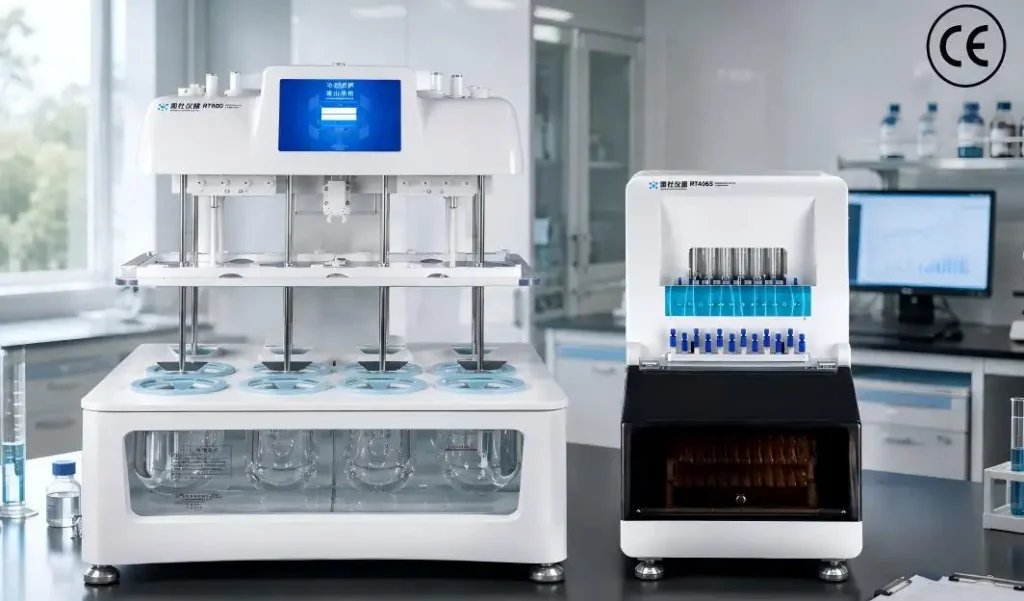
Raytor Automated Dissolution System Comparison
The following models illustrate how throughput and configuration can guide dissolution tester selection.
| Feature | Raytor RT600-ST | Raytor RT612-ST |
| Dissolution Positions | 8 | 12 |
| Recommended Environment | Medium-throughput routine QC | Higher-throughput QC and batch release |
| Sampling | Automated, high-precision pump | Automated, high-precision pump |
| Dosing | Synchronous automatic dosing | Synchronous automatic dosing |
| Temperature and Speed | Real-time display | Real-time display |
| Preheating | Automatic scheduled preheating | Automatic scheduled preheating |
| Paddle/Basket Design | Co-axial design for easier method changes | Co-axial design for easier method changes |
| Pipeline | Anti-adsorption PTFE pipeline | Chemically stable, anti-adsorption pipeline |
| Filtration | Optional dual online filtration | Optional dual online filtration |
| Sample Collection | Up to 120 vial positions | Up to 120 vial positions |
| Method Flexibility | Adjustable speed, volume and optional dilution | Flexible sampling parameters and optional dual drive |
| Data Management | Raytor cloud-system connectivity | Raytor cloud-system connectivity |
The RT600-ST may be suitable when an eight-position autosampling system meets routine capacity. The RT612-ST provides twelve positions for laboratories processing more samples per run. Final suitability should be confirmed against the validated method, analytical workflow, documentation requirements, and local service plan.
Final Selection: Match Equipment to the QC Workflow
Understanding How to Select Dissolution Testing Equipment for QC Labs begins with pharmacopoeial and dosage-form requirements. Laboratories should then define apparatus type, vessel capacity, daily throughput, sampling automation, UV or HPLC integration, mechanical qualification, data integrity, and lifecycle support.
While preparing a system specification, QC teams can provide Raytor with the relevant pharmacopoeias, dosage forms, apparatus requirements, sample volume, sample points, analytical workflows, and qualification documents. As a manufacturer of dissolution testing instruments, Raytor has the capability to assist in the evaluation of appropriate configurations and sampling options, as well as the selection of accessories and documentation, and the assessment of workflow compatibility before the lab makes its final selection.