

Pharmaceutical Laboratory Instruments for Automated Drug Dissolution Testing
2026-08-17


Drug dissolution testing is not simply a matter of maintaining 37°C and rotating a paddle at a specified speed. The reported dissolution profile is the combined result of hydrodynamics, temperature control, dosing synchronization, sampling position, filtration, sample-transfer delay, and analytical workflow.

This is why selecting Pharmaceutical Laboratory Instruments for automated dissolution testing should begin with measurement uncertainty and laboratory workload rather than automation level alone. A system may collect samples automatically yet still produce variable data if vessel alignment, tubing recovery, sampling delay, or cleaning is poorly controlled.
Where Dissolution Variability Actually Comes From
Consider a 12-vessel test with six sampling points. One run generates 72 vessel-level sampling events. At five runs per day, the laboratory must manage 360 sampling events, plus filtration, media replacement, vial transfer, and analysis.
Automation can remove much of the timing variability, but several variables remain critical:
• Rotation stability: Changes the boundary layer around the dosage form.
• Medium temperature: Affects viscosity, diffusion, and solubility.
• Vessel and shaft geometry: Changes local hydrodynamics.
• Sampling depth: determines Whether the sample represents the intended concentration zone.
• Filter and tubing recovery: Can create falsely low results through adsorption.
• Carryover: can increase apparent concentration at later sampling points.
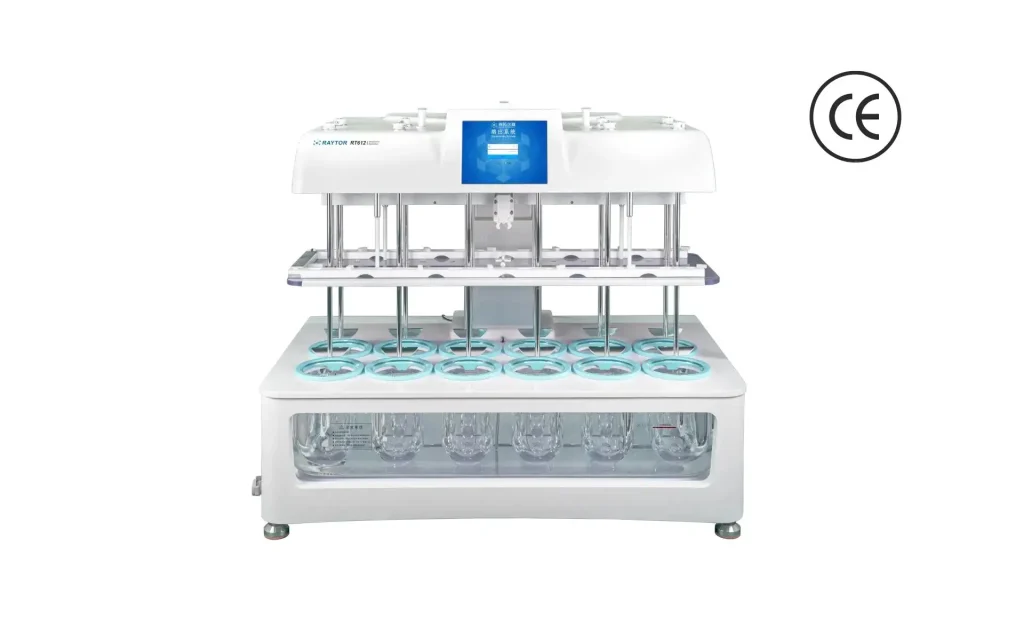
Raytor's 12-position dissolution platform shows how modern Pharmaceutical Laboratory Instruments combine rotational, thermal, and mechanical control to improve dissolution-test consistency.
| Control Parameter | Raytor Specification | Testing Impact |
| Rotation range | 0–300 rpm | Supports different dissolution methods |
| Speed resolution | 0.01 rpm | Enables precise method settings |
| Steady-speed error | ≤±0.3 rpm | Reduces hydrodynamic variation |
| Temperature accuracy | ≤±0.2°C | Stabilizes solubility and diffusion conditions |
| Temperature resolution | 0.01°C | Supports fine monitoring |
| Shaft/vessel verticality | 90°±0.5° | Helps maintain consistent flow patterns |
| Centering deviation | <±2.0 mm | Reduces vessel-to-vessel variability |
| Depth-positioning deviation | <±1.0 mm | Improves paddle/basket positioning consistency |
Key point:
• Accurate RPM alone is insufficient.
• Geometry, alignment, temperature, and positioning must be controlled together.
This system-level control is what makes Pharmaceutical Laboratory Instruments suitable for repeatable dissolution testing.
Sampling Precision Is a Fluid-Path Problem
Automated sampling is often evaluated only by sample-volume accuracy. In reality:
Sampling Delay ≈ Internal Line Volume ÷ Transfer Flow Rate
If a sampling path contains 5 mL and the effective flow is 10 mL/min, the sample reaching the collection point may represent fluid from approximately 30 seconds earlier.
That difference becomes important at early dissolution points.
Raytor's automated sampling architecture publishes a 1–20 mL sampling range, up to 20 programmable samples, sampling precision of ≤±1%, and operating periods up to 720 hours. The first programmable sampling point can be set from 3 minutes, with routine subsequent sampling intervals from 5 minutes.
The broader workflow also includes online filtration, anti-adsorption fluid-path designs in selected configurations, flexible sampling parameters, and optional online dilution.
This is more meaningful than simply describing a system as "automatic."
Sample Withdrawal Changes the Dissolution Environment
Volume balance becomes important in multi-point methods.
For a 900 mL vessel:
8 mL/sample × 8 time points = 64 mL withdrawn
That equals roughly 7.1% of the original medium volume.
The validated method therefore has to specify whether medium is replaced and how previous sample removal is incorporated into concentration calculations. Replacement medium should also enter at controlled temperature; otherwise, volume correction solves one problem while introducing another.
Match the Apparatus to the Dosage Form
Different Pharmaceutical Laboratory Instruments create different hydrodynamic environments.
| Testing Architecture | Typical Use | Critical Technical Variable |
| Basket | Capsules and contained dosage forms | Basket condition, wobble, mesh interaction |
| Paddle | Conventional tablets and capsules | Paddle height, centering, coning |
| Flow-through cell | Poorly soluble or complex formulations | Flow rate, cell geometry, filtration |
| Online UV | Rapid dissolution profiling | Optical interference, pathlength |
| Offline HPLC | Complex APIs/formulations | Transfer stability and analytical capacity |
Raytor's dissolution portfolio covers equipment architectures corresponding to USP Apparatus 1–4 and related dissolution workflows. Its online UV configuration also supports individual flow cells and fluid lines for each vessel, with published optical pathlength options from 1 to 10 mm, helping laboratories adapt absorbance conditions to different concentration ranges.
When Flow-Through Testing Becomes the Better Choice
Conventional basket and paddle methods are not always ideal for poorly soluble drugs, nanoparticles, suspensions, liposomes, or extended-release formulations.
Flow-through Pharmaceutical Laboratory Instruments continually move medium around the dosage form, allowing laboratories to control medium renewal and hydrodynamic conditions more directly.
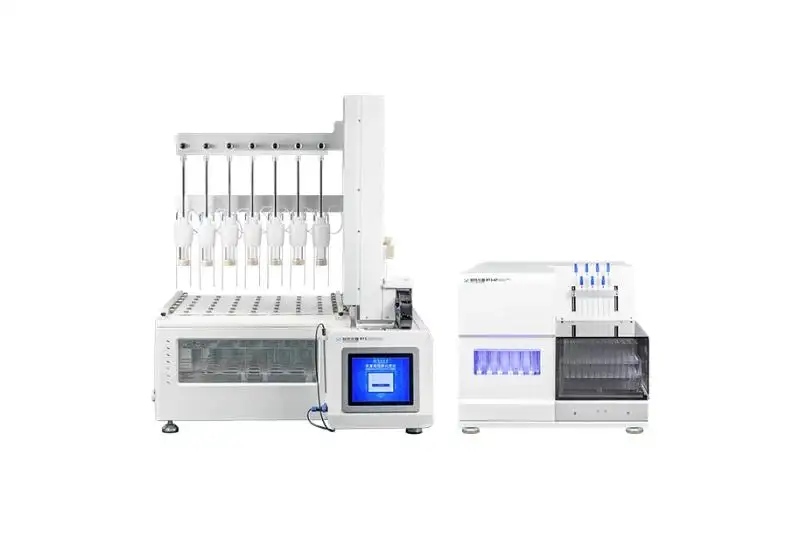
Raytor's flow-through configuration provides:
| Engineering Parameter | Raytor's Capability |
| Test channels | 7 |
| Medium flow range | 1–38 mL/min |
| Flow resolution | 0.1 mL/min |
| Temperature range | Ambient +5°C to 50°C |
| Temperature control error | <±0.2°C |
| Inter-cell temperature difference | <±0.5°C |
| Closed-loop sample-volume error | ≤±2% |
| Open-loop sample-volume error | ≤±5% |
The system supports both open-loop and closed-loop operation, enabling method developers to choose between continuous fresh-medium delivery and recirculation depending on solubility, medium consumption, and release-test objectives.
Size Automation Around QC Throughput
A useful planning relationship is:
Daily Sample Load = Batches × Vessels × Sampling Points
An 8- or 12-position system can increase parallel testing capacity, but laboratories with repetitive workloads should also evaluate batch-to-batch automation.
Raytor's laboratory automation portfolio includes systems designed to integrate media dispensing, dissolution testing, cleaning, and experiment recording, with published capability for up to 10 consecutive batches in an automated workflow.
However, faster dissolution testing is useful only when downstream UV or HPLC capacity can handle the resulting samples.
Installation and Validation Complete the Measurement System
Even high-specification Pharmaceutical Laboratory Instruments require controlled installation. Qualification should consider:
• Bench level and vibration;
• Vessel centering and shaft verticality;
• Paddle or basket positioning;
• Actual medium temperature;
• Probe positioning;
• Tubing and filter condition;
• Cleaning and carryover control.
Software should be evaluated separately from mechanical qualification. Raytor states that its dissolution systems support workflows addressing 21 CFR Part 11 audit requirements, including audit-trail and data-management functions. Final regulatory compliance still depends on the laboratory's validated software environment, access control, SOPs, records management, and qualification process.
Select Pharmaceutical Laboratory Instruments Around the Method
The strong procurement specification starts with the dosage form, applicable pharmacopoeia, apparatus type, medium volume, sampling schedule, analytical finish, daily workload, filtration strategy, and qualification requirements.
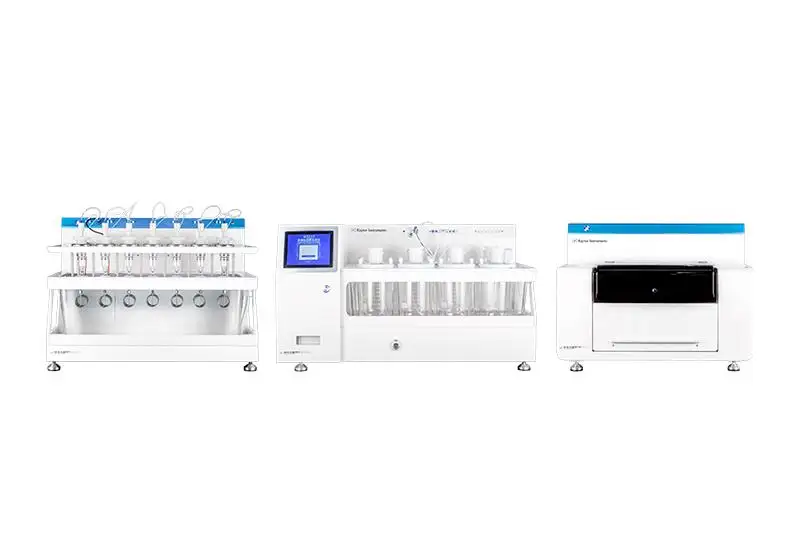
For laboratories moving from manual testing toward controlled automation, Raytor provides conventional vessel systems, automated sampling, online UV analysis, flow-through testing, and multi-batch automation within one dissolution workflow. Reviewing the actual method and expected daily sample load with Raytor can help determine which Pharmaceutical Laboratory Instruments configuration provides sufficient control without adding unnecessary automation.
FAQs
Q1. Which pharmaceutical laboratory instruments does Raytor provide for dissolution testing?
Raytor offers complete automated solutions for conventional bottle and paddle systems with online UV analysis and flow through, as well as solutions for multi-batch automation. Additionally, Raytor offers solutions for automated sampling.
Q2. Does Raytor provide automated drug dissolution testing systems?
Yes. Raytor provides automated systems that meet well defined steps including sample collection, dosing, medium and sample handling, filtration, and experiment logging, along with system cleaning.
Q3. How many testing positions does a Raytor dissolution system have?
Raytor manufactures both 8-position and 12-position systems. This allows Laboratories to automate a number of dissolution vessels that matches usual QC demand.
Q4. What rotation ranges does Raytor incorporate into its dissolution systems?
The published 12-position platform gives the user a range of 0-300 rpm with a resolution of 0.01 rpm and steady speed error of ≤±0.3 rpm.
Q5. How well does Raytor control temperature during dissolution?
Raytor's 12-position platform has a temperature accuracy of ≤±0.2°C with a temperature resolution of 0.01°C.