

Subcutaneous Drug Delivery Research: Simulating the Subcutaneous Tissue Environment In Vitro
2026-07-21


Subcutaneous Drug Delivery Research increasingly depends on in vitro models that can reproduce selected conditions around an injection site. These conditions include interstitial fluid composition, temperature, diffusion resistance, membrane transport, local hydrodynamics and drug clearance.
No laboratory system can fully reproduce the biological complexity of human subcutaneous tissue. A practical model should therefore be designed around a defined research question, such as formulation screening, depot release comparison, membrane transport evaluation or method development.
Why Subcutaneous Tissue Simulation Matters
After subcutaneous injection, a formulation enters an environment composed of adipose tissue, extracellular matrix, interstitial fluid, blood vessels and lymphatic vessels. Depending on its composition, the formulation may disperse rapidly or remain as a localized depot.
Common subcutaneous dosage forms include:
•Aqueous solutions
•Concentrated biologics
•Drug suspensions
•Polymeric microspheres
•Thermoresponsive gels
•In situ forming implants
•Other sustained-release depots
Drug release is influenced by both formulation properties and local physiology. A standard buffer may provide comparative release data, but it cannot independently represent protein binding, tissue resistance, enzymatic degradation, local fluid movement or lymphatic uptake.
For this reason, Subcutaneous Drug Delivery Research should focus on reproducing the variables most likely to control the performance of a specific formulation.
What Happens After Subcutaneous Injection?
Once administered, a formulation either spreads through the interstitial space or forms a depot near the injection site. Drug molecules must then leave the formulation, move through the surrounding matrix and reach blood or lymphatic vessels.
The process may involve:
•Drug dissolution
•Molecular diffusion
•Convective transport
•Polymer hydration or erosion
•Protein binding
•Enzymatic degradation
•Blood or lymphatic absorption
Depot geometry, drug loading, viscosity, particle size and polymer composition can significantly change the release profile. For example, PLGA microspheres are affected by water penetration and polymer hydrolysis, while high-concentration biologics may be limited by viscosity, aggregation and restricted molecular movement.
Critical Variables in Subcutaneous Tissue Simulation
A useful in vitro model for subcutaneous drug delivery should control more than the receptor medium.
| Experimental Variable | Potential Impact | Typical Control Strategy |
| Temperature | Affects solubility, diffusion, gelation and polymer degradation | Controlled heating and real-time monitoring |
| Medium composition | Influences stability, binding and drug solubility | Buffer, surfactant or simulated interstitial fluid |
| pH and osmolality | Affect ionization, protein stability and degradation | Validated physiological or accelerated conditions |
| Diffusion barrier | Represents resistance around the depot | Synthetic membrane, hydrogel or tissue |
| Agitation | Changes receptor uniformity and boundary-layer thickness | Defined and verified stirring speed |
| Sink conditions | Prevent drug saturation in the receptor phase | Medium optimization and volume replacement |
| Sampling interval | Determines whether burst and sustained release are captured | Formulation-specific sampling schedule |
| Air bubbles | Reduce active diffusion area | Degassing and controlled filling |
| Membrane compatibility | May cause adsorption or unintended resistance | Recovery and membrane-integrity studies |
These parameters should be selected scientifically rather than copied from unrelated dissolution or permeation methods.
Why Simulated Interstitial Fluid Is Difficult to Standardize
Unlike blood plasma or gastrointestinal fluids, subcutaneous interstitial fluid does not have one universally accepted laboratory composition.
A biorelevant medium may need to consider:
•Electrolytes and buffer capacity
•Protein and lipid content
•Enzymatic activity
•Osmolality
•Drug-binding components
•Formulation stability
•Analytical compatibility
Patient variability further complicates Subcutaneous Drug Delivery Research. Tissue structure can differ between the abdomen, thigh and upper arm. Age, adipose thickness, injection depth, local blood flow, disease state and injection volume may also influence depot formation and drug transport.
Consequently, there is no universal receptor medium for every product. Protein formulations may require aggregation and proteolysis studies, while poorly soluble suspensions require carefully maintained sink conditions. Thermoresponsive gels additionally require precise temperature control to preserve their intended structure.
In Vitro Models Used in Subcutaneous Drug Delivery Research
| Model | Suitable Applications | Main Limitation |
| Sample-and-separate | Microspheres, suspensions and long-acting depots | Separation may disturb the formulation |
| Dialysis | Nanoparticles and carrier-based formulations | Membrane transport may control the result |
| Diffusion cell | Release screening and membrane transport | Does not reproduce blood flow or tissue deformation |
| Flow-through system | Long-duration release under continuous medium exchange | Greater complexity and medium consumption |
| Hydrogel model | Extracellular matrix and diffusion-resistance studies | Limited biological activity |
| Cell-based model | Cellular uptake, toxicity and local response | Higher variability and maintenance requirements |
| Ex vivo tissue | Transport through biological tissue | Donor variability, storage and ethical constraints |
The correct method depends on whether the objective is early formulation screening, release-mechanism analysis, quality control or development of an in vitro–in vivo relationship.
Can Franz Diffusion Cells Be Used?
A vertical Franz diffusion cell cannot reproduce the complete subcutaneous tissue environment. However, an appropriately adapted system can provide a controlled platform for:
•Comparing depot formulations
•Screening receptor media
•Evaluating membrane transport
•Studying temperature effects
•Investigating hydrodynamic conditions
•Measuring early-stage release differences
USP <1724> addresses performance testing of semisolid drug products and related diffusion-cell applications. It is not a dedicated compendial method for subcutaneous injections. A Franz diffusion cell used in Subcutaneous Drug Delivery Research therefore requires formulation-specific justification, system suitability assessment and method validation.
Improving Experimental Control with Raytor
Raytor supports adapted diffusion and in vitro drug release testing by controlling variables that frequently contribute to poor reproducibility.
Controlled Temperature
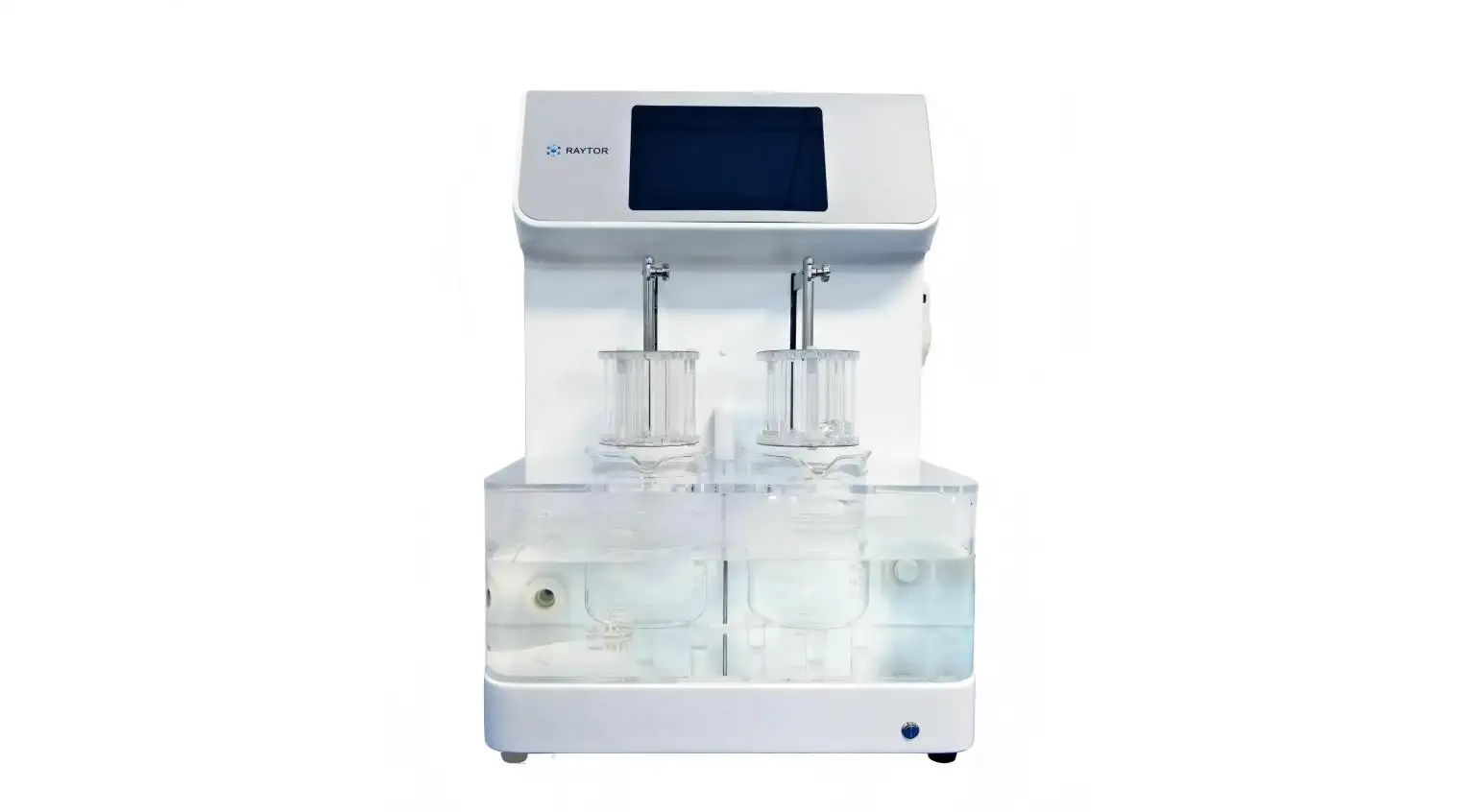
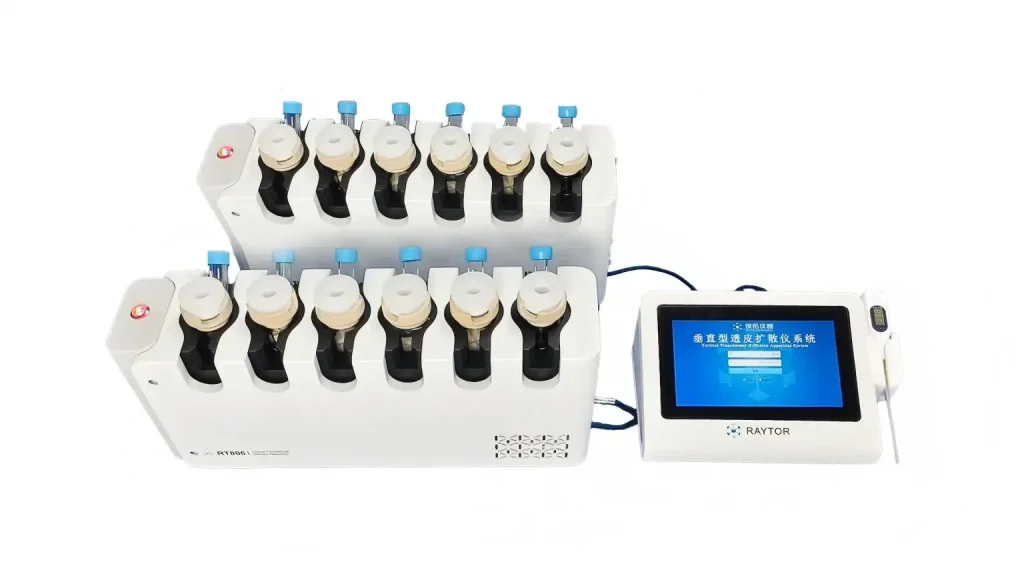
The Compact Vertical Diffusion Platform is equipped with built-in heating and the capability for temperature measurement. The operating range from ambient to 55°C allows for nearly physiological or accelerated testing. Temperature control at ±0.5°C minimizes variation between test cells.
Adjustable Hydrodynamics
Stirring can be adjusted from 200 to 900 rpm. This allows researchers to investigate receptor-medium uniformity, diffusion boundary layers and particle sedimentation using a consistent experimental configuration.
The selected speed should be fixed, documented and verified because excessive agitation may alter fragile gels or other depot structures.
Reduced Bubble Interference
Air trapped below the membrane can interrupt receptor contact and reduce the effective diffusion area. Raytor uses a dedicated filling-point design intended to limit bubble formation during medium loading, supporting more consistent membrane contact and more dependable comparative results.
Parallel Comparative Testing
Six diffusion cells per group allow laboratories to:
•Run formulation replicates
•Compare membrane materials
•Screen receptor media
•Evaluate operating conditions
•Detect abnormal cells
•Quantify inter-cell variability
Manual sampling also provides flexibility for early development and customized time points, provided that withdrawal volume, replacement medium, filtration and cumulative-release calculations are carefully controlled.
Practical Method Development Workflow
A structured Subcutaneous Drug Delivery Research workflow should include:
- Define the formulation-specific research question.
- Characterize concentration, viscosity, particle size and depot structure.
- Evaluate membrane adsorption, compatibility and recovery.
- Select a receptor medium that maintains stability and sink conditions.
- Fix temperature, stirring speed and exposed diffusion area.
- Degas the medium and inspect the membrane interface for bubbles.
- Sample the initial burst, intermediate and late release phases.
- Verify repeatability, mass balance, recovery and discriminatory ability.
Building More Reliable In Vitro Models
Reliable Subcutaneous Drug Delivery Research requires a layered experimental strategy. Medium composition, diffusion resistance, temperature, agitation, sampling and formulation properties should be evaluated together rather than as isolated parameters.
Raytor provides a compact and configurable diffusion-testing platform for laboratories developing fit-for-purpose release and membrane-transport methods. Controlled heating, adjustable stirring, bubble-reducing filling and multi-cell testing help standardize critical variables before researchers progress to more complex tissue models or in vivo studies.
Build a More Controlled In Vitro Research Setup
Researchers can contact Raytor to discuss diffusion-cell configuration, experimental capacity and application requirements for formulation screening, membrane transport and controlled in vitro release testing.
Discuss Your Research Method
FAQs
Q1. How does Raytor assist with the research of Subcutaneous Drug Delivery?
Raytor manufactures vertical diffusion testing systems that give laboratories the ability to control temperature, contact, stirring, and sampling of membranes. These control features enable the comparison of formulations, transport studies of membranes, and the development of fit-for-purpose in vitro release testing methods.
Q2. Can Raytor equipment truly simulate Subcutaneous Tissue of Humans?
No laboratory equipment can fully replicate the entire biological complexity of the Subcutaneous Tissue of Humans. The equipment is manufactured to control and standardize the variables of an experiment including temperature, stirring, diffusion barriers, and the receptor medium.
Q3. What is the temperature range of the Raytor diffusion system?
The Raytor vertical diffusion platform allows testing in the range of ambient to 55 °C with an accuracy of ±0.5 °C. This range allows testing to be done in the near physiological range and in some cases, methods and studies involving the release can be accelerated.
Q4. Why is control of stirring important in Subcutaneous Drug Delivery?
Diffusion boundary layers and sedimentation are strongly influenced by stirring. The adjustable range of 200-900 rpm offered by Raytor enables researchers to explore and establish suitable hydrodynamic conditions for formulation.
Q5. How many diffusion cells can Raytor systems accommodate?
Raytor systems are designed to accommodate six diffusion cells, enabling laboratories to run replicas or compare formulations and membranes or receptor media, and assess variability between cells in the same study.